An AI guardrail failure doesn’t come with a warning. One minute, a response goes out. Next minute, it’s a screenshot in the wrong hands, and the question isn’t how it happened. It’s why nobody had defined what the model was allowed to do in the first place.
Most teams never asked what the model was actually permitted to do. Deployment happens fast. AI data privacy and leakage prevention aren’t configuration tasks. The teams that treat it like one usually figure that out the hard way.
Gartner put a number on the cost of getting this wrong: 30% of generative AI projects won’t survive past the proof-of-concept stage. Weak risk controls sit at the top of the reasons list. What are AI guardrails doing in that gap? Quietly holding together the projects that do survive.
What AI Guardrails Actually Do (And What They Don’t)
Guardrails in AI are the boundaries that a model can’t enforce on itself. Input filters, output controls, and violation flags. That’s what the documentation covers. Documentation doesn’t run in production. The implementation does, and that’s where the gap lies.
Samsung found this out in 2023. Employees pasted sensitive source code directly into ChatGPT. No enterprise controls, no guardrail layer, no policy that matched the workflow people actually ran. The model didn’t cause the exposure. The absence of a defined boundary did.
When implemented properly, guardrails operate across three distinct layers:
| Layer | What It Does | What It Catches |
| Input Validation | Screens every user prompt before it reaches the model | Prompt injection attacks, jailbreak attempts, out-of-scope queries |
| Output Filtering | Scans model responses before they reach users | AI data leakage, hallucinated facts, toxic content, policy violations |
| Runtime Monitoring | Logs, flags, and escalates anomalies in real time | Pattern violations, unusual access behaviour, audit gaps |
Most enterprises invest heavily in input validation, lightly in output filtering, and barely at all in runtime monitoring. The audit usually reveals which one they skipped.
One thing the table above doesn’t capture: these layers interact with each other. An AI data leak that slips through input validation can still get caught at output, but only if the output filter is actually scanning for data patterns, not just keywords. Most off-the-shelf filters aren’t. That’s the gap worth closing before deployment, not after.
The Four Types of AI Guardrails You Actually Need
Not all guardrails in AI solve the same problem. Content filters catch one thing. Data protection covers another set of failures entirely. Access control is its own category with its own failure modes. Teams that bundle all three together tend to find the gaps in the worst possible order.
Content and Safety Guardrails
Toxicity, bias, harmful instructions, and off-brand language. Foundation models ship with basic versions of these baked in. Regulated industries and deployments with internal data access require more granular controls than foundation model defaults provide.
Data Privacy and Leakage Guardrails
LLMs don’t handle data the way databases do. Give a sales assistant CRM access, and it can pull one customer’s records into another customer’s session. Nothing in the system flags it. The log looks clean. By the time someone notices, the exposure has already happened several times over.
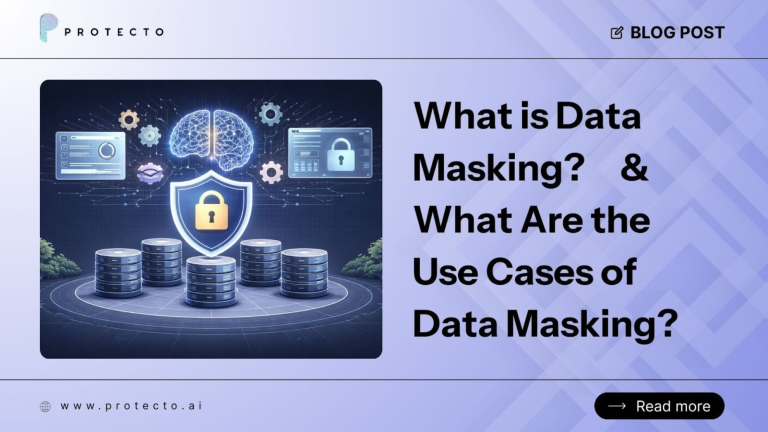
Data masking at the retrieval layer addresses this directly. Protecto’s data masking platform applies tokenisation and masking without disrupting model functionality. Most legacy data masking tools were built for structured database environments. Inference pipelines operate differently, and older tools weren’t designed with that in mind.
Compliance and Policy Guardrails
GDPR, HIPAA, SOC 2. Regulated industries don’t get to call compliance a general principle and move on. Financial services teams, healthcare organisations, and legal departments all need guardrails that enforce specific regulatory requirements at the inference layer.
An AI data governance framework that lives in a PDF enforces nothing. The constraint has to exist within the model’s operating boundaries.
IBM’s Cost of a Data Breach Report 2023 put the global average at $4.45 million per breach. Misconfigured LLM or stolen credentials, the number doesn’t adjust. Compliance guardrails catch the threats that traditional security teams never had a mandate to find.
Access Control Guardrails
Role-based access control draws the lines that the model itself can’t draw. Which users reach which data? Which agents touch which tools? Which roles see which outputs? Remove those lines, and every database your AI touches becomes one unlocked door. RBAC implementation inside AI systems is the structural layer that makes every other guardrail meaningful.
The Multi-Agent Security Problem Nobody Talks About
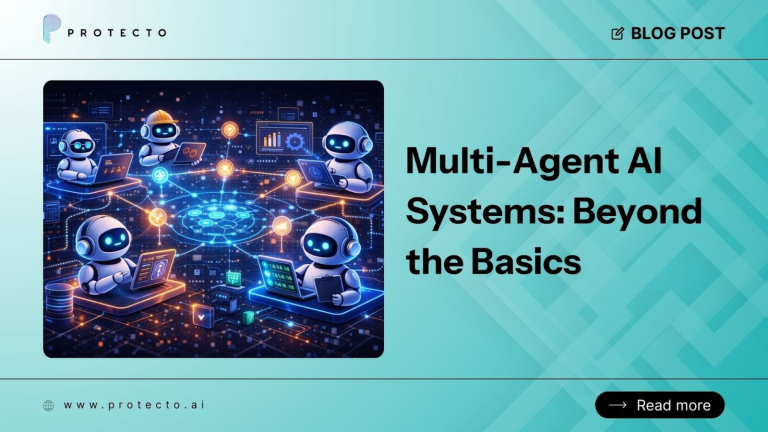
Single-model deployments have one security perimeter. In multi-agent AI deployments, each agent has its own instance, and most organisations secure only the last one. Each handoff between agents creates an ungoverned boundary. Guardrails configured on agent one don’t transfer to agent two. By the time a response reaches the user, it has passed through several checkpoints that nobody audited.
The architecture is the problem, not the configuration. Protecto’s LLM data security approach covers the full pipeline, not just the user-facing endpoint most teams remember to secure.
Implementing AI Guardrails Without Breaking Your Product
Six months in, the AI data governance framework running in production looks nothing like the one that shipped. Constraints loosened. Nobody documented why. The interventions that resist that:
- Define your threat model before your filters. Without a specific target, the filter protects against nothing in particular.
- Apply data masking at the retrieval layer, not just at output. Keep sensitive data out of the model’s context entirely, and the model loses its ability to reproduce it.
- Red-team your own system with prompt injection attacks before deployment. A customer finding the gap first is a significantly worse discovery process.
- Instrument runtime monitoring with comprehensive logging. A guardrail with no audit trail is just a hope with a dashboard.
The teams that get this right aren’t the ones who locked everything down on day one. They’re the ones who knew exactly what they were unlocking when they made changes.
Guardrails in AI aren’t a one-time project. They’re infrastructure. If you’re deploying LLMs with access to sensitive data and haven’t explicitly mapped your AI data leakage prevention architecture, that’s the gap worth closing before anything else. Protecto builds its AI data privacy and governance platform from the data layer up. Everything else is just filtering output from a pipeline that nobody fully secured.
Frequently Asked Questions
What are AI guardrails in simple terms?
Boundaries the model can’t set for itself. Input filters decide what goes in. Output filters decide what comes out. Runtime monitoring watches everything the other two didn’t catch. Remove any one of them, and the gap doesn’t stay empty. Something fills it.
What is the difference between guardrails and alignment?
Alignment is about training the model to behave correctly by design. Guardrails in AI enforce behaviour at inference time, regardless of what the model might otherwise do. You need both. Alignment without guardrails is optimism. Guardrails without alignment are duct tape on a model you never fully understood in the first place.
How does AI data leakage prevention work inside an LLM deployment?
AI data leakage prevention doesn’t happen at one checkpoint. Mask sensitive fields before data enters the model’s context. Outputs need to be scanned for PII patterns before they leave the system, and everything in between needs a log entry. Miss any one of those, and the other two cover less than you think.
Data masking at the retrieval stage is the intervention most teams skip. Not because it’s difficult. Because most people assume the output filter will catch what the input layer missed. It won’t. Not consistently.
What are guardrails in AI for multi-agent systems specifically?
In multi-agent AI systems, the user-facing boundary is the one everybody protects. Every agent boundary behind it is where the actual exposure happens. Each handoff is a potential gap, and most orchestration frameworks leave it for you to fill.
You’re either building that coverage from scratch or working with a platform that treats the full pipeline as the enforcement scope. There’s no comfortable middle option.