
Protecto finds PHI in claims tables and clinical notes and replaces it with tokens. Each patient keeps one token everywhere, so research, BI and AI keep working.
SOC 2 Type II · ISO 27001 · HIPAA, BAA available




How an insurance provider protects claims data and clinical notes
Claims documents in scope at a healthcare data platform
Documents tested in under a week at Inovalon
Records handled at a healthcare insurer
A data team copies five years of discharge summaries into the lake to train a readmission model. A script masks the patient name column. The notes field still holds names, record numbers and a daughter’s phone number. Redaction then turns every person into the same placeholder, and the model can no longer tell who came back.
The copy is not safe, and it is not useful either.
Column rules miss the names, record numbers and phone numbers written inside notes, transcripts and logs.
When every identifier becomes the same placeholder, readmission counts, cohorts and links to claims stop working.
Researchers and reviewers sometimes need the real patient. With no governed way to get it, raw copies spread and nobody can show who saw what.
Switch between the copies and see which questions your data team can still answer.
clinical_notes, one row
Discharge summary
What the data team can still do
Synthetic note. Your policy decides which entities are replaced and whether approved roles can reverse them.
See this on notes of your own.
Safe Harbor lists 18 identifiers to remove before health data counts as de-identified. Protecto detects them in structured columns and inside free text, and adds the IDs your organization uses, such as member numbers.
You pick the outcome per dataset: tokens that approved roles can reverse, or anonymization with no way back. Your privacy team confirms each release.
The 18 Safe Harbor identifiers
Source: HIPAA, 45 CFR 164.514(b)(2). Protecto works on text and imaging metadata. Photos and biometric data need their own controls.
One policy engine, two outcomes. Choose by who will read the data and whether anyone should ever get the real values back.
| When the dataset is for | Use | Why |
|---|---|---|
| Analytics and model training inside your organization | PseudonymizationConsistent tokens | Each patient stays distinct across tables, and nobody needs a real name to build a cohort or train a model. |
| Care, claims or support teams who need the real patient | PseudonymizationUnmask by role | Approved roles request the real value through a policy. The stored data does not change, and each request is logged. |
| An LLM, RAG or search system reading clinical notes | PseudonymizationTokens in free text | The model reads the clinical meaning, and patients, relatives and clinicians stay distinct. |
| A dataset leaving your organization, such as a research partner | AnonymizationNo way back | An anonymization policy turns unmasking off for good, with no change to your pipeline calls. |
Tokenized data is usually still PHI under HIPAA. Your privacy team and counsel decide how each dataset is released.
Call Protecto from the step that already moves the data, using its API, a Snowflake UDF, Databricks, Kafka or Spark. Tables keep their columns, so downstream jobs read them as before.
For years of history already in the lake, submit an async job and collect the result when it finishes.
Request
PUT /api/vault/mask
{"mask": [{"value": "Maria Lopez was admitted on 03/14/2026 with heart failure."}]}
Response: token_value
<PERSON>VJYe 03W</PERSON> was admitted on <DATE>5Fd890</DATE> with heart failure.
Synthetic example. The clinical words stay as written, so the note still reads as a note.
Protecto finds the PHI, handles the volume, applies your policy and keeps the records your auditors ask for.
50+ entity types across PII, PHI and PCI, plus custom entities such as member or encounter IDs, added in days.
Async APIs, queuing and batches handle years of notes and claims as well as each new load.
Unmasking never happens on its own. It takes an explicit request, a policy that allows it and the right permissions.
Event logs record each mask and unmask. Reports show where PHI flows and how your data policies were enforced.
“Protecto enabled our team to harness the full power of AI and analytics while maintaining strict HIPAA compliance and data privacy.”
It removes or replaces the identifiers in health data, such as names, record numbers, dates and phone numbers, so the data no longer points to a person. Protecto does this in tables and in free text such as clinical notes, before the data is used for analytics or AI.
Yes. Protecto detects the Safe Harbor identifiers in structured columns and free text, and you can add custom identifiers. Your privacy team still confirms each release. If you use Expert Determination, your expert reviews the output.
Usually, yes. Tokenization is pseudonymization: while a mapping exists, a token can be linked back to a person. Many teams keep their BAA and access controls in place for tokenized data. Your counsel decides what applies to each dataset.
Yes. Protecto finds PHI inside discharge summaries, progress notes, transcripts and logs, and replaces only the identifiers. The clinical words stay as written.
Not with consistent tokens. The same value always gets the same token, so joins, cohorts and readmission counts still work, and patients stay distinct in free text. We measure how well AI answers hold up after masking with our accuracy metric, RARI.
Run a backfill. Submit an async job, receive a tracking ID, check its status and read the result when it finishes. Async APIs need a paid plan. Book a demo and we will set up a proof of concept for your volume.
Protecto runs on your servers or in your private cloud, or as SaaS. When Protecto hosts or manages the service, or has access to your installed instance, Protecto is a business associate and signs a BAA before PHI flows. When it runs in your environment with no Protecto access, Protecto does not receive PHI.
Protecto runs in data pipelines through its API, a Snowflake UDF, Databricks, Kafka or Spark. The output is still data your tables can hold, so BI and ML tools read it as they do today.
Yes. Protecto supports multiple tenants, each with its own policies, so one hospital, client or project never shares tokens or access with another.
Bring a few notes and a claims table, with synthetic data if you prefer. We will show you what Protecto finds and which queries keep working.
This datasheet outlines features that safeguard your data and enable accurate, secure Gen AI applications.
By submitting you agree to Protecto’s privacy policy.
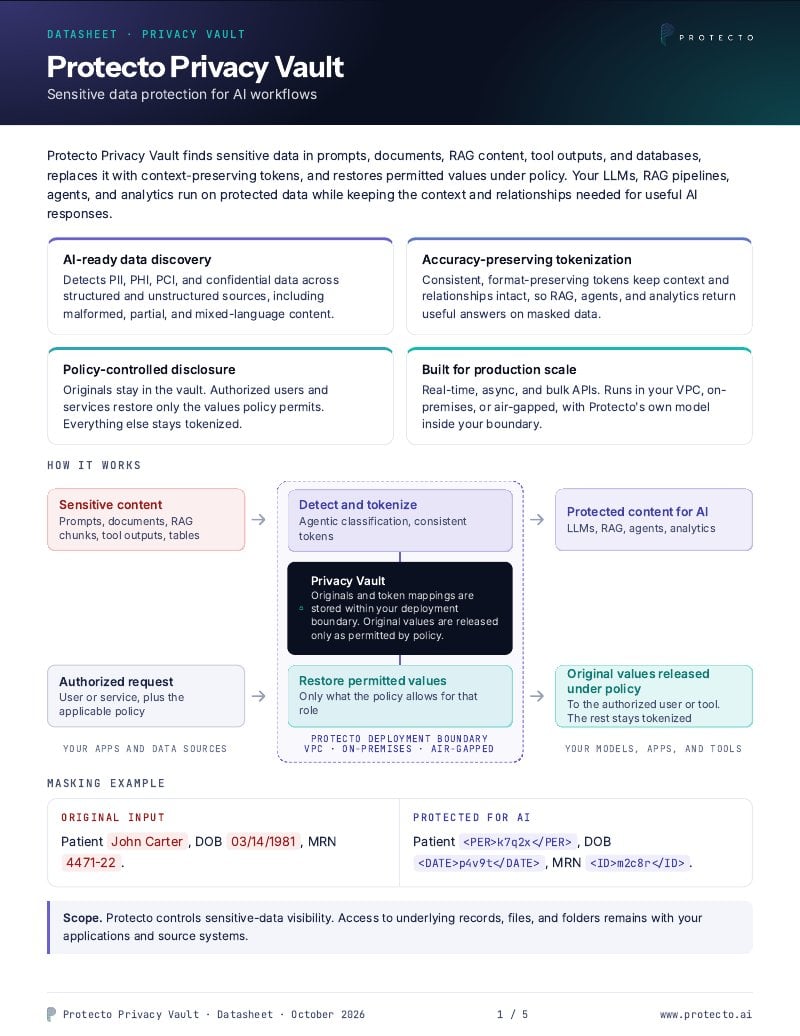
Features that safeguard your data across agents, AI applications, RAG pipelines, MCPs, data lakes, and enterprise systems.
By submitting you agree to Protecto’s privacy policy.