Let your bank use frontier AI while customer data stays in the country
Protecto runs inside your bank, finds customer data headed to AI and applies your policy: models get tokens, approved roles see real values, every release is logged.
Animated example. A relationship manager asks the bank's AI assistant to summarize a loan file that contains a customer's Arabic name and IBAN. Protecto detects both values, replaces them with tokens, and sends only tokens to the AI model outside the country. The model answers in tokens. Protecto restores the real values for the relationship manager and logs the release. For a contact center agent, the IBAN stays partly hidden.
Bank AI assistant · any LLMIllustrative
Protecto
1Detect
2Mask
3Send
4Unmask
RM
Summarize the loan file for فاطمة الحارثي[PERSON_7a1], IBAN OM81 0270 0012 3456 7890 123[IBAN_c42]OM81 •••• 0123.
Tokens only → model, outside the country
AI
Model replyفاطمة الحارثي[PERSON_7a1]missed one payment on 12 Sep. AccountOM81 0270 0012 3456 7890 123[IBAN_c42]OM81 •••• 0123is otherwise current. Suggest a restructuring call.
Viewing as Relationship manager0 releases logged
Trusted by regulated enterprises & agentic platforms
Why bank AI projects stall at the data residency review
A bank in the Gulf wants its relationship managers to use an assistant built on a frontier model, such as Gemini, GPT or Claude. The model runs in a data center outside the country. Every request would carry customer names, account numbers and payment history.
The bank’s regulator expects customer data to stay at home, so the project sits in review. This is the data residency problem: the best AI is somewhere the data is not allowed to go.
Host a smaller model in-country.
The data stays home, but answers get weaker, and your team pays to run and tune the model.
Keep AI away from customer data.
The regulator is satisfied. Your teams fall behind banks that ship AI on the work that matters.
Rely on DLP and redaction alone.
DLP still guards email, endpoints and file transfers, but it was not built to follow data into prompts, retrieval and agent tools. Redaction turns a loan file into “[REDACTED] missed a payment on [REDACTED]”, and the model has to guess.
What Gulf bank regulators expect before customer data reaches AI
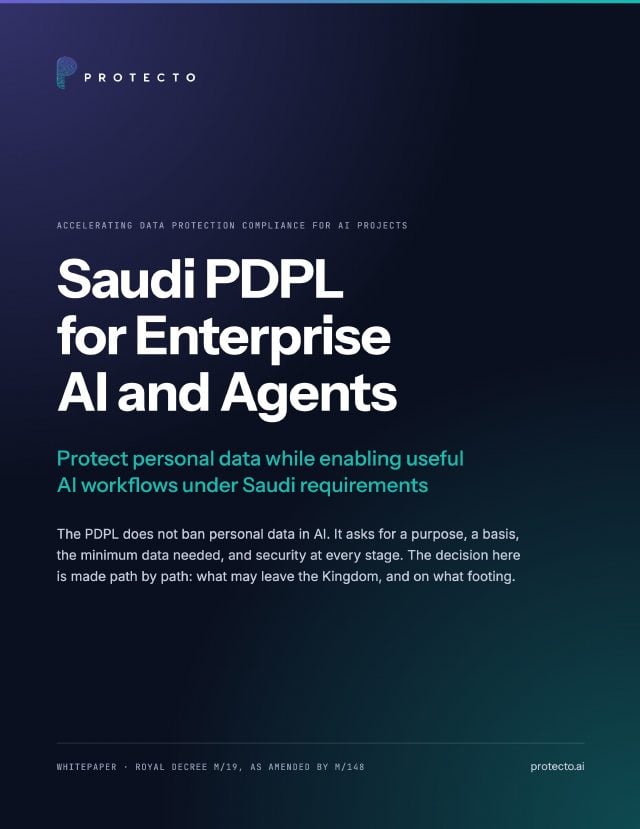
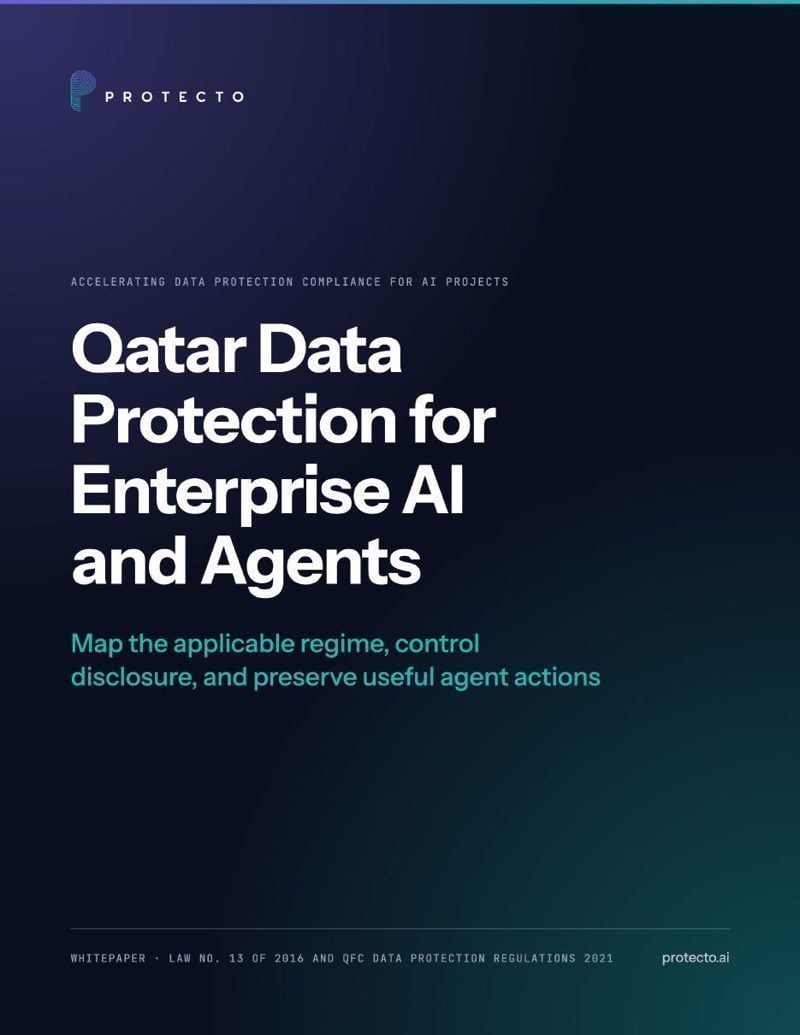
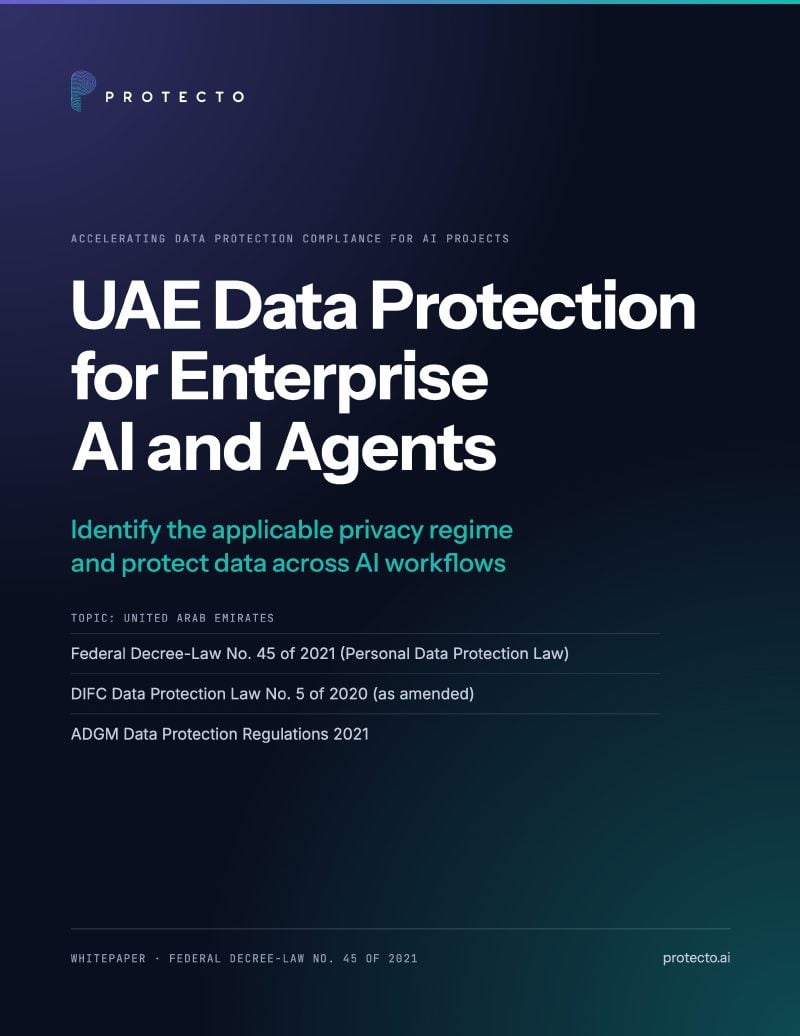
Sector rules for banks are often stricter than the national privacy law. Here is the short version for four markets.
Summaries, not legal advice. Confirm your position with counsel and your regulator.
One checkpoint inside your bank, in front of every AI model
Protecto runs in your private cloud or data center. Data passes through Protecto before it reaches a model, a search index or a tool.
Real timeProtects model input, retrieval, logs, tool calls and agent memory as data moves, not just stored files.
Real valuesTokensAnswers coming back
On-premises · Private cloud · Air-gapped · SaaS. When Protecto runs in your environment, token mappings, keys and logs stay on your servers.
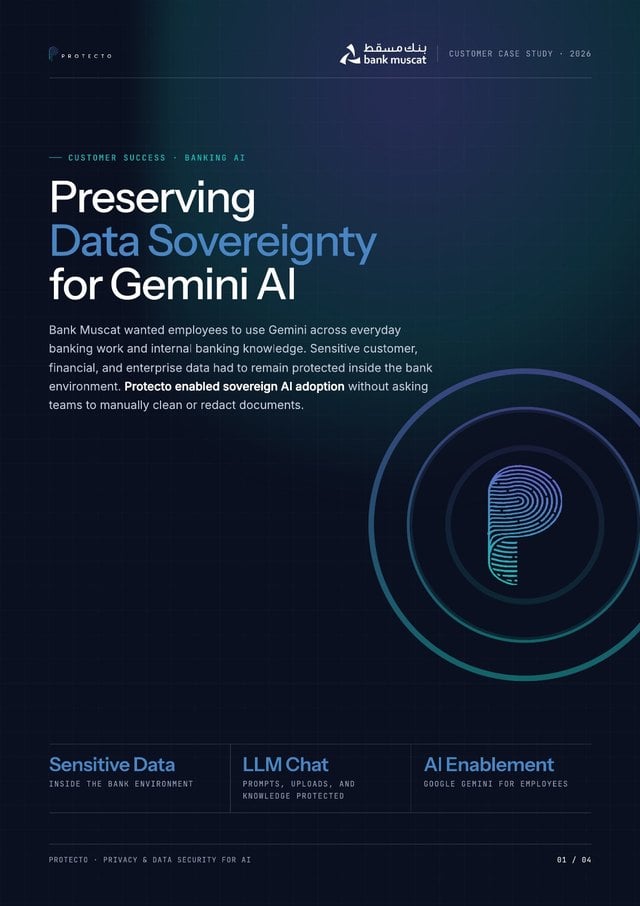
How Bank Muscat got to a working proof in four weeks
Bank Muscat wanted Gemini for its teams. Its regulator said customer data stays in the country. Its records mixed Arabic and English, with transliterated names and Arabic numerals, which is hard for pattern-based tools.
Protecto ran inside the bank’s private cloud, found the sensitive values in both languages and sent the model tokens only. The proof of concept was working in four weeks.
Blunt redaction breaks the answer. Protecto swaps sensitive values for tokens that keep the data’s shape, and controls who sees the real ones.
01
Consistent tokens
The same customer gets the same token in every message and document, so the model can follow one account through a loan file.
02
Format kept
A tokenized IBAN still looks like an IBAN and a date stays a date, so downstream checks and tools keep working.
03
Arabic, English and mixed text
Detection is officially tested in seven languages, including Arabic and English, and handles transliterated names and Arabic numerals.
04
Real values back by policy
Controlled unmasking returns real values only to the roles your policy names, and logs each release.
Where banks put Protecto first
Relationship manager assistants
Summarize a client’s file, draft a follow-up and prepare a meeting. Data: names, account and loan details, notes.
Customer service chat and email
Draft replies to complaints and requests in Arabic or English. Data: names, phone numbers, card and account numbers.
Credit and loan review
Summarize applications and supporting documents for an analyst. Data: national IDs, income, payment history.
Policy and procedure search
Let staff ask questions over internal documents through a search index that holds only tokens. Data: customer details inside those files.
Security & compliance
Built for regulated data at enterprise scale.
Protecto combines data protection, audit logs, and ready-to-use policies for regulated data, whether deployed as SaaS, on-prem, in a private cloud, or air-gapped.
SOC 2 Type II
Audited controls
ISO 27001
Certified ISMS
HIPAA
BAA available
GDPR
EU data ready
DPDP
India privacy law
CCPA / CPRA
US privacy
Independently verified to outperform AWS Comprehend and Microsoft Presidio · audit logs on every scan, mask, and unmask.
Questions banks ask before AI touches customer data
Do tokens still count as personal data under our regulator's rules?
Possibly. Tokenization is pseudonymization, not anonymization: while the mapping exists, a token can be linked back to a person. Whether sending tokens abroad counts as a transfer is a question for your counsel and regulator. Protecto gives you the control: you decide which recipients get tokens, which get real values, and which get nothing.
Where do the real values and token mappings live?
When Protecto runs in your environment (on-premises, private cloud or air-gapped), detection, token mappings, keys and logs stay on your servers. External models only receive tokens.
How does Protecto work with our DLP?
Keep your DLP. It still guards email, endpoints and file transfers. Protecto covers the AI path that DLP was not built for: data going to models, search indexes, agents and tools. It finds sensitive values in free text, including Arabic, and applies your policy for each recipient instead of blocking the request.
What can we show our regulator?
Your policy, where Protecto runs, where token mappings and keys are kept, and a log of which AI received which customer data and who saw real values. When Protecto runs in your environment, those logs stay on your servers.
Which AI models can we use?
Protecto is model agnostic. Use models from OpenAI, Anthropic or Google, or a model you host in-country, behind the same policy.
Does Protecto handle Arabic?
Yes. Detection is officially tested in seven languages: English, German, French, Spanish, Dutch, Arabic and Japanese. In the Bank Muscat case study, on mixed Arabic and English data, Protecto reached 99% recall and 96% precision.
Will protecting the data hurt answer quality?
Consistent, format-preserving tokens keep the structure the model needs. Bank Muscat retained 85% semantic accuracy after masking.
How long does a proof of concept take?
Bank Muscat had a working proof of concept in four weeks. Bring a sample of your own data and we will scope yours on the first call.
This page is general information, not legal advice.
Bring one AI project your regulator blocked. We will show you what leaves the bank.
Share a sample of customer text in Arabic, English or both. We will run it through Protecto and walk you through what each model and tool would receive.