
Protecto finds personal and confidential data in your datasets and replaces it, keeping the context and structure your models learn from.
SOC 2 Type II · ISO 27001 · HIPAA, BAA available





Long texts a day at a SaaS company
Lower cost than its in-house build estimate
Claims documents in scope for AI at a healthcare data platform
Your data team wants to fine-tune a support model on three years of tickets. The tickets hold exactly what the model should learn. They also hold customer names, emails, card numbers and the contract terms account managers mention.
Privacy review stops the project. Teams then drop whole fields and lose the signal, or run a script that misses what customers typed into free text.
Protect the sensitive information. Keep the training value.
Field rules miss the names, emails and card numbers that customers type into tickets, chats and notes.
When every person becomes [REDACTED], the model can no longer tell customers apart or follow who did what.
Prices, discounts and deal terms in notes and emails end up in the training set, where a model can memorize and repeat them.
Redaction makes data safe by making it useless. Switch between the copies and see what a model can still learn from each.
tickets.jsonl, one record
Billing ticket 48213
What the model can still learn
Synthetic ticket. Your policy decides which entities are replaced and whether the copy can ever be reversed.
See this on records of your own.
Protecto runs where your data already moves, before any dataset reaches a training job or an outside model provider.
50+ entity types across PII, PHI and PCI, plus confidential business data such as prices and deal terms, in tables and free text. Add custom entities, such as internal account IDs, in days.
Set a policy per entity type: consistent tokens, format-preserving values, or anonymization with no way back. The same value always gets the same token.
Async jobs and batches handle a full training corpus as well as each new export, so datasets stay current.
Reports show where sensitive data was found and how your policy was applied, so privacy and security can sign off on a dataset.
Some datasets need a way back for approved reviewers. Others should never be re-identified. Protecto does both, chosen by policy.
| When the dataset is for | Use | Why |
|---|---|---|
| Fine-tuning a model you run yourself | PseudonymizationConsistent tokens | Customers stay distinct across files, and nobody needs a real name to train the model. |
| Evaluation sets your team reviews | PseudonymizationUnmask by role | Approved reviewers request a real value through a policy when they need to check an answer, and each request is logged. |
| Fine-tuning with an external model provider | AnonymizationNo way back | No mapping is stored, so the copy you send can never be re-identified. |
| A dataset shared with a partner or researcher | AnonymizationNo way back | The data leaves your organization with the context intact and the identities gone for good. |
Tokenization is pseudonymization, not anonymization. De-identification is one control and does not by itself establish compliance.
Call Protecto from the step that builds the dataset, using its API, a Snowflake UDF, Databricks, Kafka or Spark. Deploy it as SaaS, in your private cloud, on-premises or air-gapped.
Detection is tested in seven languages: English, German, French, Spanish, Dutch, Arabic and Japanese. Others are tested on your data.
Request
PUT /api/vault/mask
{"mask": [{"value": "Maria Lopez renewed at $412,000 a year and asked for a refund."}]}
Response: token_value
<PERSON>Qm7xK2</PERSON> renewed at <DEAL>Wn4Lp82</DEAL> and asked for a refund.
Synthetic example. The rest of the sentence stays as written, so the record still teaches the model something.
It finds personal and confidential values in a dataset, such as names, emails, account numbers and deal terms, and replaces them before the data is used to train, fine-tune or evaluate a model. Protecto replaces only those values, so the rest of each record stays useful for training.
No. Tokenization is pseudonymization: a mapping exists in a vault, so approved users can reverse it. If a dataset must never be re-identified, use anonymization, which stores no mapping.
Dropping fields or redacting text does, because the model loses the patterns it needs. Protecto replaces only the sensitive values and gives the same value the same token, so relationships and meaning stay in the data. We measure how well AI answers hold up after masking with our accuracy metric, RARI.
Yes. Along with PII, PHI and PCI, Protecto detects confidential business content such as prices, discounts and deal terms, and you can add custom entities for your own identifiers.
Yes. Use anonymization for any copy that leaves your organization. No mapping is stored, so the provider receives data that cannot be traced back to your customers.
Yes. Protecto deploys as SaaS, in your private cloud, on-premises or air-gapped, so raw training data does not have to leave your environment.
Yes. Protecto detects PHI in tables and clinical notes and supports HIPAA Safe Harbor identifiers. See PHI de-identification for data lakes.
No. You train and run your own models or use the providers you choose. Protecto protects the data that goes into them.
Bring a sample of your own dataset, or synthetic data if you prefer. We will show you what Protecto finds and how much context it keeps.
This datasheet outlines features that safeguard your data and enable accurate, secure Gen AI applications.
By submitting you agree to Protecto’s privacy policy.
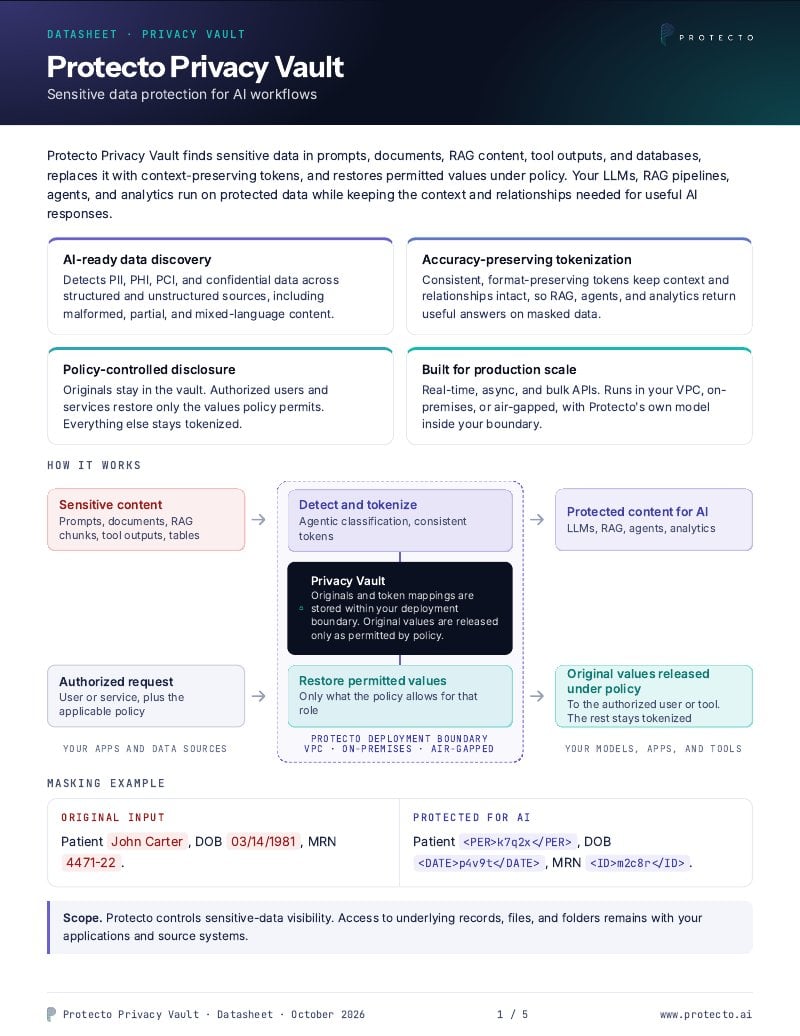
Features that safeguard your data across agents, AI applications, RAG pipelines, MCPs, data lakes, and enterprise systems.
By submitting you agree to Protecto’s privacy policy.