
Protecto swaps names, Social Security numbers and addresses for consistent tokens before your AI model sees them. Residents still get answers about their own case.
SOC 2 Type II · ISO 27001 · HIPAA, BAA available





Automation Anywhere protects AI data across its enterprise tenants
Live enterprise tenants
Set by each tenant
Every reveal of a real value
A resident asks the city’s chatbot why the permit for 412 Elm Street is on hold and adds an account number. Leave those details in, and they reach a hosted model and its logs. Strip them out, and the model sees “[REDACTED]”, finds no record, and the resident calls 311 anyway.
This is the citizen data problem in government AI: the chatbot needs the details your review will not let it see.
Social Security numbers land in service requests, addresses link to owner records, and utility questions carry payment details. Names and contact details appear throughout.
Permit files, meeting minutes and case records mix public facts with personal ones. Once indexed for a chatbot, those details can surface in answers to someone else.
Scrubbing the data or limiting the bot to public pages makes the review easier. Residents then get generic FAQs instead of answers about their own permit, bill or case.
Keep your CRM, permitting and records platforms. Protecto connects through standard REST APIs and protects data on its way to AI.
Protect names and addresses in building permits, zoning requests and planning files before AI reads them.
Protect resident details in service requests, complaints and case notes, so staff assistants can still follow each case.
Let residents search meeting archives and ordinances without exposing the personal details buried in them.
Protect sensitive details while AI helps staff search and summarize requests. Your records officers still decide what is released.
Data passes through Protecto before it reaches a model, a search index or a tool. You add one control point instead of a separate fix for each department.
On-premises · Private cloud · Air-gapped · SaaS. When Protecto runs in your environment, token mappings, keys and logs stay on your servers.
Protecto acts at each stage of a chatbot conversation, and tokens keep the context a model needs to answer.
Protecto scans and masks city documents, permit records and meeting minutes before they are embedded for retrieval. Your search index holds tokens.
Protecto masks each question before the model sees it. The same resident gets the same token in every message, so the model can still follow the case.
Answers come back with tokens. Protecto restores real values only for the residents, staff and tools your policy names. Each release is logged.
Run Protecto as SaaS, in your private cloud, on-premises or air-gapped. In your environment, token mappings and keys stay on your servers.
“Protecto enabled us to deliver data security, privacy, and compliance for our AI features at scale across 5,000+ enterprise clients, strengthening customer trust in our AI automation solutions.”
Protecto is API-first, so your team can call it from the chatbot code you already have.
Synchronous calls mask data during the conversation, so the exchange with a resident keeps moving.
Asynchronous jobs process council archives, planning documents and historical records before you embed them.
Planning, Finance, HR and Public Works can each manage their own masking policies. Your application passes each user’s role to Protecto.
Redaction removes the words a chatbot needs. Tokens keep them in usable form while the real values stay protected.
| What a government chatbot needs | Generic redaction | Protecto |
|---|---|---|
| What the model sees | “[REDACTED]” in place of each value. | A consistent token such as [PERSON_7a1]. |
| Following one resident | Every person looks the same to the model. | The same token across messages and documents. |
| Answers about one case | Generic, or no record found. | Specific to the case, with real values restored by policy. |
| Details in free text | Pattern rules can miss them. | 50+ entity types plus custom entities. |
| Staff access | Everyone sees the redacted text, or the original. | Real values by role, passed from your application. |
| Record for the review | Depends on the tool. | Logs of each mask and release, plus policy reports. |
Independent benchmark: UT Dallas and DataXpert measured a higher F1 for Protecto than for AWS Comprehend and Microsoft Presidio.
Yes. The model works with tokens, an approved tool can receive the real value it needs to look up a record, and Protecto restores real values in the answer for the people your policy names.
With Protecto in the path, the model receives tokens. Real values stay under your control. This covers questions, retrieved documents, tool calls and answers.
Yes. Protecto runs as SaaS, in your private cloud, on-premises or air-gapped. When it runs in your environment, token mappings, keys and logs stay on your servers.
Protecto is model agnostic. You can use a public model such as GPT, Gemini or Claude, or a model you host, behind the same policy.
Bank Muscat measured 99% recall and 96% precision on its data. An independent UT Dallas and DataXpert benchmark found a higher F1 than AWS Comprehend and Microsoft Presidio. Protecto covers 50+ entity types plus custom entities.
Detection is officially tested in seven languages: English, German, French, Spanish, Dutch, Arabic and Japanese. Other languages are available on request and tested on your data.
Consistent tokens keep who-is-who intact, so the model can still reason over the conversation.
Yes. A multi-tenant setup lets each department manage its own masking policies, and your application passes each user’s role so Protecto can decide who sees real values.
Yes, through Privacy Gateway. You keep each user’s masking and unmasking access in AD or Okta groups, and Gateway issues a Protecto auth key with that access at login. If you use Protecto Vault directly, it’s a headless API, so your team can build the integration around it.
Protecto protects sensitive data while AI reads and summarizes records. Decisions about what to release under public records laws stay with your records officers and counsel.
Usually, yes. Tokenization is pseudonymization, not anonymization: while a mapping exists, a token can be linked back to a person. Your counsel decides what that means for each AI path.
No. DLP keeps guarding email, endpoints and file transfers. Protecto covers where it falls short: AI traffic, context and unstructured data moving to models and agents.
No. Protecto holds SOC 2 Type II and ISO 27001 and is HIPAA compliant. Protecto can also run in your own environment, on-premises or air-gapped, so your team can assess it inside a boundary you already control.
Bring one resident-facing AI project. We will show you what each model and tool receives.
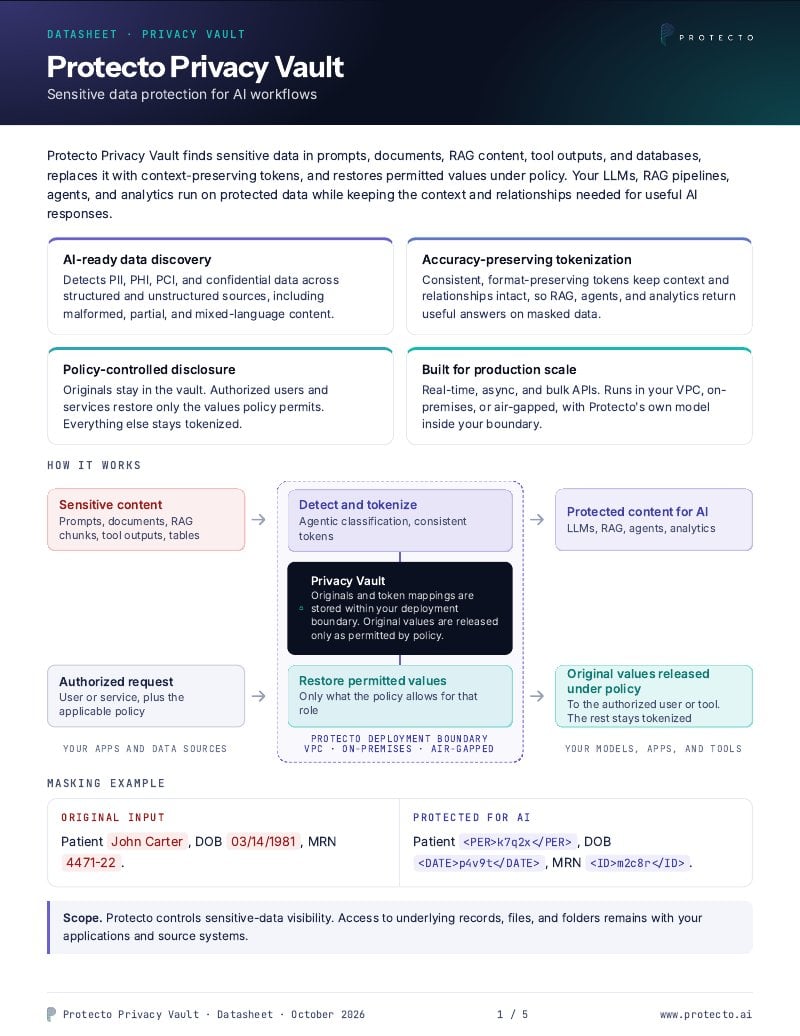
Features that safeguard your data across agents, AI applications, RAG pipelines, MCPs, data lakes, and enterprise systems.
By submitting you agree to Protecto’s privacy policy.

A third-party study compares how accurately Protecto, Microsoft Presidio, and AWS Comprehend find personal and health data in unstructured text.
By submitting you agree to Protecto’s privacy policy.
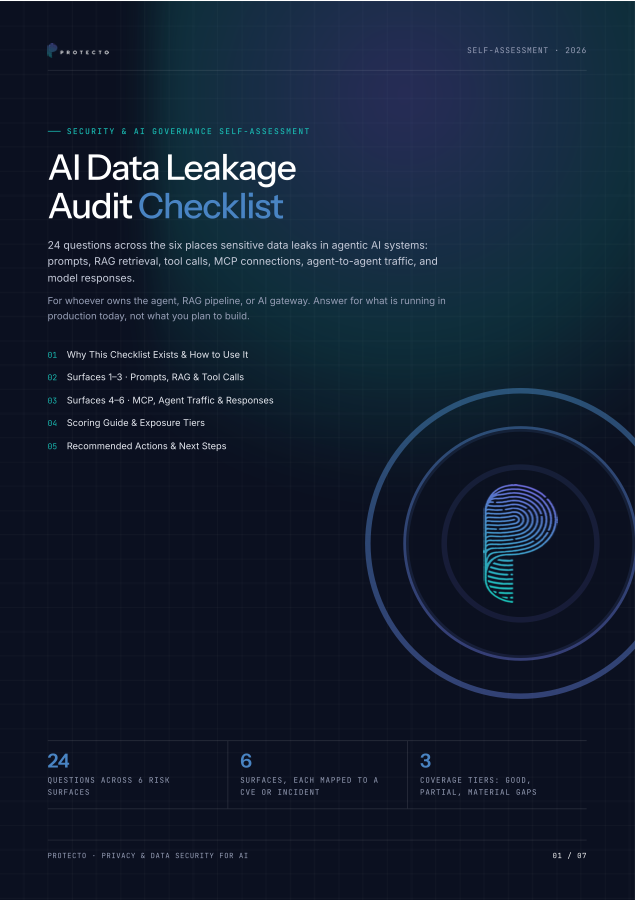
24 yes or no questions across the six places sensitive data leaks in agentic AI, from model requests to tool calls and agent memory.
By submitting you agree to Protecto’s privacy policy.