
Protecto masks personal data in records and free text before any model, agent, or tool receives it, on-premises or in your private cloud.





Automation Anywhere protects AI data across its enterprise tenants
Live enterprise tenants
Set by each tenant
Every reveal of a real value
An insurer connects its claims archive to an AI assistant. The files hold names, IBANs, and doctors’ notes, in French, German, and English. The assistant sends text to a model, writes chunks to a search index, logs every call, and hands cases to a refund tool. Before the DPO signs off, someone has to say who receives what. Nobody can.
Claims, tickets, contracts, and CRM records are where AI saves the most time. They hold names, account numbers, and health details, in tables and in free text.
GDPR asks you to record who receives personal data (Art. 30) and to assess high-risk processing before it starts (Art. 35). Every new model, index, log, and tool adds a recipient.
Many masking tools are tuned on English, so a German street name or a Spanish ID number in an email slips through. Tools that blank everything break the answer, and teams switch them off.
A line saying a claimant spent a month in rehab is special category data under Article 9. Breaking those rules can cost up to €20 million or 4% of worldwide annual turnover (Art. 83(5)).
Your claims assistant reads a German case file. Protecto runs on your servers or in your private cloud, finds the personal data, and applies a policy for each recipient. The model, the index, and the logs get tokens. The refund tool gets the real IBAN because your policy says so, and the release is logged.
Jonas Becker → [PERSON_7a1]The same person always gets the same token, so the AI can still follow the case.
refund tool ← IBANA tool or role gets the real value it needs for its task, and the release is logged.
health note → not sentArticle 9 data is kept away from models and indexes unless your policy allows it.
Runs on your servers, in your data center.
Runs in your cloud account, in an EU region you choose.
One use case, one data sample in your own languages. Add flows as reviewers sign off.
Reviews stall on questions code cannot answer quickly: which personal data does this flow touch, who receives it, and what do they see? Protecto logs every decision, so your team can report the answer for each flow.
[PERSON_7a1], geb. [DATE_2b9], bittet um Erstattung auf [IBAN_c40]. Art. 9 note held back
Mme [PERSON_3f1], domiciliée [ADDRESS_51e], demande le remboursement du dossier 2291.
summary: "[PERSON_7a1] requests a refund to [IBAN_c40]"
refund(iban=DE89 3704 … 30 00, payee=[PERSON_7a1])
Jonas Becker: Laut Arztbrief vier Wochen Reha nach Bandscheiben-OP.
Fines reach €20 million or 4% of worldwide annual turnover, whichever is higher, for the core principles and Article 9 (Art. 83(5)), and €10 million or 2% for duties such as Articles 25, 30, 32, and 35 (Art. 83(4)). References are to Regulation (EU) 2016/679.
| Rule | Requirement | Protecto solution |
|---|---|---|
| Data minimization and securityArt. 5(1)(c), 5(1)(f) | Personal data must be limited to what the purpose needs and kept secure. | Each recipient gets only the values its task needs. The rest arrive as tokens. |
| Special category dataArt. 9(1) | Health, ethnic origin, religious or philosophical beliefs, sex life, and similar data are prohibited unless an Article 9(2) condition applies. | Protecto flags these values in free text and holds them back from models, indexes, and logs unless your policy releases them. |
| Protection by design and defaultArt. 25(1), 25(2) | Build in measures such as pseudonymization, and by default process only the data each purpose needs. | Tokenization is a pseudonymization measure, applied before data reaches the model, on every call. |
| ProcessorsArt. 28(1) | Use only processors that give sufficient guarantees. | Model vendors receive tokens, not real values. When Protecto runs on your servers, real values do not reach Protecto either. |
| Records of processingArt. 30(1)(d), 30(1)(g) | Record the categories of recipients and, where possible, a description of security measures. | The flow report lists each recipient and what it received, so your records match what the system does. |
| Security of processingArt. 32(1)(a) | Measures that fit the risk, including pseudonymization and encryption. | Tokens replace real values on the way to models, tools, and logs. Mappings and keys stay in your environment. |
| BreachesArt. 33(1), 34(3)(a) | Notify the authority without undue delay, where feasible within 72 hours. Telling individuals can be avoided if protection such as encryption made the data unintelligible. | A leaked model log or index holds tokens, not real values. Your DPO decides what that means for each duty. |
| Impact assessmentArt. 35(1), 35(7)(d) | Assess high-risk processing, especially with new technologies, before it starts, including the measures that address the risks. | The scan and flow report show which personal data a flow touches and how each recipient is handled. |
| Transfers outside the EEAArts. 44, 46 | Data sent outside the EEA needs an adequacy decision or safeguards such as standard contractual clauses. | Protecto sends tokens, not real values. Tokens are still personal data, so the transfer basis stays your decision. |
Sector rules can add duties, for example DORA for financial entities. Check with counsel.
The guide follows one AI workflow through retrieval, the model, and a CRM update, with what each destination may see.
Automation Anywhere brings AI agents to thousands of enterprises. A hospital and a bank need different rules for what to detect, who may see original values, and how long data is kept. Protecto detects and masks sensitive data in each tenant’s AI workflows, applies that tenant’s policy, and reveals original values only to authorized users, with every reveal logged. Automation Anywhere runs the tenants through its own platform.
Live enterprise tenants protected
Set by each tenant, with its own retention rules
Original values revealed only when authorized
Bring one AI flow and a sample of your records. We will show what each recipient receives.
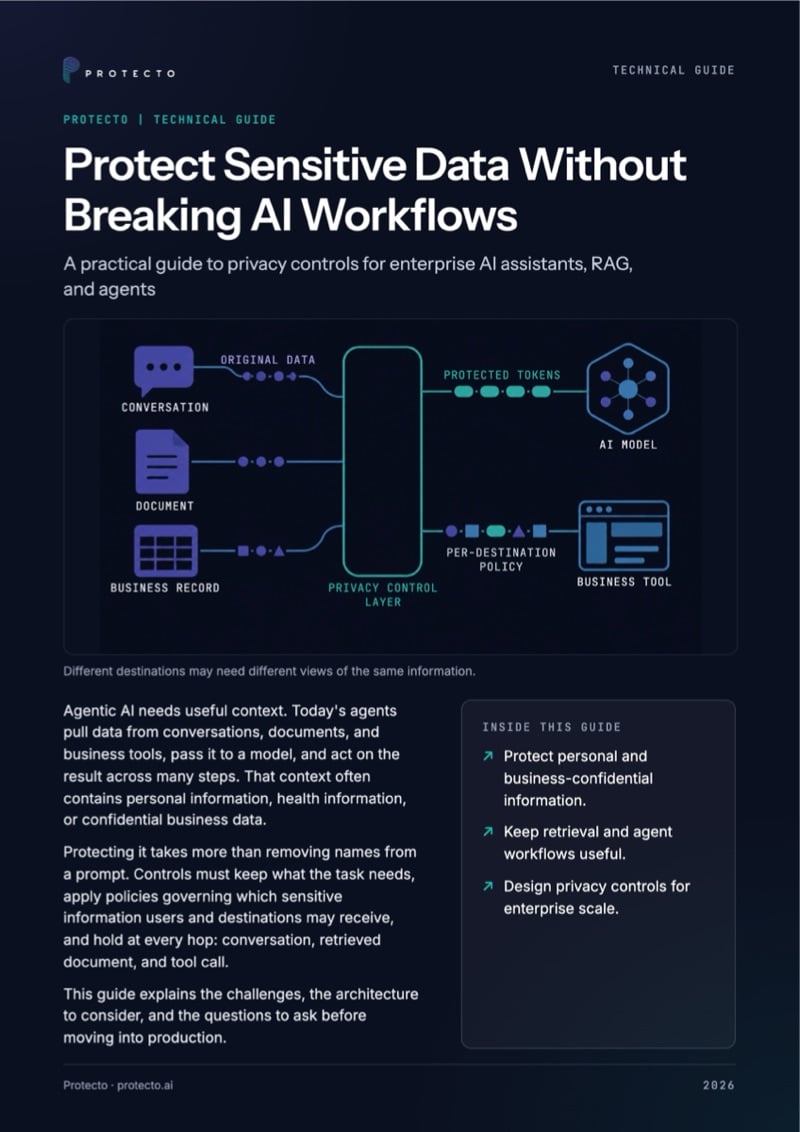
A practical guide to privacy controls for AI assistants, RAG, and agents. One workflow traced from request to CRM update, with what each destination may see.
A third-party benchmark of Protecto, Microsoft Presidio, and AWS Comprehend.
Find where sensitive data moves through your AI systems, layer by layer.
Yes. Protecto replaces values with tokens, which is pseudonymization, not anonymization. GDPR says pseudonymized data that can be linked back to a person with additional information is still personal data (Recital 26). Protecto keeps that additional information, the token mapping, separate and under your control, which is what the definition in Article 4(5) describes. Leave the legal call on any specific flow to your DPO.
With Protecto in the path, the model provider receives tokens instead of real names, emails, and account numbers. Tokens are still personal data, so you still need a processor agreement with the provider and, for recipients outside the EEA, a transfer basis such as an adequacy decision or standard contractual clauses (Arts. 44 and 46). What changes is how much the provider can see.
Article 35 asks for an assessment before high-risk processing starts, including the measures that address the risks (Art. 35(7)(d)). Protecto gives you facts for that assessment: which personal data a flow touches, which recipients get it, and what each one receives. Your DPO still owns the assessment.
Protecto detects personal data in English, French, German, Spanish, Dutch, Japanese, and Arabic, with more languages on request. Protecto covers 50+ entity types out of the box and supports custom entities, so you can add identifiers specific to your business, such as a national ID format.
Yes. Protecto masks values in structured records, such as CRM tables and data exports, and in unstructured text, such as emails, tickets, and documents. The same person gets the same token in both, so records and text stay linked.
Article 9 data, such as health details, religious beliefs, or sexual orientation, often sits in free-text notes. Protecto flags it so your policy can hold it back from the model, the index, and the logs, and release it only to the roles that need it. Every release is logged.
Basic redaction can, because a blank placeholder tells the model nothing. Protecto uses consistent, format-preserving tokens, so the same person maps to the same token and the model can still follow who is who. Test it on your own data before relying on any figure.
On-premises, in your private cloud account in a region you choose, air-gapped, or as SaaS. For an air-gapped setup the AI model runs inside the same boundary, so you host it yourself.
Protecto is an API product. Your team calls the API before the model, or routes model traffic through Protecto as a proxy, and your app logic stays as it is. Start with one AI flow and one data sample, then add more flows as reviewers sign off.
Bring one AI flow and a sample of your records, in your own languages. We will show what each model, tool, and log receives, and the report your reviewers get.
A practical guide to privacy controls for AI assistants, RAG, and agents. One workflow traced from request to CRM update, with what each destination may see.
By submitting you agree to Protecto’s privacy policy.
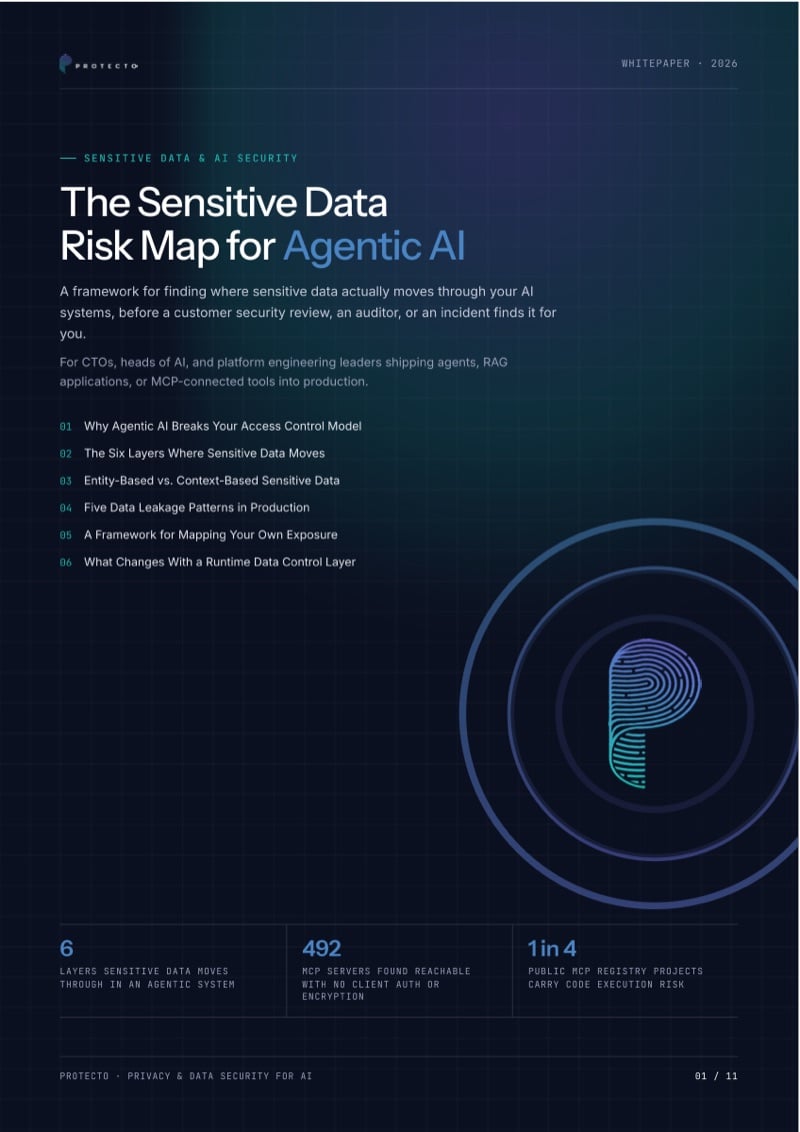
A framework for finding where sensitive data moves through your AI systems, before a security review or an auditor finds it for you.
By submitting you agree to Protecto’s privacy policy.

A third-party study compares how accurately Protecto, Microsoft Presidio, and AWS Comprehend find personal and health data in unstructured text.
By submitting you agree to Protecto’s privacy policy.