
Over the past few years, enterprises have rapidly integrated GenAI into an increasing number of workflows and use cases. Amidst the rush and excitement to adopt a free tool that significantly boosts productivity, business leaders de-prioritized privacy, till it became a compliance issue.
As privacy tools offering a quick patch quickly flooded the market, businesses ran into a new problem – which is the best tool? One popular tool is CalypsoAI, but is it the best? This article explores CalypsoAI alternatives to help you choose the right one.
A quick overview of CalypsoAI
Before jumping to CalypsoAI competitors, let’s take a deep dive into their platform. This will give you an in depth understanding beyond the website copy.
The platform at a glance: core offerings
CalypsoAI is a unified AI security platform that combines red-teaming, real-time defense, and continuous monitoring to secure AI models against a number of privacy risks. Enterprises can protect their AI agents from sensitive data leakage and misuse of data.
PII identification and masking
Calypso AI employs a mix of advanced ML/LLM models and rule-based policies. It also uses adversarial attack simulations and reinforcement learning for its red-teaming of models. The architecture is cloud-native but can be deployed to work within an enterprise’s environment.
CalypsoAI’s out of the box scanners combine NER (named entity recognition) and classification models to detect and prevent PII exposure to unauthorized users.
When should you consider an alternative for CalypsoAI?
While CalypsoAI’s robust capabilities help users actively identify and manage AI threats, you should consider another tool if these are important for your use case:
- Calypso AI focuses on redacting sensitive data before it hits the LLM, but it loses context in the process, hurting model performance and user experience.
- Unlike tools like Protecto or Skyflow, it can’t unmask data on the way back, meaning users never see the full picture, even if they’re authorized. This limits Calypso in use cases where controlled unmasking is critical.
- Steep learning curve and may require coordination between AI developers and security teams. For example, setting up custom policy scanners takes effort and in depth understanding of business context.
- Though Calypso does a solid job in securing text-based LLM applications, it may not suffice if the enterprise needs to protect non textual data like images or data static stores.
- Does not replace a full data anonymization pipeline for training data but complements one by guarding interactions. Users may need to pair it with a solution like Protecto or Skyflow.
Pricing module
Calypso’s does not publicly disclose their pricing; it likely involves custom enterprise licenses or subscriptions. Prospective buyers should expect a significant investment. ROI may be clear for large-scale deployments, but might exceed the budget of smaller organizations.
CalypsoAI alternate #1: Protecto
Launched in 2022, Protecto offers similar capabilities but works slightly differently. Let’s explore the tool in detail.
The platform at a glance: core offerings
Protecto is a data privacy and security platform designed for AI and LLM use cases. The platform combines two main functions to comprehensively protect sensitive data; AI data guardrails and a privacy vault. It uses smart and advanced tokenization to maintain context and utility. It’s built to scale horizontally and auto-scales for large jobs.
PII identification and masking
Protecto uses DeepSight, an AI-native sensitive data identification engine designed for unstructured, high-volume, context-rich environments such as free text, documents, databases, logs, and other data stores.
It plugs directly into your data pipeline, understands real world use cases, and identifies PII and PHI without breaking workflows.
The platform combines three highly trained learning modules to identify PII with the highest accuracy rate in the industry. These modules are trained on large data sets to easily understand context, patterns, and semantics. Once identified, the data is masked, tokenized, or anonymized.
The platform’s Privacy Vault securely stores the original sensitive values while providing masked or tokenized versions for analytics and model training. This way, users can leverage AI to its fullest potential without compromising on the quality of output.
Protecto uses an entropy-based tokenization method that renders tokens irreversible. Using transformer based NER models helps it to achieve high accuracy in context. It uses regular expressions and dictionary lookups for patterns and heuristic algorithms to check Luhn validity on credit card numbers. Combining these techniques ensures in depth detection.
Product USP (Unique Selling Point)
One of the key capabilities that sets it apart from competitors is its ability to preserve the accuracy of masked data without compromising the quality of output. Compared to other tools that simply redact the data thereby reducing context for AI, Protecto preserves context to ensure no compromise on model performance.
For example, if “John Doe” is tokenized to “A1B2C3” once, any time “John Doe” is stored or encountered, it can be consistently tokenized to “A1B2C3”. This consistency allows cross-referencing: an AI model can see “A1B2C3” in a prompt and treat it as a name without knowing the actual name, and then later on the token can be detokenized for an authorized user.
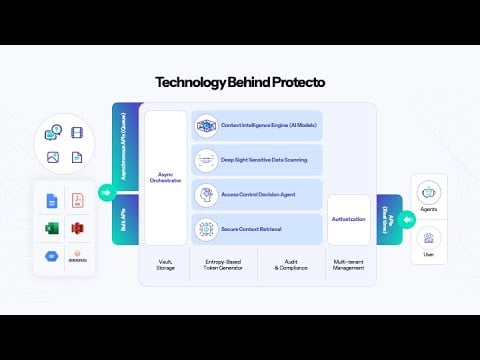
Protecto uses advanced AI models to detect sensitive data while supporting deterministic rules and regex for full coverage and custom needs. This blend results in higher detection rates and fewer false negatives.
Protecto offers role-based access controls (RBAC), giving fine-grained governance over who can see original data versus masked data. It also generates audit logs and reports of scans, tokenizations, and unmasking events to help businesses prove compliance to auditors and regulatory bodies.
Why should you consider Protecto AI?
To sum things up, if you are looking for a PII privacy tool, Protecto is a great choice as:
- Detects PII/PHI with high precision and near perfect accuracy across structured and unstructured fields.
- Smart tokenization retains the relational format and context of data. This enables the AI model to perform with the same accuracy if the original data were added.
- Offers an all in one, holistic privacy solution that includes identification, masking, access control, and compliance reporting from a single platform.
- Can be deployed both on the cloud and on-premises. Developer friendly APIs integrate into ETL, data lakes, or real time pipelines to suit a wide range of enterprise use cases.
- Comparisons show that it beats Microsoft Presidio and AWS on PII detection accuracy.
Pricing module
Protecto offers a no credit card free trial and even a freemium tier. In this module, initial volumes are free based on usage but scales with paid plans. Protecto charges based on the number of records or data volume processed, the number of API calls, and the deployment type (SaaS vs on-prem has different licensing).
CalypsoAI alternate #2: Skyflow
Skyflow has been a key payer in the market since 2019. Let’s take a tour of their services.
The platform at a glance: core offerings
Skyflow describes themselves as a zero trust privacy vault that enables companies to isolate, protect, and govern sensitive data. Users can store masked or encrypted data in Skyflow’s secure vault and use tokens or APIs to retrieve or operate on it as needed.
Its core features include deterministic tokenization, fine grained access control, secure data exchange, and policy driven data governance.
PII identification and masking techniques
Skyflow identifies and classifies sensitive data by combining data schemas with a sensitive data dictionary, allowing users to customize what is considered sensitive. The platform is more focused on storing sensitive data fields rather than crawling unstructured texts for PII.
During training data ingestion or prompt processing, Skyflow completely removes those terms or replaces them with tokens. To detect PII, Skyflow uses pattern matching and some ML for context, but the platform doesn’t depend too much on it. Instead, it allows users to configure which columns/fields are sensitive in a dataset and route them to the vault.
Skyflow uses polymorphic encryption; they allow multiple methods of encryption/tokenization depending on use case.
Skyflow allows users to mark their sensitive fields and de-identifies those in any combined dataset. It eliminates the risk of false negatives (which could lead the model to memorize or leak it) by excluding or tokenizing personal data upfront.
While Skyflow does not offer the highest accuracy in PII detection via AI, it shifts the paradigm: you architect your system so that sensitive data is handled from the start.
Product USP (Unique Selling Point)
Skyflow is differentiated by its vault architecture and ease of integration in contrast to traditional DIY security. Its zero trust architecture fully isolates data in the vault – an approach that secures data better than scattershot encryption methods. Users can search, sort, or run functions on encrypted data to analyze tokenized data, similar to Protecto.
While most solutions are single-purpose, Skyflow can replace multiple systems. Companies can use one vault for payments, PII, and LLM privacy, getting centralized privacy governance. This is suitable for customers who don’t want too many point solutions.
Why should you consider Skyflow?
Here are some reasons to consider Skyflow:
- Offers robust protection for sensitive data by keeping it in a vault. This privacy by design architecture significantly reduces the risk of unauthorised access while enabling AI models to function to their full potential through the use of tokens.
- Simplifies HIPAA/ PCI/ GDPR compliance through data retention policies and audit logs.
- Allows multiple parties to collaborate on datasets without exposing sensitive data to one another.
- Easily integrates with popular cloud data warehouses, databases, and apps.
When should you consider an alternative to Skyflow?
While Skyflow has a proven record to enable enterprises manage PII using privacy vaults, we recommend choosing an alternate if these drawbacks are non negotiable for you:
- Skyflow falls short on preventing LLMs from generating toxic or biased outputs as it is not designed to moderate content or prevent behavioral AI threats.
- If an enterprise needs full AI risk management, they’d need a complementary solution (like Calypso or Protecto) for prompt integrity, hallucination control, etc.
- Using Skyflow (especially as a SaaS) means entrusting third parties with critical data handling. If your company has policies against externalizing PII management, the self-hosted option or virtual private cloud can mitigate concerns, but may reduce SaaS convenience or cost advantage.
- Since Skyflow targets enterprise SaaS audiences, it is not cost effective, especially for what it offers – if projects touch a small amount of PII, a full vault is an overkill.
Pricing module
Skyflow does not publish exact pricing, but based on their comparison to VGS: we predict they have a predictable pricing model by data subjects rather than per API call. This implies you pay based on the number of unique customer records or vault entries.
For example, if you have 1 million customer profiles with PII, there might be a tier for that. This model eliminates unpredictable costs and fully integrates the vault into all operations.
That said, storing 1M records securely across regions, etc., won’t be cheap – likely an annual subscription that could range from tens to hundreds of thousands of dollars.
CalypsoAI alternate #3: LLM Guard by Private AI
Private AI offers similar capabilities to Calypso and Protecto. Let’s understand the platform better.
The platform at a glance: core offerings
LLM Guard, a product by Protect AI, secures LLM applications in real time. Described as an “enterprise firewall”, it detects, redacts, and sanitizes prompts as they flow between users and AI models. Its core capabilities include sensitive data leak prevention, prompt injection defense, harmful content moderation, and custom policy monitoring.
PII identification and masking techniques
LLM Guard specifically targets PII and secret leakage in AI interactions, using a sensitive data scanner that works by identifying patterns and detection rules.
LLM guard combines advanced regex patterns and trained classifiers to identify PII and uses an approach of “masking” on-the-fly redaction or replacement rather than persistent masking in a database. It doesn’t maintain a vault or tokens for later reversal; instead, it sanitizes in transit. LLMGuard performs dynamic redaction: it doesn’t provide a safe version for analysis like a token – it simply strips or obscures the content.
Product USP (Unique Selling Point)
Of the key differentiators of LLM guard is its open source availability, which adds to its transparency.
Another advantage of LLM Guard is that it heavily focuses on machine learning security operations. It is built with an understanding of AI pipelines, which sets it apart from traditional DLP or WAF (web app firewall) products being retrofitted for AI.
Finally, it is designed to be plugged in within minutes into existing code and works with any LLM platform.
Why should you consider LLM Guard?
We recommend choosing LLM guard if these pros matter to you:
- LLMGuard addresses a wide range of issues – from PII to prompt injections and toxic content in one toolkit, reducing the need to rely on multiple tools.
- Being open source fosters trust and allows rapid improvement from the community. Organizations can deploy it at no licensing cost and even modify it to fit their needs.
- LLMGuard is easy to integrate in libraries, APIs, or as a reverse proxy style. It’s model-agnostic; you can swap LLM backends without changing your guardrail logic.
When should you consider an alternative to LLM Guard?
Pros aside, you should skip this tool if these are non negotiable for you:
- LLMGuard’s detection uses regex and fixed rules – while this is fast and transparent, it might miss sensitive data that doesn’t match known patterns
- The open-source nature means a savvy security team can extend it, but less sophisticated users might stick to defaults which could have gaps.
- LLMGuard operates in-memory on the fly; it doesn’t provide a data vault or long-term anonymization strategy. If your use case requires storing conversation logs or training data safely, you’d still need a solution like a vault or rigorous logging hygiene.
- As an open tool, LLMGuard might lack enterprise-grade features such as a user-friendly dashboard, reporting UI, or integration with SIEM.
- LLMGuard is tailored for text-based large language models. It cannot support enterprises dealing with images, audio models, or non-LLM AI systems.
Pricing module
LLMGuard is currently free and open source for the base version. Protect AI presumably monetizes by offering an enterprise version and by integrating it into their broader platform. So pricing is a bit two-fold: the open source core has no cost, which is a major contrast to others on this list. This means organizations can start using it without procurement. The catch is if they want official support, updates, and additional features, they might go for the commercial edition.
Choosing the best solution: what to know before buying
A key player in the AI privacy tool market, CalypsoAI is trusted by a large customer base, it helps users navigate AI privacy constraints with ease.
When it comes to picking a solution, choosing the first option you know of is seldom a good idea. If it works perfectly for one business, it does not guarantee the same for you. A good practice is to evaluate a few tools with similar capabilities to understand which one truly fits your business use case. The “best” solution, therefore, boils down to what suits your unique use case better than others.
Having clarified that, we wrote this blog to help you move closer to a decision. We analyze five main CalypsoAI competitors in detail – key features, functionalities, pricing difference, pros, and cons. By the end, you should be equipped with enough data to make the right choice.
Still confused? Let us help you
It’s understandable if you still have questions or didn’t get the exact information you wanted.
One way to determine if a tool is right for you is by using the tool for a trial period before making a purchase. If you are interested in a free trail, or want to discuss your needs, book a demo with our experts.

