When we consider the modern digital economy, data privacy is no longer just a “nice to have” addition. It is now a legal necessity. Research shows that companies with strong privacy practices achieve a 2.7x return on investment, driven by increased customer trust.
On the other hand, failing to protect data can be financially burdensome. Since the GDPR took effect, European authorities have imposed fines totaling over $9 billion on companies that did not comply with the rules.
To avoid the potential risks, businesses today use a Data Protection Impact Assessment (DPIA). This is a formal review to find privacy risks in new projects. Doing this on paper is next to impossible given the scale. That is why smart companies use a DPIA tool to automate the work.
In this guide, we will review the top 7 tools for data protection impact assessments (DPIAs) to help you stay compliant and secure.
Understanding DPIA and the Role of a DPIA Tool

A Data Protection Impact Assessment is a process for identifying, evaluating, and mitigating privacy risks associated with the processing of personal data. Several privacy laws, including GDPR, require an organization to perform DPIAs when data processing tends to pose a high risk to individuals.
A modern DPIA tool aims to simplify this requirement by guiding users through structured questions, calculating risk levels, documenting decisions, and securely storing evidence. Instead of relying on scattered documents, businesses use dedicated platforms to consistently and efficiently manage DPIAs.
Well-designed tools for data protection impact assessments (DPIAs) help organizations move from reactive compliance to proactive privacy management.
When your team uses professional tools for data protection impact assessments (DPIAs), you can focus more on your core business goals and less on paperwork.
Top 7 DPIA Tools in 2026
DPIA tools are now a standard requirement for 2026, turning complex privacy requirements into clear, manageable assessment workflows that teams can apply with confidence.
Below are the top 7 tools for data protection impact assessments (DPIAs):
1. Protecto
Protecto offers a modern, enterprise-ready DPIA tool designed to make privacy risk assessments practical, fast, and audit-ready. It focuses on simplifying complex DPIA workflows while aligning closely with global data protection regulations.
What makes it different:
- Guided DPIA workflows with clear logic
- Built-in risk scoring as well as mitigation guidance
- Centralized documentation along with audit trails
- Easy collaboration across legal and security teams
- Scales well for large and growing organizations
Protecto is the ultimate choice for organizations that want structured, regulator-ready DPIAs without unnecessary complexity.
2. OneTrust
OneTrust provides a widely adopted DPIA tool as part of its broader privacy and governance platform. It is designed to support organizations with complex data environments and multi-region compliance needs.
OneTrust is well-suited for enterprises that want a comprehensive privacy platform with DPIA as a core component.
What makes it different:
- Extensive pre-built DPIA templates
- Automated risk scoring based on responses
- Workflow approvals and task assignments
- Strong reporting and documentation controls
3. TrustArc
TrustArc focuses on making the privacy journey easy to understand. It is a great DPIA tool for companies that want a clear path from start to finish. TrustArc is perfect for teams that need to collaborate across departments such as legal, IT, and marketing.
What makes it different
- Step-by-step DPIA questionnaires
- Visual risk dashboards for fast insights
- Regulation mapping across jurisdictions
- Clear audit logs for accountability
- Flexible configuration for compliance teams
TrustArc is quite suitable for companies that need dependable DPIAs, which are properly supported by strong analytics as well as reporting.
4. DataGrail
DataGrail provides a streamlined DPIA tool that connects assessments directly with data mapping and privacy operations. DataGrail is a practical option for teams that want DPIAs closely tied to real data flows and ongoing compliance efforts.
What makes it different
- Automated DPIA creation that aims to minimise manual documentation work
- Real-time visibility into data processing activities across systems
- Centralized privacy dashboards offer reporting and risk summaries that are clear and highly helpful
- Simple collaboration features for legal, compliance, and security teams
5. BigID
BigID brings a data-centric approach to DPIAs by combining privacy assessments with deep data discovery and classification. BigID is ideal for organizations that want DPIAs grounded in accurate, real-time data intelligence.
What makes it different
- DPIAs informed by real data discovery
- Automated identification of sensitive data
- Risk insights based on actual data usage
- Strong integration with privacy and security tools
- Supports large-scale data environments
6. Collibra
Collibra integrates DPIAs into its broader data governance and catalog platform, helping teams connect privacy risk with data ownership. Organizations that want DPIAs aligned with mature data governance practices can choose Collibra without a doubt.
What makes it different
- DPIAs linked to data governance workflows
- Clear visibility into data ownership and lineage
- Centralized risk, along with compliance reporting
- Strong collaboration between data and privacy teams
7. Securiti.ai
Securiti.ai offers a secure DPIA tool, carefully designed to automate privacy risk assessments even for complex digital ecosystems. The platform combines automation, regulatory intelligence, and data visibility to make DPIAs more efficient and scalable.
Securiti.ai is one of the top options for organizations looking to automate and scale DPIAs while maintaining regulatory alignment worldwide.
What makes it different
- Automated DPIA workflows with guided assessments
- Continuous monitoring of privacy risks
- Built-in regulatory intelligence covering global laws
- Centralized compliance dashboards
- Integration with data discovery and classification systems
What Makes a Good DPIA Tool?
A good DPIA tool should ensure privacy risk assessments are clear, consistent, as well as easy to manage. It needs to help companies identify risks early on, document decisions aptly, and, more importantly, stay aligned with data protection laws without complexity.
The goal is not just to complete a DPIA, but to do it correctly and confidently. Here are the features that a good DPIA tool must have:
-
Clear and guided assessments
The tool should provide structured questionnaires that guide users step by step. This ensures that even non-technical teams can complete DPIAs without missing important privacy considerations.
-
Accurate risk identification and scoring
A reliable DPIA tool must evaluate the likelihood and impact of privacy risks based on user inputs. Built-in risk scoring helps teams understand which activities require mitigation or further review.
-
Strong documentation and reporting
The tool should automatically generate well-structured, audit-ready reports. Clear documentation is quite a significant aspect when it comes to demonstrating compliance, especially during regulatory reviews or internal audits.
-
Regulatory alignment and flexibility
Privacy laws evolve. The DPIA tool should align with current regulations and adapt to changes without requiring major rework.
-
Security and access controls
Since DPIAs involve sensitive information, the tool itself must adhere to strict security practices, including role-based access and secure data storage.
Key Steps in the DPIA Process
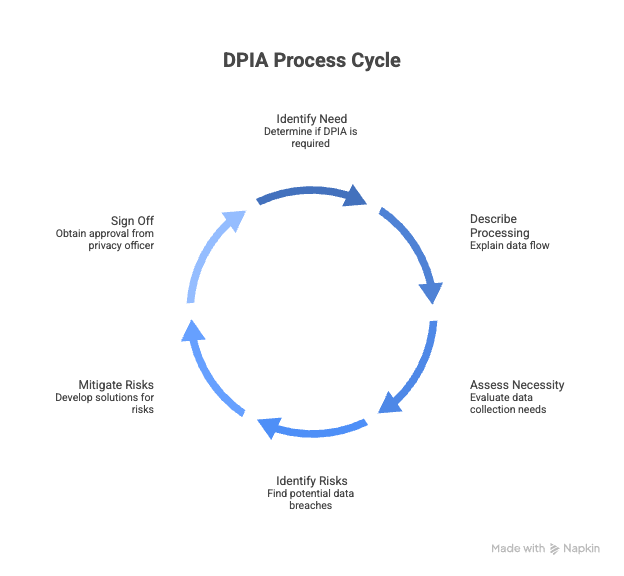
When using any of the tools for data protection impact assessments (DPIAs) mentioned above, you will typically follow these steps:
- Step 1: Identify the Need. Decide if the project involves high-risk data processing.
- Step 2: Describe the Processing. Explain exactly how the data flows through your system.
- Step 3: Assess Necessity. Ask if you really need all the data you are collecting.
- Step 4: Identify Risks. Use your DPIA tool to find potential leaks or security gaps.
- Step 5: Mitigate Risks. Create a plan to address the identified problems.
- Step 6: Sign Off. Have your privacy officer approve the final report.
Conclusion
Choosing the correct DPIA tool for your business is a big decision. It will aid in protecting your company from heavy fines and also strengthen your relationship with customers. Whether you choose a tool like Protecto for its deep automation or OneTrust for its global reach, the goal is the same: keeping data safe.
The best tools for data protection impact assessments (DPIAs) are the ones that fit into your daily workflow without slowing you down. By investing in a high-quality DPIA tool, you ensure that your company remains compliant, ethical, and ready for whatever new privacy laws come next.
Remember, privacy is a journey, and it is necessary to have the right tools to make the trip much smoother.
Frequently Asked Questions
Why is a DPIA tool important for compliance?
A DPA tool ensures that privacy risks are identified early, properly documented, and, more importantly, aligned with laws such as the GDPR. It reduces the chances of regulatory penalties and improves audit readiness.
How does a DPIA tool improve risk management?
A DPIA tool automates risk scoring and highlights potential privacy gaps. This allows teams to implement mitigation measures before launching a project.
How does a DPIA tool support audit readiness?
A good DPIA tool helps companies to maintain a clear audit trail, store documentation centrally, and curate reports that regulators can review without a glitch.
What is the main difference between a DPIA tool and a PIA tool?
A DPIA focuses specifically on data protection risks as per privacy regulations, whereas a Privacy Impact Assessment can be a little broader, depending on the jurisdiction.