
The term “cloud” in the domain of IT infrastructure and computing conjures images of a rather abstract concept for storing data – most don’t know how it works and where it is located. A common misconception is that it lacks a physical location. This, however, is not true – cloud ecosystems operate from servers, and these servers always have a physical location.
Data can travel across borders without any hurdles, unless privacy constraints like government enacted regulations prevent it from doing so. These regulations aim to protect the privacy of their citizens through data residency laws.
What is data residency?
Data residency refers to the physical or geographical location of where data is stored, irrespective of its origin. This includes but is not limited to servers, databases, and even on premise data centers.
With new threats emerging every day, concerns related to data privacy, right to govern personally identifiable information, and confidentiality are also on the rise. Just knowing where your data resides is no longer sufficient to protect it.
These necessitate the need for strong governance and compliance policies, leading to the evolution of data residency laws.
What are data residency laws?
Data residency laws refer to the policies, restrictions, and mandates practices to storing, processing, transmitting, and using data that resides in the data center of a specific country. It is important as the location and processing practices have direct implications on privacy violations and compliance exposure.
For example, if your business is based out of Australia but collects and processes personal data of European residents, the General Data Protection Regulation (GDPR) may apply in your case.
Similarly, if your business collects and processes personal information of Indian residents, the Digital Personal Data Protection Act (DPDP) applies to your IT systems. DPDP is based on the principle of data localization; data of the country cannot leave its boundaries.
The table below gives you a quick summary of data residency laws around the world.
| Law | Origin country | Description | Applies to | Penalty for non-compliance | Data covered | Industries affected | Effective date |
| General Data Protection Regulation (GDPR) | European Union | Regulation safeguarding natural persons’ personal data and governing its free movement across the EU/EEA | Data controllers & processors handling personal data of individuals in the EU, irrespective of the organization’s location | Up to €20 million or 4 % of annual global turnover (whichever is higher) | Any information relating to an identified or identifiable natural person | All industries processing personal data | May 25, 2018 |
| Health Insurance Portability and Accountability Act (HIPAA) (,) | United States | Federal law setting national standards for privacy, security, and breach notification of protected health information (PHI) | Covered Entities (healthcare providers, health plans, clearinghouses) and Business Associates handling PHI | Civil monetary penalties $141–$2,134,831 per violation; criminal fines and imprisonment in cases of willful neglect | Protected Health Information (any individually identifiable health data) | Healthcare providers, insurers, pharmacies, and related service vendors | Privacy Rule: April 14, 2003; Security Rule: April 21, 2005 |
| Digital Personal Data Protection Act, 2023 (DPDP Act) | India | First cross-sectoral law on digital personal data, balancing individual rights with lawful processing needs | Data Fiduciaries processing digital personal data within India | Up to ₹250 crore per violation; tiered fines from ₹50 crore to ₹250 crore depending on breach type | Digital personal data by which a person is identified | All sectors, cross-sectoral applicability | Act Assented: August 11, 2023; Rules implementation pending |
| Personal Information Protection Law (PIPL) | China | Comprehensive framework for processing personal information, requiring local storage for CIIOs and security assessments for cross-border transfers | Personal information handlers, Critical Information Infrastructure Operators, and entities processing Chinese personal data | Fines up to CNY 50 million or 5 % of previous year’s turnover; possible business suspension or license revocation | Personal information: any data identifying an individual | All industries, notably telecom, finance, healthcare, internet services | November 1, 2021 |
| Lei Geral de Proteção de Dados (LGPD) | Brazil | Federal law regulating processing of personal data, inspired by GDPR and strengthening individual rights | Any individual or legal entity processing personal data in Brazil or offering services to Brazilian residents | Up to 2 % of the company’s Brazilian revenue (capped at BRL 50 million) per infraction | Personal data: any information relating to an identified or identifiable person | All industries, with particular focus on sectors handling sensitive personal data | Law Enacted: September 18, 2020; Penalties Enforceable: August 1, 2021 |
Data residency laws are often restricted to specific industries of types of data. Healthcare and financial data tend to be held to a higher level of scrutiny compared to other industries. However, if you don’t handle sensitive private data, it is not a signal to take data privacy lightly. You should still implement security controls to minimize the probability of a breach.
Why are data residency laws important?
In complex environments like multi or hybrid cloud systems, managing data privacy can be challenging, especially as regulations and requirements differ from one country to another. Understanding data residency laws are critical to connect the right data to the policy that applies to it.
Moreover, businesses often struggle to protect their customers’ sensitive data, demonstrate good security practices, or identify gaps. They can benefit from using a reference framework to get started. These regulations are designed to standardize security practices across departments, provide a structured framework for consistently implementing security measures, identify security gaps, and enhance the resilience of IT systems.
Businesses adopt data residency regulations for three reasons: 1) they handle data that fall within the scope of a legal/ government proposed regulation, 2) to unlock sales deals; their customer wants proof of good security practices, or 3) a breach occurred and they want to tighten their security practices.
In the first case, compliance is compulsory. Non compliance can result in hefty penalties, loss of business license, and unnecessary legal hassle.
If you are complying to demonstrate good security practices to potential clients, non compliance won’t land you legal trouble. In the long run, it will be a competitive disadvantage and negatively impact your bottom line.
The third case is a lesson on the importance of taking data governance seriously. Breaches are costly, eat up the bandwidth of IT teams, and set back projects by weeks at best and months at worst. Adopting a security first approach is better than patching issues after they have caused damage.
Understanding similar concepts: data localization and sovereignty
Concepts like data residency, data localization, and data sovereignty are often used interchangeably. While these are somewhat similar in nature and fall under the umbrella of data governance, subtle differences set them apart.
The table below gives you a quick overview of the key differences and similarities.
| Aspect | Data residency | Data localization | Data sovereignty |
| Definition | The physical or geographic location where data is stored or processed. | A legal requirement that specific categories of data must be stored on servers physically located within a jurisdiction. | The principle that data is subject to the laws and governance structures of the country where it resides, regardless of physical location. |
| Legal enforcement | Generally advisory or contractual; often driven by corporate policy or service-level agreements. | Statutorily mandated through national laws or regulations (e.g. Russia’s Personal Data Law, RBI guidelines). | Enshrined in national law or constitutions; may overlap with localization but focuses on jurisdictional authority over data. |
| Data location | Can be anywhere, provided the location is known and tracked for compliance or performance. | Must remain within national borders; cross-border transfers require special approval or mechanisms. | Data may be stored abroad, but any access, transfer, or processing is subject to home-country legal controls and oversight. |
| Control & governance | Governed by data owners’ policies, cloud-provider SLAs, and international standards (e.g., ISO). | Government retains direct control; foreign-hosted services often need local partners or permits. | Sovereign legal systems dictate retention, access rights, encryption standards, and audit requirements—even if data is physically overseas. |
| Flexibility | High: organizations choose any region or provider that meets their requirements. | Low: Providers must maintain infrastructure in each jurisdiction or use approved local hosts. | Medium: data may flow internationally under treaty or adequacy frameworks, but ultimate legal authority remains with the origin country. |
| Objective | Optimize performance, cost, and basic compliance by knowing where data lives. | Protect national interests (security, privacy), foster local economy, and ensure regulatory oversight. | Ensure that citizens’ data is governed by their own laws, protect against foreign surveillance, and uphold national security and privacy norms. |
| Typical examples | Multi-region cloud deployments with documented storage regions (AWS, Azure). | China PIPL local storage for “important data”; RBI’s mandate for payment data in India. | EU’s claim that any data on EU citizens is subject to GDPR no matter where stored; U.S. CLOUD Act asserting access rights abroad. |
| Similarities | All relate to geographic considerations of data. Aim to address privacy, security, and compliance concerns. | All enforce some form of geographic control over data. Often emerge from concerns about cross-border risk. | All acknowledge that data location and jurisdiction impact legal risk and governance. |
| Differences | Mostly policy-driven vs. legal mandate. Focused on visibility rather than restriction. | Legally restrictive, tightly controlling where data must reside. | Emphasizes legal authority and jurisdiction over data, not just physical storage; can permit overseas hosting under legal frameworks. |
How can I comply with data residency laws?
As previously outlined, businesses often struggle to meet regulatory requirements due to gaps in understanding where to start. Here are some simple steps to get started:
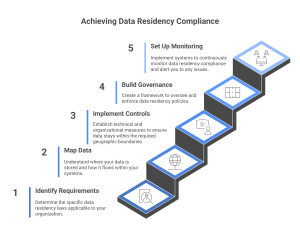
Identify your requirements
While some regulations apply to any business handling sensitive data, your legal obligations may look completely different from others.
Start by evaluating your data landscape to know under which law it falls. Implementing privacy controls is costly and resource-intensive, so we recommend scoping as not every data falls under compliance obligations. Next, identify every country or region where you operate and understand its rules for data storage, processing, and transfer.
Map your data
Once you understand the scope of laws, build a comprehensive inventory of your data. This involves knowing where sensitive data is collected, stored, processed, and transferred across departments, platforms, and third party vendors.
Unless you have conducted a comprehensive data discovery and classification exercise, it’s almost impossible to enforce residency policies correctly.
Implement residency controls
Once you have identified compliant storage and processing locations, conduct a risk assessment to know where compliance gaps exist. Implement the data privacy controls based on high risk items assets. This usually involves geo-fencing data, setting up regional data stores, or using tokenization and encryption tools. The goal is to guarantee that sensitive data doesn’t cross borders it’s not allowed to and can be audited and demonstrated to regulators.
Build a governance framework
Complying with data residency regulations is not a one time project. It requires ongoing governance, establishing policies and procedures for access controls, data transfers at intervals, and regular audits.
Train staff to understand residency rules and their role in upholding them. Make sure every relevant function like compliance teams, IT departments, and engineers understand how their work affects compliance and are held accountable.
Set up automated monitoring and alerting systems
As regulations evolve, so must your controls. Set up a process for continuous monitoring, conducting regular internal audits, and external assessments. A good practice is to use automation where possible to reduce manual workload, comply faster, and patch issues as soon as they arise.
Challenges of data residency laws: navigating international borders
If you are entering new markets, understanding the nuances of the regulatory landscape is critical to future proof your products/services and avoid surprises down the line. Here are some common challenges in adopting data residency laws:
Here are some common challenges businesses face while adopting data residency laws:
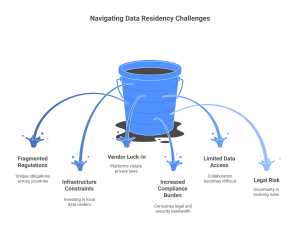
Fragmented global regulations
Every country has its own version of data residency requirements. The EU’s GDPR, India’s DPDP, and USA’s HIPAA – all define personal data differently and impose unique obligations on where data can be stored or transferred.
These fragmented and sometimes contradictory regulations make it extremely difficult for businesses operating globally to maintain a unified data strategy. Companies are often forced to create country specific workflows that quickly become unmanageable.
Infrastructure constraints
Complying with data residency often requires storing and processing sensitive information entirely within the borders of a specific country. For many businesses, this means investing in local cloud infrastructure or building in-country data centers.
Even if you are using a cloud provider like AWS or Azure, ensure that the data never leaves the designated region as this is not always guaranteed by services or APIs. These infrastructure limitations can increase costs significantly and introduce latency or operational inefficiencies in the future.
Vendor lock-in and cloud limitations
Many enterprise tools and platforms, especially those offering AI, analytics, or CRM functions, are not designed with data residency in mind. These vendors often store or process data in regions that violate local data protection and privacy laws.
This puts businesses in a bind: either they switch to local alternatives with fewer features or they attempt to anonymize or tokenize data before using such platforms. Both involve added costs, engineering effort, and potential performance degradation.
Increased compliance burden
Ensuring compliance with data residency laws eats up a significant chunk of legal, security, and engineering teams bandwidth. Businesses must continually audit data flows, map the storage of data, update their privacy policies, and demonstrate compliance during external reviews. Any misstep can snowball into a legal issue or customer backlash.
For startups and mid-sized companies without robust compliance teams, this can add a significant burden on resource drain.
Limited data access across teams
One often-overlooked impact of data residency laws is internal data friction. When teams in different regions are restricted from accessing data stored elsewhere, collaboration becomes difficult.
Product, analytics, or customer support teams may find themselves working with incomplete datasets or delayed access, which slows down decision-making and reduces agility. Data silos grow deeper, and the organization’s ability to innovate or respond to market needs suffers.
Legal risk and uncertainty
Data residency laws are still evolving, and governments frequently update or reinterpret their rules. Businesses face legal uncertainty, especially in regions with opaque enforcement or politically driven policy shifts.
What’s compliant today might become a liability tomorrow. Companies are forced to practice extra caution, invest in legal counsel, and continuously adapt to avoid regulatory exposure. This shifting landscape makes long-term planning extremely difficult.
Comply with data residency laws without compromising data accuracy
By now, you know how data residency works – basically, your data cannot leave the perimeter of a specific country. Businesses that depend on service providers operating outside the country or use platforms hosted outside to process or store data must do so without violating compliance.
Tokenization is one of the most effective ways to address data residency requirements. It replaces sensitive information with random placeholders known as or tokens that have no value or meaning if exposed.
For example, data privacy tools like Protecto take uses AI-driven detection to locate sensitive data across unstructured environments. It separates sensitive data from its context, preserving meaning and structure, so AI and analytics can operate on tokens as if they were working with the original data. Meanwhile, the raw, sensitive data never leaves its residency boundaries, ensuring total compliance.
For multinational businesses grappling with data residency, this approach ensures regulations while enabling global teams and AI systems to extract value from the data using tokens. This protects privacy without crippling the utility of that data.
Schedule a demo or start your free trial to get started today.


