AI or artificial intelligence has significantly altered how we work. From customer support bots to internal copilots, they help teams move faster and smarter. But there is a growing concern that many companies are still not ready for. It is data leakage in AI.
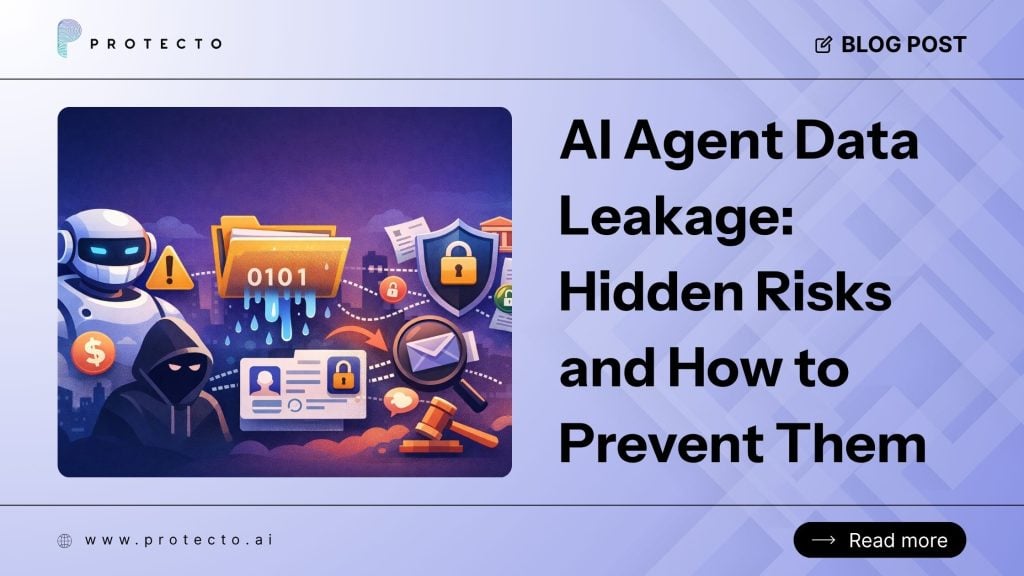
When an AI agent accidentally or unknowingly shares private information with the wrong person or another system, it is called a data leak. When AI systems handle sensitive data, even a small mistake can expose private information. It is not simply a technical issue. It is known to lead to financial loss, legal trouble, and loss of trust.
In this guide, we will look at the hidden risks of AI agents and how to use AI data-leakage prevention strategies to keep your business safe.
What Is AI Data Leakage?
To understand data leakage in AI, we first need to examine how these agents operate. AI agents are software programs that use large language models (LLMs) to perform tasks. To be helpful, they need access to data.
AI data leakage happens when sensitive or private data is exposed through AI systems unintentionally. It can occur either during training, testing, or even while the AI is in use.
It is a form of unintended data exposure. The system may reveal confidential data in responses, logs, or outputs without proper controls in place. It is not uncommon. In fact, according to a Moneycontrol report, employees often accidentally leak company data via AI platforms by pasting it in error.
This is why AI and data leakage are now major concerns for security teams.
Why AI Agents Are a Unique Risk?
Traditional software follows strict rules. AI agents are different. They use “probabilistic” thinking, which means they guess the best answer based on their training. This creates several hidden risks.
1. Training Data Exposure
If an AI agent is trained on private company files, it might remember those details. If a user asks the right question, the AI might repeat a password or a private client name from its training set. This is a common form of AI data leak that is hard to track.
2. Prompt Injection Attacks
People sometimes “trick” an AI platform. By using specific phrases, they can force the AI to ignore its safety rules. This is known as a prompt injection attack, and it can lead the AI to disclose sensitive data it was supposed to keep hidden.
3. Third-Party Plugins
Many AI agents connect to other apps like Slack, Gmail, or Google Drive. Every time an agent moves data between these apps, there is a risk of AI and data leakage. If one app is not secure, the whole system is at risk.
Hidden Risks Most Companies Ignore
Many organizations think basic security is enough. It is not. Here are some hidden risks tied to AI data leakage:
- Shadow AI Usage: Employees use AI tools without approval. This leads to uncontrolled data exposure.
- Poor Access Controls: Without role-based access control, AI agents may access more data than needed.
- Privacy Compliance Gaps: Ignoring compliance requirements can result in serious penalties. This ties into AI privacy, Hidden Data Compliance Risk.
- Lack of Data Classification: If you do not know what data is sensitive, you cannot protect it.
How to Prevent AI Data Leakage?
Protecting your company requires a clear plan for preventing AI data leakage. You cannot just stop using AI; you must learn to use it safely. Here are the best ways to protect your information.
Use Data Masking
One of the most effective ways to stop data leakage in AI is to hide sensitive details before the AI ever sees them. This is known as Data Masking. For example, if a document has a credit card number, the masking tool replaces it with “XXXX.”
The AI can still understand the document’s context without seeing the actual secret numbers. Businesses might feel the cost of a data masking tool is high, but it is justified, as the investment is much cheaper than paying a legal fine after a leak.
Implement Role-Based Access Control
Not every employee needs to see every piece of data. Role-based access control (RBAC) ensures that an AI agent can access only the data it needs for a specific user.
If a junior employee asks an AI agent about executive salaries, the AI should be blocked from finding that data. This is a key part of AI Data Security.
Prioritise Privacy Policies
Many companies rush to use AI and worry about security later. This is a “Privacy Later” mindset. By building security into your AI projects from day one, you avoid the AI privacy hidden data compliance risk that comes with messy, unprotected data sets.
Monitor and Filter Inputs and Outputs
You need to track what goes into and comes out of AI systems. The business needs to scan prompts for any sensitive data, filter the output for restricted content, and set clear rules for safe responses.
Secure AI Integrations
AI tools often connect with other platforms. Hence, it is important to use secure APIs, encrypt the data in transit, and, more importantly, limit third-party access. It will considerably help to prevent data leakage in AI across connected systems.
Regular Audits and Testing
Running security audits at regular intervals is necessary because it helps you see what needs to be fixed. Test AI systems for leakage and simulate attack scenarios to identify the gaps in your AI data leakage prevention strategy.
Train Your Teams
Having the most advanced security is not enough if you do not have competent teams. Your employees first need to understand AI risks before they share sensitive data. Also, it is important to follow all security protocols, as human error is a major cause of AI data leakage.
Common Scenarios Where Leaks Happen
Understanding where AI and data leakage occur can help you stay alert.
- Customer Support Bots: A customer might ask for their order history. If the bot is not configured correctly, it might accidentally show the history of a different customer with a similar name.
- Coding Assistants: Developers often use AI to write code. If they paste a snippet of code that contains an API key or a secret password, that data is now part of the AI’s memory. This is a major source of AI data leaks.
- Internal Analysis: A manager might ask an AI to summarize a meeting. If that meeting included talk of layoffs or new inventions, the AI might share those secrets with other employees who use the same tool.
Conclusion
AI agents can, without a doubt, boost speed and productivity, but they also raise real risks of AI data leakage. The smarter AI data leakage prevention approach is simple. It is necessary to build systems with privacy in mind from day one.
Use strong controls such as data masking and Role-Based Access Control, and continue monitoring how data flows through your AI tools.
Stay safe, stay secure, and use AI responsibly. Protecting your data is not just a tech task; it is a promise to your customers and your employees. With the right plan in place, you can lead your industry in both innovation and safety.
Frequently Asked Questions
Why is AI data leakage a serious risk?
AI data leakage can expose personal, financial, or business-critical information. It can further lead to legal penalties, financial losses, and reputational damage. Hence, AI data leakage prevention is essential for organizations adopting AI technologies.
How does an AI data leak happen in real-world scenarios?
An AI data leak can occur when employees input sensitive data into AI tools or when AI models return confidential information in responses. Improper logging and a lack of data masking also contribute to such risks.
Can generative AI models cause data leakage?
Yes, generative AI models can unintentionally reveal sensitive data from training datasets or user inputs. This makes managing AI and data leakage critical when using large language models.
What industries are most affected by AI data leakage?
Healthcare, finance, and e-commerce industries often tend to face a higher risk of AI data leaks due to the large volumes of sensitive data being shared. Strong AI data leakage prevention is critical in these sectors.