
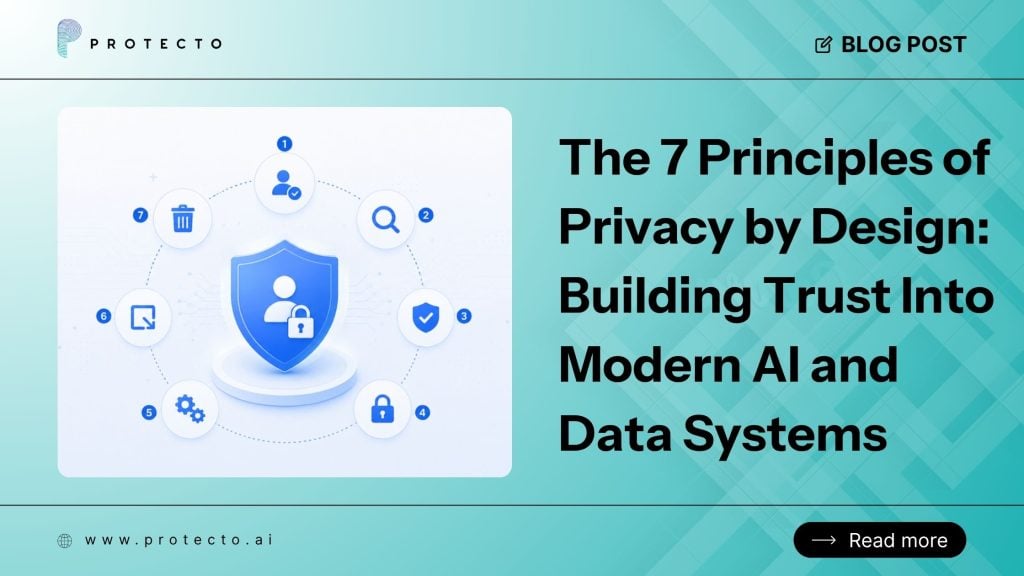
Data privacy is not just a checkbox for compliance requirements. It has become a core business expectation. Customers now want to know how companies collect, store, process, and protect their data. At the same time, global regulations like the GDPR and CCPA have made privacy a critical part of product development.
According to a report by Cisco Consumer Privacy Survey, 99% of companies saw measurable benefits by investing in privacy. There is another Deloitte report indicating that consumers are increasingly opting for brands they can trust, particularly regarding data.
Hence, understanding and implementing the principles of privacy by design becomes very important. Instead of adding privacy controls after a product is built, this approach embeds privacy directly into systems, applications, and workflows.
For AI-driven businesses, adopting the 7 principles of privacy by design helps reduce risks, improve transparency, and strengthen long-term customer confidence.
The Seven Principles of Privacy by Design
The well-known seven principles of privacy by design are meant to act as a guide for anyone building a product or service that handles personal data. Let’s look at each one in detail.
1. Proactive, Not Reactive; Preventive, Not Remedial
The first principle mainly focuses on preventing privacy risks before they can actually happen. Organizations need to actively identify vulnerabilities, monitor threats, and secure systems during development rather than react after incidents occur. It includes:
- Running privacy assessments
- Reviewing AI workflows
- Monitoring API activity closely
- Securing cloud environments
- Evaluating risks that can happen due to vendors
A proactive privacy strategy helps in reducing the chances of costly breaches and compliance failures.
Example: An AI chatbot can automatically detect and mask sensitive customer information before sending prompts to any external AI models.
Protecto’s DeepSight – AI-Native Sensitive Data Detection helps organizations discover hidden PII, PHI, and sensitive business information across structured and unstructured datasets. Unlike traditional detection tools, DeepSight can identify context-dependent, fragmented, and obfuscated sensitive information commonly found in AI environments.
2. Privacy as the Default Setting
Users should not have to manually enable privacy protections. Under this principle, systems automatically apply the highest privacy standards by default. This principle aligns closely with global privacy regulations that promote data minimization.
Here is what organizations must do:
- Collect minimal data
- Restrict unnecessary tracking
- Limit data sharing
- Automatically secure user information
In fact, as per OECD’s report, consumer concerns around digital privacy continue to influence online behavior and purchasing decisions globally.
3. Privacy Embedded Into Design
Privacy should become part of the system architecture itself, not an afterthought. Companies need to integrate strict security and privacy controls into product development, AI pipeline models, cloud systems, databases, and enterprise applications.
It helps in reducing operational complexity later on.
Example: An AI coding assistant can remove API keys as well as sensitive credentials from prompts before storing the logs. This demonstrates how the privacy by design framework works within AI operations.
4. Full Functionality; Positive-Sum, Not Zero-Sum
Privacy and innovation need to work together rather than compete against each other. Many businesses tend to make a mistake by believing that stronger privacy controls can also lead to reduced system performance or poor customer experience. This principle rejects that assumption.
Businesses can simultaneously support:
- Security
- Innovation
- Compliance
- Performance
- Customer experience
For organizations building conversational AI systems, AI-powered customer support, or AI automation platforms, balancing privacy with usability is important, as studies from the World Economic Forum show that digital trust is a major influencing factor when it comes to customer loyalty.
Privacy by Design Example:
A banking AI assistant is known to offer personalized financial recommendations while using data masking or tokenization, which helps to protect customer identities. This principle essentially explains exactly how the privacy by design framework supports both privacy and functionality simultaneously.
5. End-to-End Security and Lifecycle Protection
Privacy protection needs to continue throughout the entire data lifecycle. Businesses need to secure information during different stages like collection, storage, processing, sharing, archiving, and deletion.
This principle is very important for businesses that manage cloud security, AI monitoring, and enterprise data governance because AI systems constantly move information across environments.
Example: A healthcare AI platform automatically deletes patient records after legally required retention periods while maintaining encrypted backups during active usage. This is one of the strongest healthcare-focused privacy by design examples.
6. Visibility and Transparency
Organizations need to clearly explain how data is collected, processed, stored, and protected. A user must have clear information as to:
- What information is collected
- Why is it collected
- Who can access it
- How long has it been stored
- How is privacy maintained
Transparency is extremely necessary for businesses focused on AI governance frameworks. Clear privacy notices and audit visibility also improve customer confidence.
7. Respect for User Privacy
The seventh principle places users at the center of decisions related to privacy. Businesses, at any cost, have to prioritize a user’s consent, easy opt-out options, privacy-friendly settings, accessible data controls, as well as responsible handling.
Example: An AI recruitment platform enables candidates to review, edit, download, and delete extremely personal data that is used during the hiring process. This approach can drastically improve overall trust while supporting privacy compliance needs.
How Can Businesses Implement a Privacy by Design Framework?
Successfully implementing the 7 principles of privacy by design requires both technical and organizational changes. Here is what businesses can do:
- Conduct Privacy Assessments Early: It is essential to review how data travels across AI systems, APIs, and cloud infrastructure before deployment.
- Strengthen AI Security Controls: Protect prompts, embeddings, datasets, and inference pipelines from exposure.
- Minimize Sensitive Data Collection: Collect information that is only necessary for business operations.
- Monitor Third-Party Vendors: Check integrations and external tools on a regular basis.
- Automate Privacy Monitoring: Use AI-driven monitoring systems to help identify risks at a faster rate.
- Train Internal Teams: Engineering, security, compliance, and operations teams need to be aware of privacy responsibilities in a clear way.
Organizations increasingly use public and private LLMs to support productivity, customer service, analytics, and automation. However, sensitive information can accidentally appear in prompts, uploaded documents, and generated outputs.
Protecto’s GPTGuard – Data Loss Prevention (DLP) for AI Chat helps organizations identify and mask sensitive information before it reaches AI models. This enables businesses to adopt AI while maintaining privacy, compliance, and data governance standards.
Enterprise Checklist for Implementing the Principles of Privacy by Design
Successfully applying the principles of privacy by design requires more than technical safeguards. Organizations need a structured approach that combines governance, security, and continuous monitoring. Before launching any application or AI system, use this checklist:
- Conduct a Privacy Impact Assessment (PIA) during the design phase.
- Map how personal data flows across applications, APIs, and third-party tools.
- Collect only the minimum data required for the intended purpose.
- Encrypt sensitive data both at rest and in transit.
- Apply role-based access controls and the principle of least privilege.
- Continuously monitor AI systems for sensitive data exposure and policy violations.
- Define clear data retention and secure deletion policies.
- Regularly audit privacy controls to ensure ongoing compliance with evolving regulations.
Common Mistakes Organizations Make When Applying Privacy by Design
Many organizations claim to follow the privacy by design framework, but common implementation mistakes can reduce its effectiveness. Some of the most frequent pitfalls include:
- Treating privacy as a compliance requirement instead of embedding it into product and system design.
- Collecting excessive personal data “just in case” rather than following data minimization principles.
- Relying solely on default cloud security settings without implementing additional privacy controls.
- Failing to assess the privacy and security practices of third-party vendors and technology partners.
- Overlooking AI-specific risks, such as prompt leakage, sensitive training data exposure, and insecure model interactions.
- Delaying privacy impact assessments until after development instead of addressing risks during the design phase.
- Working in silos, where engineering, security, legal, and compliance teams do not collaborate, leads to inconsistent privacy practices across products and workflows.
Conclusion
Creating a world where data is safe requires a shift in how we think about technology. The principles of privacy by design give us a roadmap to get there. By being proactive, making privacy the default, and keeping things transparent, we can build a digital future that respects everyone.
Whether you are looking at privacy by design examples or building your own privacy by design framework, the goal is always the same: keep the user safe.
Following the 7 principles of privacy by design is the best way to ensure that innovation and privacy go hand in hand. It is time for every organization to make these principles a part of its DNA.
FAQs on Principles of Privacy by Design
What are the famous 7 principles of privacy by design?
The well-known 7 principles of privacy by design are proactive privacy, privacy by default, embedded privacy, full functionality, lifecycle security, transparency, and user-centric privacy protection.
Why are the principles of privacy by design important?
The principles of privacy by design help organizations reduce data risks, improve compliance, strengthen cybersecurity, and build customer trust from the start.
How does privacy by design support GDPR compliance?
The principles of privacy by design align with GDPR Article 25, which requires organizations to implement data protection by design and by default.
How does privacy by design help AI systems?
The privacy by design framework helps AI systems aim to protect sensitive prompts, secure training data, reduce exposure risks, and improve responsible AI governance.
How does privacy by design improve cybersecurity?
The principles of privacy by design strengthen cybersecurity by minimizing exposure of data, improving access controls, and securing information through the entire lifecycle.

