
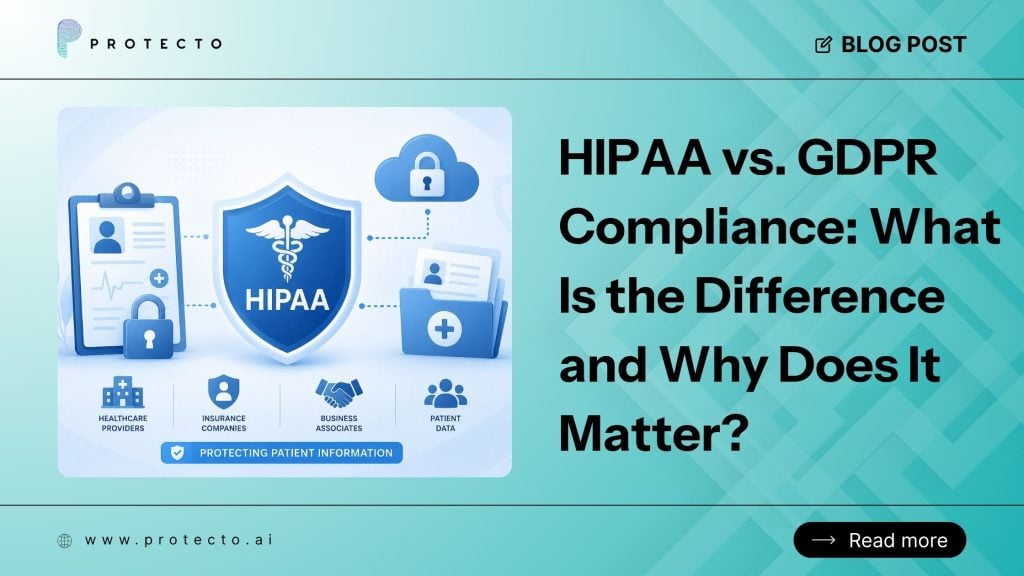
For any business now, data privacy is no longer a legal issue. Companies today collect massive amounts of customer information through AI tools, healthcare apps, SaaS platforms, analytics systems, and cloud services.
This has led organizations to take global privacy laws more seriously. This is even more important when it comes to the concept of GDPR vs HIPAA compliance requirements.
While both HIPAA and GDPR focus on protecting sensitive information, they are built for different industries, regions, and use cases. Businesses operating internationally often struggle to understand which law applies, what data is protected, and how compliance requirements differ.
Given that businesses are now using AI-powered systems on a larger scale, maintaining data privacy is a top priority. This is more concerning, as according to IBM’s Cost of a Data Breach Report, the global average cost of even a single data breach reached $4.88 million.
We will break down the concept of HIPAA vs GDPR compliance. Explain the key difference, and also explain how organizations can stay compliant in a rapidly changing digital environment.
What Is HIPAA?
HIPAA essentially stands for the Health Insurance Portability and Accountability Act. It was passed in 1996 in the US. The main goal of HIPAA is to protect “Protected Health Information” (PHI). This includes things like your medical records, doctor’s notes, and insurance details.
HIPAA does not apply to everyone. It just applies to “Covered Entities” like doctors, hospitals, and health insurance companies. It also covers “Business Associates,” which are companies that offer services to healthcare providers. Such service may include cloud storage or billing software. If you handle US patient data, you must follow HIPAA.
What Is the GDPR?
The General Data Protection Regulation, or its abbreviation GDPR, is a much newer law. It started in the European Union (EU) in 2018. Unlike HIPAA, the GDPR is not just for healthcare. It covers all “Personal Data.” This means anything that can identify a person, like their name, email, IP address, or even their physical location.
The GDPR is very broad. It applies to any company in the world that handles the data of people living in the EU. Even if your office is in New York, you must follow the GDPR if you have customers in Paris or Berlin. This is why GDPR vs HIPAA compliance is a common topic for global tech companies.
What Are the Core Differences Between GDPR and HIPAA?
Businesses tend to compare GDPR vs HIPAA compliance requirements as both regulations focus on protecting sensitive information. However, the laws differ significantly in scope, enforcement, user rights, and compliance obligations. HIPAA is designed specifically for the US healthcare industry, while GDPR protects the personal data of EU residents across all industries.
Understanding the differences between GDPR and HIPAA helps an organization build the right privacy, security, and AI governance strategies. The table below clearly explains the core distinctions.
| Feature | GDPR | HIPAA |
| Full Form | General Data Protection Regulation | Health Insurance Portability and Accountability Act |
| Region | European Union | United States |
| Main Purpose | Protects personal data and the privacy rights of EU residents | Protects healthcare information and patient privacy |
| Industry Coverage | Applies across all industries | Applies mainly to healthcare organizations |
| Protected Data | Covers all personal data, including names, emails, IP addresses, biometric data, and financial records | Covers Protected Health Information (PHI) only |
| Applies To | Any organization processing EU resident data | Healthcare providers, insurers, and business associates |
| Consent Rules | Requires clear, informed, and freely given consent | Allows some healthcare data sharing without direct consent for treatment and operations |
| User Rights | Includes the right to access, erase, transfer, and restrict data | Mainly allows access to medical records |
| Breach Reporting Timeline | Requires reporting within 72 hours | Requires reporting within 60 days |
| Maximum Penalties | Up to €20 million or 4% of annual global revenue | Civil and criminal penalties depending on severity |
| Data Minimization | Strong emphasis on collecting only necessary data | Less detailed compared to GDPR |
| International Reach | Applies globally if EU data is processed | Primarily applies within the US healthcare sector |
| AI and Automation Impact | Strict rules around profiling and automated decision-making | Focuses more on healthcare data security controls |
| Enforcement Authority | It is enforced by EU data protection authorities | It is enforced by the US Department of Health and Human Services |
| Compliance Focus | Transparency, accountability, and privacy rights | Security, confidentiality, and healthcare privacy |
The discussion around the concept of HIPAA vs. GDPR has become very important as AI systems now process both healthcare and personal data on a large scale. Organizations using AI chatbots, analytics systems, cloud platforms, and automation tools often need to comply with both frameworks simultaneously.
This is why businesses increasingly invest in data masking, AI governance, encryption, and compliance automation to reduce privacy risks.
Protecto’s AI Data Privacy & Compliance approach helps organizations address multiple regulatory frameworks through centralized privacy controls, tokenization, audit trails, policy enforcement, and sensitive data protection. This simplifies compliance efforts while supporting secure AI adoption across regulated industries.
Why AI Has Changed the Compliance Conversation?
AI has completely changed how businesses collect, process, and store data. While AI improves speed and automation, it also creates new privacy and compliance risks that many organizations were never designed to handle.
Today’s AI systems can unintentionally expose a lot of sensitive information through AI prompts, chat histories, logs and embeddings, vector databases, and training datasets. A single unsecured AI workflow can leak customer, financial, or healthcare data within seconds.
This growing risk is also affecting customer trust. According to Cisco’s 2025 Data Privacy Benchmark Study, 94% of organizations said consumers would avoid buying from companies with weak data protection practices.
To reduce any type of risk, businesses are now investing heavily in smarter AI governance strategies, including:
- Data masking to hide sensitive information
- Tokenization for safer AI processing
- AI observability to monitor model behavior
- Sensitive data discovery across various AI pipelines
- Compliance automation for faster audits and reporting
Protecto’s DeepSight – AI-Native Sensitive Data Detection helps organizations identify sensitive information across structured and unstructured data sources. Unlike traditional pattern-based tools, DeepSight can detect context-dependent, fragmented, and obfuscated sensitive information, helping businesses reduce hidden compliance risks before they become regulatory issues.
Best Practices for Meeting HIPAA and GDPR Requirements
Organizations handling sensitive data must build strong privacy and security processes to meet both GDPR and HIPAA compliance requirements more effectively. A structured approach makes compliance easier and reduces long-term risk.
1. Identify Sensitive Data
Businesses need to first locate where personal or healthcare data exists. It can include cloud storage, AI systems, databases, APIs, and logs.
2. Limit Data Collection
Collect essential information that is necessary for business operations. This supports data minimization and lowers exposure risks.
3. Monitor AI and User Activity
It is also necessary to track access logs, AI prompts, and data movement on a continuous basis to detect unusual behavior quickly.
4. Use Strong Encryption
Businesses must encrypt sensitive data both at rest and during transfer to prevent unauthorized access.
5. Automate Compliance Controls
Use tools for different aspects like data masking, audit logging, and compliance monitoring to simplify reporting as well as improve security readiness.
Managing Compliance Risks in AI-Powered Environments
Modern AI systems create new compliance challenges because sensitive information can appear in prompts, logs, vector databases, AI outputs, training datasets, and enterprise chat platforms.
Protecto’s GPTGuard – Data Loss Prevention (DLP) for AI Chat helps organizations prevent sensitive information from reaching public LLMs by masking confidential data before it leaves the enterprise. By combining Privacy Vault and DeepSight, organizations can strengthen both HIPAA and GDPR compliance while safely leveraging AI technologies.
Conclusion
Understanding GDPR vs HIPAA compliance is essential for businesses handling sensitive healthcare or personal data. While HIPAA focuses on healthcare privacy in the US, GDPR provides a much broader protection for personal data.
As AI and cloud technologies continue to grow, compliance is now becoming more complex and more important. Businesses that prioritize strong data security, AI governance, and privacy-first practices will not only reduce regulatory risks but also help build long-term customer trust.
Frequently Asked Questions
What is the main difference between GDPR and HIPAA?
The main difference between GDPR and HIPAA is that GDPR protects all personal data in the EU, while HIPAA specifically protects healthcare information in the United States.
Does GDPR apply to healthcare organizations?
Yes, GDPR applies to healthcare organizations if they process personal data belonging to EU residents. The data includes patient records, appointment information, and medical histories.
Which regulation is stricter, GDPR or HIPAA?
Many businesses consider GDPR as more strict as it applies across a large range of industries; however, it offers more comprehensive privacy rights and imposes larger penalties for non-compliance violations.
What industries are covered under HIPAA?
HIPAA mainly applies to healthcare providers, insurance companies, healthcare clearinghouses, and businesses that deal with patient health information.
How can AI impact GDPR and HIPAA compliance?
AI systems can expose sensitive data via prompts, logs, training datasets, and analytics pipelines, thereby increasing compliance and governance challenges significantly.


