
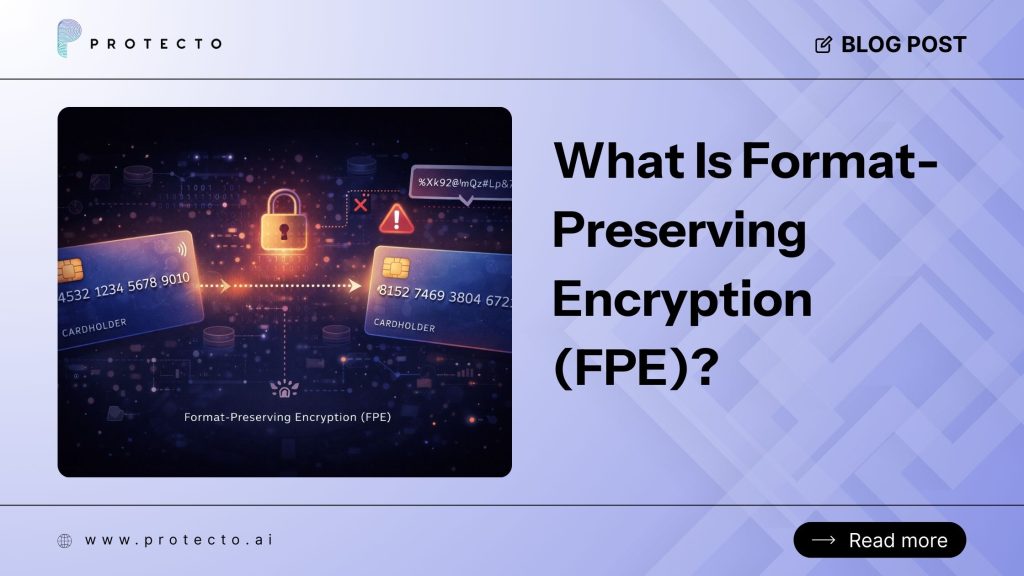
Your database stores a credit card number: 4532 1234 5678 9010.
You encrypt it for security. Now it looks like this: %Xk92@!mQz#Lp&7.
Problem. Your payment system can’t process that. It expects a 16-digit number. Your billing software breaks. Your downstream analytics fail. Your whole pipeline comes to a halt.
This is the exact problem that format-preserving encryption was built to solve.
What Is Format-Preserving Encryption?
Format-preserving encryption, or FPE, is a type of encryption in which the output matches the input exactly.
Same length. Same structure. Same character type.
If you encrypt a 16-digit credit card number using FPE, you get back a 16-digit number. Not random symbols. Not binary code. A 16-digit number that looks just like the original but carries zero real information.
That’s the core idea behind format-preserving encryption. You protect the data without changing its shape.
Traditional encryption doesn’t work this way. Standard encryption algorithms, such as AES, produce binary ciphertext. That output is completely unstructured. It has no relationship to the original data’s format. This is fine for storing files. But it breaks most real-world systems that expect data in a specific format.
FPE encryption was designed specifically to protect data that needs to stay usable inside existing systems.
What Does FPE Mean in Plain Terms?
Let’s break it down.
Format means the structure of the data. A US phone number has 10 digits. A Social Security Number has 9. A ZIP code has 5. A credit card number has 16.
Preserving means keeping that structure exactly as-is after encryption.
Encryption means the actual values inside that structure are scrambled and unreadable to anyone without the key.
So when you ask what FPE means, the simplest answer is: your data gets protected, but its shape stays the same.
A phone number like 512-456-7890 becomes something like 783-219-4056 after FPE. Still 10 digits. Still formatted correctly. But the real number is gone.
Why Was FPE Encryption Created?
The problem with traditional encryption is architectural.
Standard block ciphers operate on fixed-size blocks of data, usually 64 or 128 bits. They treat the input as a binary string. The output is also a binary string of the same block size. There’s no concept of “keep this as a 16-digit number” or “keep this formatted as an email address.”
This creates a hard limitation. Most enterprise systems, databases, and applications were built around data in specific formats. A CRM expects a phone number field. A payment processor expects a card number. A healthcare database expects a patient ID in a specific structure.
If you encrypt those values with traditional encryption, the systems break.
FPE encryption was developed to close this gap. It lets you encrypt sensitive data at rest or in transit without breaking the surrounding infrastructure.
This matters most in three areas:
- Financial systems. Credit card numbers, account numbers, and payment card data need to be protected, but also flow through payment terminals, processors, and banking systems that expect structured numeric input.
- Healthcare records. Patient IDs, insurance numbers, and other identifiers follow strict formats defined by healthcare standards. Changing that format breaks interoperability across systems.
- Databases and data pipelines. Encrypted data must match the column schema of the original. If the column expects a 9-character string, FPE produces an encrypted 9-character string.
How Does FPE Encryption Actually Work?
At its core, FPE uses a concept called an alphabet.
An alphabet, in this context, is just the set of valid characters for a given field. For a credit card number, the alphabet is digits 0 through 9. A cardholder’s name can include uppercase letters, spaces, and certain symbols. For a hexadecimal field, the alphabet includes digits 0 through 9 and letters A through F.
FPE maps each character in the original data to a number within that alphabet. It then encrypts those numbers using a cipher. The output numbers are mapped back to characters within the same alphabet. The result is encrypted data that uses the same character set and has the same length as the original.
This is why an FPE-encrypted credit card number appears as another valid-looking credit card number. The output is constrained to the same alphabet as the input.
The most widely used FPE algorithms are defined by NIST (National Institute of Standards and Technology) under the FFX family:
FF1 uses AES as the base cipher with either a 128-bit or 256-bit key. It uses a variable-length Feistel network and a tweak string to add extra randomness.
FF2 and FF2.1 are similar but only support 128-bit AES keys.
All three algorithms take the alphabet size as a parameter, encrypt within that alphabet, and produce output that remains within the same character set.
A simpler way to picture it: imagine a substitution cipher, but instead of using simple letter swaps, it uses AES-grade mathematical operations. The output is cryptographically secure and completely indistinguishable from random data within that format.
Where Is Format-Preserving Encryption Used?
FPE shows up in several high-stakes environments.
Payment card industry. Visa’s Format-Preserving Encryption standard, known as VFPE, is used to protect Primary Account Numbers (PAN), cardholder names, and track data from payment card magnetic stripes and chips. The encrypted card data flows through the same infrastructure as normal card data because it looks identical.
Tokenization for data lakes. Large-scale data warehouses often need to anonymize millions of records without breaking the schemas that analytics tools depend on. FPE lets teams replace real identifiers with encrypted ones that fit the same columns.
Healthcare data pipelines. PHI, like patient IDs and insurance numbers, can be FPE-encrypted before being passed to analytics systems, research pipelines, or third-party tools, without reformatting the data.
AI and machine learning workflows. Training data and inference pipelines often contain sensitive information. FPE protects data before it reaches an AI model, preserving its structure so the model can still reason accurately.
FPE vs. Traditional Encryption: The Key Differences
Here is the clearest comparison:
| Traditional Encryption | Format-Preserving Encryption | |
| Output format | Binary/random ciphertext | Same format as input |
| Length | Often changes | Always preserved |
| System compatibility | Often breaks existing systems | Fully compatible |
| Use case | File/data storage | Structured data in live systems |
| Common algorithms | AES-CBC, RSA | FF1, FF2, VFPE |
The trade-off with FPE is that the encryption domain is smaller. When the output must stay within a limited alphabet, there are fewer possible values. This makes FPE slightly more complex to implement securely. That’s why standardized algorithms like FF1 and the NIST FFX family matter so much. They ensure the encryption remains cryptographically strong even within constrained output domains.
How Protecto Uses Format-Preserving Encryption for AI Pipelines
Most encryption tools were built for data at rest. Files, databases, archived records.
AI pipelines are different. Data flows in real time. It moves through prompts, agent responses, RAG workflows, and multi-step reasoning chains. Sensitive information appears mid-sentence, mixed with other text, sometimes in multiple languages at once.
Protecto was built specifically for this environment.
When sensitive data enters an AI pipeline, Protecto’s DeepSight engine detects PII, PHI, and financial data in real time. This includes structured data like credit card numbers and phone numbers, as well as unstructured data inside free-form text.
For structured fields, Protecto applies format-preserving tokenization. A credit card number gets replaced with another valid-looking number. A phone number gets replaced with another properly formatted phone number. The LLM receives data that looks real but contains no actual sensitive information.
This is critical for two reasons.
First, the AI model continues to reason accurately. Because the masked data preserves the format and semantic structure of the original, the model’s output maintains high quality. Protecto claims over 85% cosine similarity between responses generated on real data versus masked data.
Second, the original data never leaves your jurisdiction. For Indian enterprises operating under DPDP, or banks operating under PDPL or SAMA requirements, this is not optional. Protecto’s Privacy Vault stores the real values in-country and issues format-preserving tokens that can safely travel to global LLMs.
FPE is one of the key techniques that makes sovereign AI actually work in practice. The AI sees structured, realistic data. The sensitive values stay locked inside the vault.
Top Threats in LLM Security & How to Mitigate Them.
Frequently Asked Questions
What is format-preserving encryption in simple terms?
It is a type of encryption where the output keeps the same length, structure, and character type as the input. A 16-digit credit card number encrypted with FPE produces another 16-digit number.
What is the difference between FPE and tokenization?
Tokenization replaces sensitive data with a random placeholder stored in a lookup table. FPE mathematically encrypts the data so the output is a valid value within the same format. Both protect data, but FPE is reversible with a key while tokenization requires the lookup table.
Is format-preserving encryption secure?
Yes, when implemented using approved algorithms like FF1 or FF2 based on AES. NIST has standardized these algorithms. The encryption is as strong as the underlying cipher, even within a constrained alphabet.
What does FPE mean for DPDP compliance in India?
Under India’s DPDP Act, personal data must be protected and kept within Indian jurisdiction when required. FPE allows enterprises to encrypt sensitive fields before sending data to global AI models, so real personal data never crosses borders while AI workflows continue uninterrupted.
Where is FPE encryption commonly used?
FPE is most common in payment systems for encrypting card numbers, healthcare databases for protecting patient identifiers, and AI pipelines where structured sensitive data must be masked without breaking downstream systems.
