
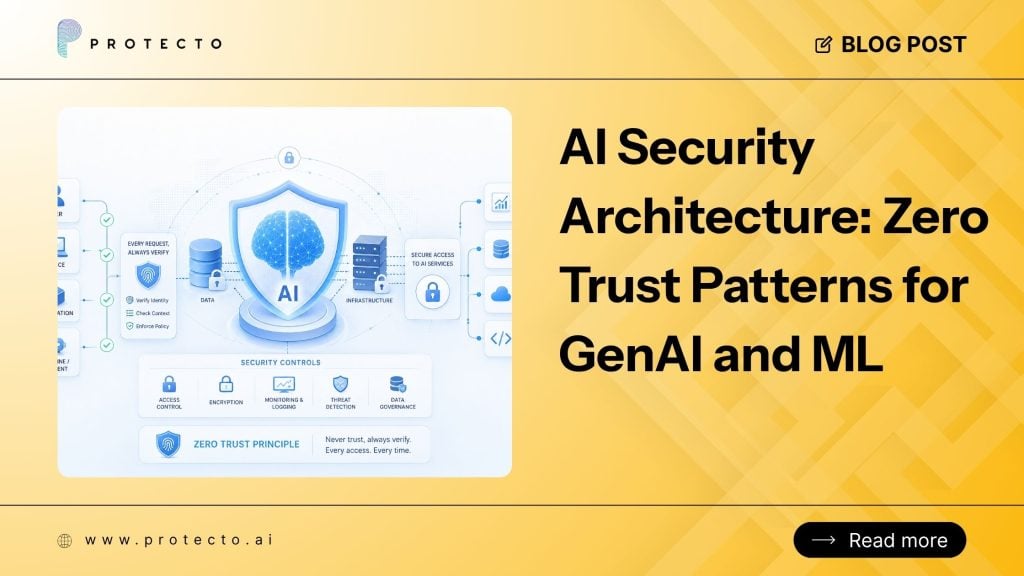
There is no doubt that AI, or Artificial Intelligence, is rapidly changing how businesses are operating. However, it also brings new risks when it comes to data.
As per industry reports, 72% of companies mention that there has been a significant increase in organizational cyber risks. It is therefore necessary to have a strong AI security architecture that helps to protect sensitive information.
In light of this, 85% of organizations are now increasing their cybersecurity budget. Hence, Businesses exploring secure AI adoption can also learn from topics like Generative AI Security and AI Context Security. These areas are becoming essential for enterprise AI safety.
In this article, we are going to explain how Zero Trust works in AI environments, why it matters for GenAI and ML systems, and how companies can improve their AI security framework and AI infrastructure security using practical security strategies.
What is AI Security Architecture?
An AI security architecture is essentially a detailed plan that aims to protect AI models, the data that is used, and the systems they run on. Think of it like a high-tech security system for a digital brain.
It ensures that only the right people can access the AI and that the information going in and out is safe. When we talk about AI infrastructure security, we are looking at the servers and cloud tools that hold the AI.
In the past, security was like a wall around a castle. Once you were inside, you were trusted. But with AI, data moves around a lot. This is why we use Zero Trust.
Zero Trust means “never trust, always verify.” Every time a user or a machine tries to talk to the AI, they must prove their identity. This is why Zero Trust has become a foundational component of modern AI security architecture.
Protecto’s CBAC (Context-Based Access Control for AI Agents) extends Zero Trust principles to AI systems by making real-time access decisions based on identity, purpose, and operational context. Instead of granting broad access through static roles, CBAC evaluates every request when an AI agent attempts to access data.
Why Zero Trust Is Important for GenAI and ML?
Zero Trust is based on a simple idea: never trust anything automatically. Every user, device, application, and AI system must be verified before getting access. This approach works especially well for AI because modern AI tools often:
- Access sensitive company data
- Connect to multiple cloud services
- Use external plugins and APIs
- Handle confidential prompts
- Support autonomous AI agents
- Operate across different environments
Without proper controls, a single weak connection can expose an entire AI ecosystem. A Zero Trust-based AI security architecture helps organizations reduce risks by continuously checking identities, permissions, and activities.
Core Pillars of the AI Security Framework
To build a good AI security framework, we need to focus on three main areas: protecting the data, securing the model, and monitoring the activity.
1. Data Privacy and Sovereignty
Data is the fuel for AI. If the fuel is dirty, the engine breaks. In an AI security architecture, we must ensure that data masking is done for sensitive information, such as names or credit card numbers, so that it stays hidden.
It is important to maintain high AI infrastructure security. It is also important for staying compliant with laws in different regions.
2. Model Integrity
The “brain” of the AI is the model. Hackers might try to “poison” the model by giving it bad data. A strong AI security architecture checks the data before it enters the system. It also makes sure no one can change the model’s settings without permission. If the model is compromised, the whole AI security framework fails.
3. Access Control
Not everyone in a company needs to see everything. Using Context-Based Access Control (CBAC), companies can decide who sees what based on their job and the situation. This is a key part of an AI security framework. It ensures that even if one person’s account is hacked, the hacker cannot access the entire AI system.
Zero Trust Patterns for Machine Learning
Modern businesses are using Zero Trust strategies to improve their AI security architecture and protect GenAI and machine learning systems from cyber threats. Unlike traditional security models that automatically trust users inside a network, Zero Trust follows a simple principle: verify everything before granting access.
Micro-Segmentation
Micro-segmentation divides systems into smaller protected zones. It helps to make sure that applications using AI only access approved resources rather than accessing the entire network.
For example, a customer support chatbot does not need access to payroll systems, while an AI coding assistant should not be allowed to change production environments. It helps to limit the spread of attacks and reduces security risks.
Context-Aware Access Control
Modern AI security also considers context before granting access. Security systems evaluate factors such as user role, device type, location, risk level, and the sensitivity of the data. It will help organizations to block unusual or unauthorized access attempts automatically.
Continuous Verification
In a Zero Trust model, users and applications are not trusted completely. Security systems verify device health, user activity, session behavior, as well as login locations on a continuous basis.
In case any suspicious behavior is detected, access can be restricted immediately. This strengthens the overall AI security framework and helps businesses identify threats faster.
Secure Prompt Management
Prompt injection is one of the biggest security risks in GenAI systems. Attackers may try to manipulate prompts to bypass restrictions or expose sensitive information.
To reduce these risks, organizations should filter prompts, validate external inputs, monitor prompt activity, and limit model permissions. Secure prompt handling has become an essential part of every strong AI security architecture.
Protecto’s GPTGuard – Data Loss Prevention (DLP) for AI Chat helps organizations prevent sensitive information from being exposed to public or private LLMs. GPTGuard identifies and masks confidential information before it leaves the enterprise, preserving context while supporting secure AI adoption across multiple AI models and RAG environments.
Implementing the AI Security Architecture
Businesses should use a layered security strategy. Here is how businesses can implement AI security Architecture:
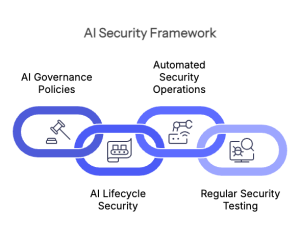
Step 1: Create Clear AI Governance Policies
Strong AI governance creates the foundation for a successful AI security framework. Hence, every company should clearly define:
- AI usage rules
- Risk ownership
- Policies for data handling
- Vendor security standards
- Compliance requirements
Step 2: Protect the Entire AI Lifecycle
Many businesses focus only on deployment security and ignore other stages. Security should cover every stage of AI development. Hence, the focus needs to be on every stage:
- Data collection
- Model Training
- Testing
- Deployment
- Monitoring
- Retirement
Step 3: Automate Security Operations
AI environments are large and complex. Automation helps security teams respond faster. Some of the useful security automation tools include real-time threat detection, risk scoring, automated policy enforcement, security orchestration, and compliance monitoring.
Step 4: Perform Regular Security Testing
Testing at regular intervals will lead to strong AI infrastructure security and improve resilience. Organizations should regularly test AI systems for weaknesses. Security teams can simulate:
- Prompt injection attacks
- Data leakage attempts
- Unauthorised access
- Adversarial inputs
Secure RAG and AI Data Pipelines
Many GenAI systems rely on Retrieval-Augmented Generation (RAG) architectures that connect models directly to enterprise knowledge sources. Without proper safeguards, sensitive information can be exposed through vector databases, prompts, retrieval layers, or generated outputs.
Protecto’s Secure RAG approach helps organizations protect data throughout the AI workflow by masking sensitive information before storage in vector databases and before LLM prompt construction. Combined with Privacy Vault, CBAC, and GPTGuard, organizations can create secure AI pipelines that support innovation without sacrificing security or compliance.
Conclusion
AI is definitely transforming industries at a rapid pace, but it is also creating new security challenges. Traditional cybersecurity methods are no longer enough for modern AI systems. A strong AI security architecture built on Zero Trust principles helps businesses secure AI models, prompts, cloud systems, APIs, data, and AI agents.
At the same time, companies must improve their AI infrastructure security and adopt a reliable AI security framework that supports compliance, governance, and secure innovation.
Organizations that focus on AI security today will reduce risks, protect sensitive data, and build more trustworthy AI systems for the future.
Frequently Asked Questions
What is AI security architecture?
AI security architecture is essentially a set of tools, policies, and controls that protect AI systems, data, models, APIs, and users from cyber threats and unauthorized access.
How does Zero Trust improve AI security architecture?
Zero Trust aims to improve AI security architecture by limiting access, verifying identities continuously, monitoring activity, and reducing the number of unauthorized accesses or even data exposure.
How does AI infrastructure security protect businesses?
AI infrastructure security protects cloud systems, APIs, containers, databases, as well as AI workloads from threats like cyberattacks, unauthorized access, and operational disruptions.
How can businesses secure AI agents?
Businesses can secure AI agents by limiting permissions, monitoring activities regularly, filtering outputs, and restricting access to sensitive systems/ data, as well as external tools.
How can organizations prevent AI data breaches?
Businesses can easily prevent breaches by using encryption, access controls, monitoring, prompt filtering, training employees, and secure AI infrastructure practices.
