
Your organization just deployed a RAG system. Engineers are impressed. Users are getting fast, contextually relevant answers from your internal knowledge base. Everything appears secure. But underneath the surface, your most sensitive data: customer PII, financial records, medical information, trade secrets may already be quietly leaking. Not through a dramatic breach. No failed logins, no traffic spikes, no SIEM alerts. The exposure happens silently, inside your embeddings, and most organizations don’t know it’s happening until it’s too late.
At Protecto, we work with enterprises building AI applications on sensitive data every day. The RAG embedding problem is one of the most underestimated security risks we encounter. This blog explains why it happens and what it takes to fix it.
The Misconception That Creates the Vulnerability
Retrieval Augmented Generation (RAG) works by converting documents into high-dimensional vector embeddings, storing them in a vector database, and retrieving the most semantically relevant chunks at query time to ground LLM responses. The pipeline is powerful and it has a critical flaw that teams consistently overlook.
Many engineering teams assume that because data has been “converted to vectors,” it is no longer sensitive. This is wrong. Vectorization is not encryption. Vectorization is not anonymization. When you embed a document, you are not destroying its information, you are compressing and preserving its semantic meaning in mathematical form. And that meaning can be reconstructed.
Research on embedding inversion attacks confirms that a generative model can take vectors as input and recover near-exact reproductions of the original source text. One study found that a single data point is sufficient for a partially successful inversion, and with as few as 1,000 samples, reconstruction reaches near-optimal accuracy across black-box encoders. OWASP formalized this risk in LLM08:2025 is Vector and Embedding Weaknesses, recognizing it as one of the top threats in modern RAG AI deployments.
Where Sensitive Data Escapes in the RAG Pipeline
RAG data privacy risks don’t live in one place. At Protecto, we see exposure points at every stage of the pipeline, not just the LLM layer.
- At Ingestion: Teams embed large document corpora under delivery pressure without PII protection in place first. Customer records with SSNs, HR files with salary data, internal documents with API keys, all indexed into the vector store with no data loss prevention gate. Once embedded, that content is retrievable by anyone whose query is semantically similar enough to trigger a match.
- At Vector DB: Most RAG deployments lack the access controls teams would never skip in a relational database. Shared indexes, absent namespace isolation, no row-level security, these turn your vector store into an unsecured data warehouse. Unlike SQL databases, vector database security cannot rely on standard RBAC patterns without purpose-built tooling, because queries resolve by semantic similarity rather than structured access rules.
- At Retrieval, top-K similarity search does not distinguish between “most relevant” and “authorized for this user.” A support agent asking about pricing could receive chunks containing internal margin data simply because the vectors are semantically adjacent. Without retrieval-time authorization filtering, similarity search becomes a path of least resistance for data exposure.
- At Context Window: Retrieved chunks are injected directly into the LLM prompt making sensitive content visible to the model, included verbatim in responses, and logged in API call history. Unscreened content also creates an indirect prompt injection vector: malicious documents planted in your knowledge base can execute instructions inside the LLM context when retrieved.
- In Multi-tenant deployments, without strict namespace or collection boundaries, one tenant’s query can surface documents belonging to another. For any RAG service handling multiple clients or business units, this cross-contamination risk is a compliance incident waiting to happen.
Why Your Existing Security Stack Won’t Catch This
Traditional security tooling operates at the transport and storage layers. It doesn’t operate at the semantic layer which is where RAG data exposure lives.
DLP tools scan file transfers and API payloads for known PII patterns. They don’t inspect float vectors being written to a vector database. Firewalls see encrypted HTTPS traffic to your vector store and LLM provider, they can’t reconstruct what those payloads semantically represent. Encryption at rest protects against storage-layer breaches but does nothing to prevent authorized query-time retrieval of sensitive content. SIEM logs capture metadata and errors, not the fact that a patient’s diagnosis appeared in an LLM prompt today.
Protecting a RAG solution requires purpose-built controls at every stage of the data lifecycle, not perimeter defenses around it.
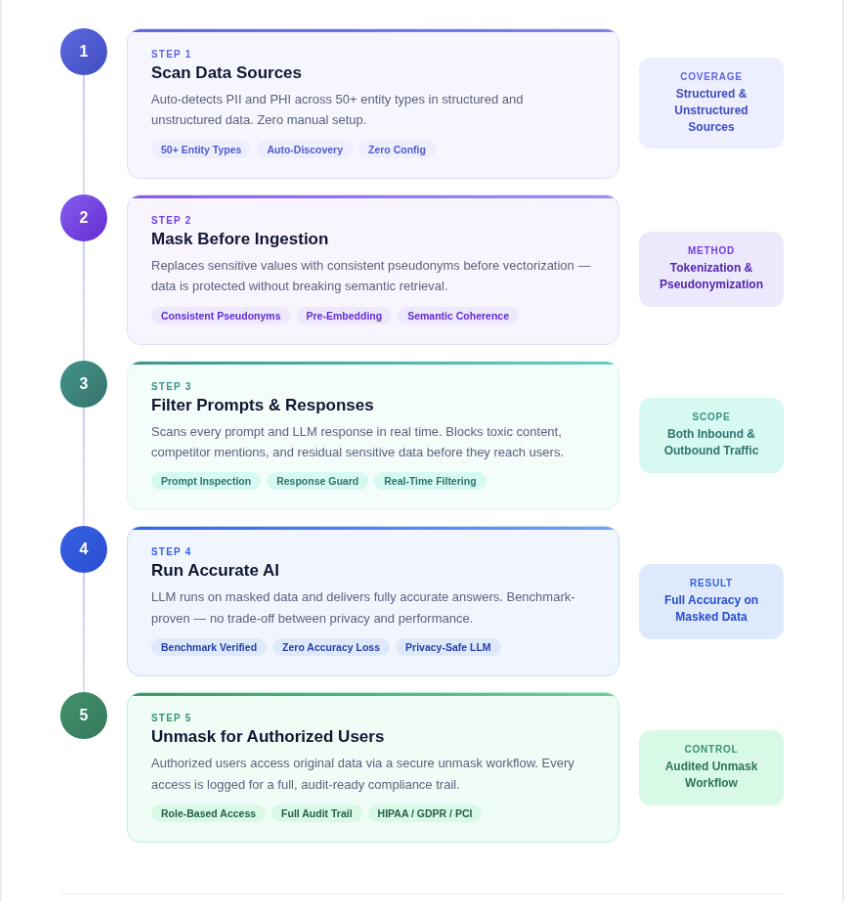
How Protecto Secures RAG In 5 Easy Steps
Protecto drops into your existing AI data pipeline with no rearchitecting required. Unlike generic security tools built for data warehouses, Protecto was designed from day one for AI workflows. so every control below works with your RAG pipeline without breaking retrieval accuracy or LLM performance.
Protecto’s Secure RAG Platform: Built for Enterprise-Scale Data Privacy
Most organizations building RAG applications don’t have the privacy engineering depth to implement all five steps correctly in-house. That is exactly the gap Protecto’s Secure RAG platform closes. Protecto embeds RAG security controls directly into the pipeline architecture as foundational properties, not optional configuration. Here is what that means in practice for your enterprise:
- Sensitive data never enters your vector store in raw form. PII and PHI are tokenized before embedding, so the vector database holds masked representations only.
- No rearchitecting of your access model. Retrieval-time authorization maps directly to your existing identity framework, enforcing permissions at the moment of retrieval, not assumed upstream.
- Tenant isolation by design. Namespace and collection boundaries are enforced structurally, eliminating cross-contamination risk across clients or business units.
- Full compliance coverage out of the box. Every data access event is audit-logged for GDPR, HIPAA, PCI-DSS, and SOC 2 giving compliance teams the records they need without custom development.
Three Things That Set Protecto Apart
Most masking tools were built for data warehouses, not LLMs. Apply them to RAG inputs and accuracy suffers. Protecto was built for AI workflows from day one, and the difference shows in three specific ways…
- We retain LLM accuracy after masking
Standard masking replaces values in ways that break context. Protecto uses consistent pseudonymization that keeps semantic relationships intact, so the LLM reasons correctly over masked data with zero accuracy trade-off.
- We deliver the highest PII detection accuracy
In independent F1 benchmarks, Protecto outperforms AWS Comprehend and Microsoft Presidio across 50+ PII entity types. Teams can add custom entity lists and define their own masking policies without retraining models.
- We are built for enterprise scale
Synchronous APIs for low-latency prompt filtering. Async APIs for high-volume batch ingestion. Full audit logs, high availability, and disaster recovery included. Deploys on-prem or as SaaS with support for strict data sovereignty and air-gapped environments.
Build On RAG Without The Security Risk
Retrieval Augmented Generation has fundamentally changed what AI can do for enterprises. But the pace of RAG adoption has outrun the industry’s understanding of its security implications. Embeddings are not a security boundary. Treating vectorization as protection leaves sensitive data exposed to inversion attacks, permissive retrieval, unsecured vector stores, and cross-tenant leakage all silently, with no traditional security signal. The organizations building the most powerful and trustworthy AI applications are the ones treating privacy as an architectural property from day one, not a feature to add later.
If your RAG pipeline wasn’t built with these controls in place, the exposure is already there. The question is whether you find it first.
Explore Protecto’s RAG as a Service to see how we help enterprises deploy RAG on sensitive data securely, compliantly, and at enterprises scale.
