
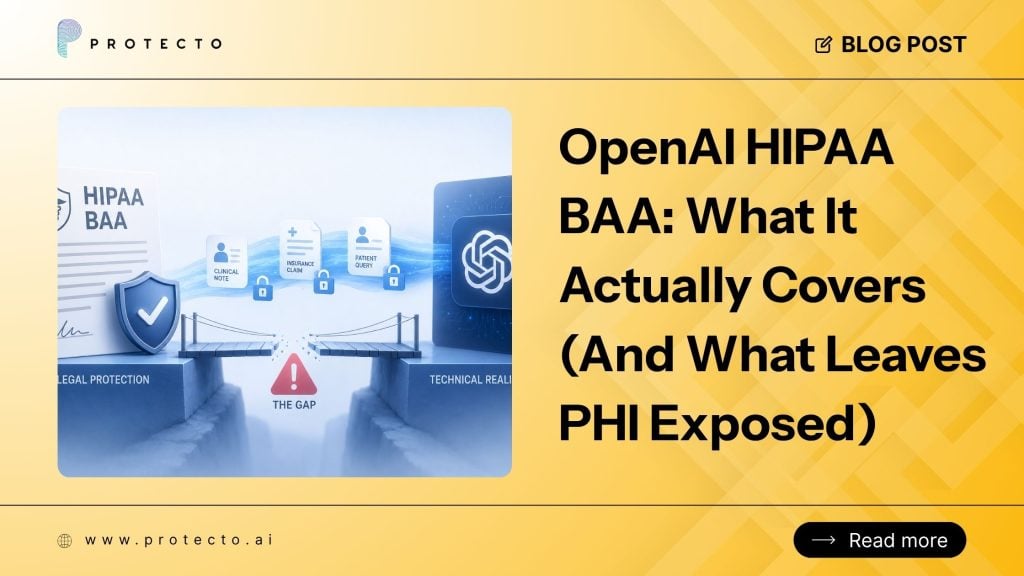
OpenAI now offers a Business Associate Agreement. For healthcare organizations and health-tech teams racing to deploy AI, that single sentence felt like permission to move fast. But here’s the harder truth: a HIPAA BAA is a legal document, not a technical control. And the gap between what OpenAI HIPAA BAA promises and what it protects is where patient data quietly slips through.
Before your team routes another clinical note, insurance claim, or patient query through a GPT-powered workflow, you need to understand exactly where the BAA ends, and where your PHI exposure begins.
What Is a HIPAA BAA, and Why Does OpenAI Offering One Matter?
Under HIPAA, any vendor that handles Protected Health Information (PHI) on behalf of a covered entity must sign a Business Associate Agreement. The BAA establishes that the vendor:
- Acknowledges they may process PHI
- Agrees to safeguard it according to HIPAA’s Security and Privacy Rules
- Will report breaches and cooperate with audits
- Will not use PHI for purposes beyond the agreed scope
OpenAI lists specific products as HIPAA eligible under a signed BAA. As of September 2026, OpenAI’s Help Center names ChatGPT for Healthcare, ChatGPT for Enterprise with Regulated Workspace, ChatGPT for Clinicians, the API with Modified Retention, and FedRAMP variants. ChatGPT Business is not covered.
For the API, OpenAI requires Modified Retention on your organization ID before you process PHI. Coverage also depends on the endpoint and feature. OpenAI excludes some features, such as improved memory and cloud-based Codex. Check OpenAI’s current HIPAA eligibility list before you send PHI.
Protecto Take: A BAA is a legal promise, not a data protection mechanism. It tells you who is responsible after a breach. It does not prevent one from happening.
What the OpenAI’s HIPAA BAA Covers
Let’s be specific about what the agreement does and does not do.
What OpenAI’s Enterprise BAA covers:
- Model training exclusion: OpenAI will not use your inputs to train or improve its models under Enterprise or API (with data opt-out settings enabled)
- Data retention commitments: Input and output data is not stored beyond the defined API session window under zero data retention (ZDR) configurations
- Legal accountability: OpenAI accepts formal BAA obligations: breach notification, minimum necessary use, restrictions on subcontractor data sharing
- In-transit encryption: Data sent to OpenAI’s API is encrypted over TLS during transmission
These are meaningful guarantees. If you are running a compliant setup, Enterprise tier, ZDR enabled, BAA signed, OpenAI is formally in your HIPAA chain of custody.
But the BAA only governs what happens inside OpenAI’s infrastructure. It says nothing about how PHI enters the pipeline, what happens before the API call, or what your application does with the response. That is entirely your problem to solve.
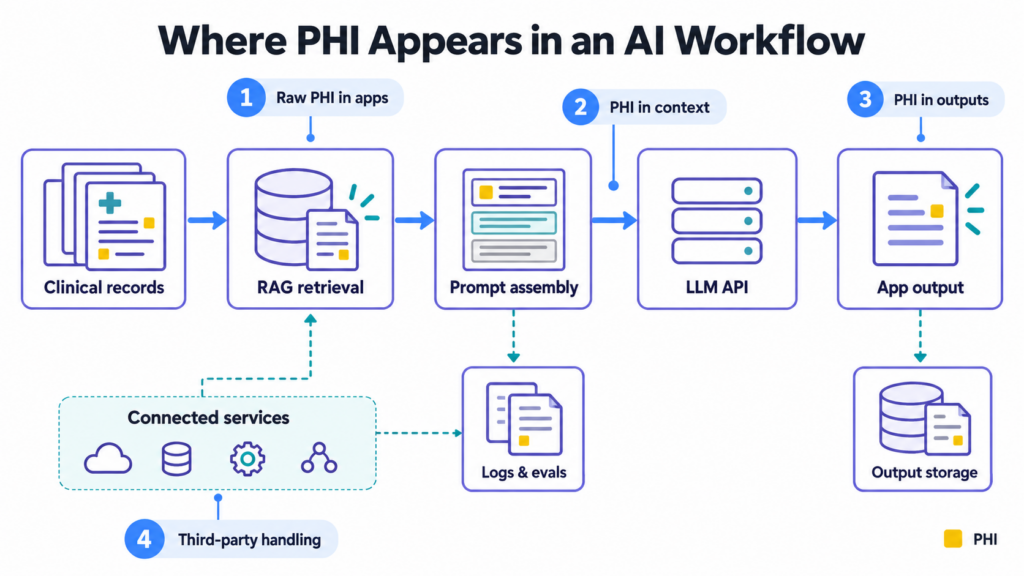
4 PHI Gaps the OpenAI’s HIPAA BAA Leaves Open
Here is where healthcare engineering teams run into serious trouble, and where the “we have a BAA” mindset becomes dangerous.
-
Raw PHI still travels through your application layer
Before any data reaches OpenAI’s API, it passes through your own infrastructure: your orchestration layer, your prompt construction logic, your logging systems, your RAG pipeline. The BAA has no jurisdiction here. If your system logs prompts before sending them, or if your vector database stores unmasked clinical notes as embeddings, you have a PHI exposure that no BAA can cover.
-
Context windows carry more PHI than teams realize
Modern LLM workflows use Retrieval-Augmented Generation (RAG) to pull relevant records and inject them into prompts. If your retrieval system surfaces a patient’s name, diagnosis, medication history, or insurance ID alongside a query, all of that is now in the context window. The BAA covers that moment in transit. But your prompt logs, your eval datasets, your fine-tuning pipelines? Those are auditable surfaces under HIPAA that BAAs don’t protect.
-
Model outputs can reconstruct PHI
LLMs can surface PHI in unexpected ways by inferring, combining, or echoing back details from retrieved context. An output that contains a patient’s age, diagnosis, and facility name is a HIPAA-sensitive record, even if it was assembled rather than copied. Your application’s output handling, storage, and display logic must treat these outputs as PHI. The BAA does not help you here.
-
Subcontractors and integrations fall outside the BAA
Your AI pipeline likely involves more than just OpenAI, vector databases, orchestration tools, embedding APIs, monitoring platforms. Unless each of those has its own BAA in place and is configured correctly, you have uncovered links in the chain. OpenAI’s BAA explicitly covers only OpenAI.
Protecto Take: The surface area of PHI exposure in an LLM pipeline is 3-4 times larger than most teams anticipate. The BAA covers one node. Protecto covers the entire pipeline.
How Protecto Closes the Gaps OpenAI’s BAA Leaves Open
Protecto is purpose-built for exactly this problem: securing PHI across the full AI data pipeline, not just at the API boundary. Protecto offers purpose-built products to secure PII/PHI across every layer of the AI pipeline, and the right product depends on how your stack is built.
For this particular use case, running prompts through OpenAI or any LLM, GPTGuard is the solution. It intercepts prompts before they reach the model, scans for PHI in real time, and applies context-preserving masking that replaces names, dates, identifiers, and clinical terms with realistic synthetic tokens. The model receives enough context to perform its task accurately; it never sees the actual patient data. When the response comes back, GPTGuard reverses the masking for authorized downstream use.
The result: your BAA with OpenAI is never even tested, because raw PHI never reaches the API.
If you are building custom AI applications, Protecto Vault is the product to use. Vault masks PHI at the point of ingestion so that your RAG pipelines, vector databases, and fine-tuning datasets never contain unmasked sensitive data. With >99.9% detection accuracy across 200+ PHI and PII entity types, Vault catches what generic tools miss: partial identifiers, clinical shorthand, embedded dates of birth, and contextual combinations that individually seem benign but together constitute a HIPAA record.
Together, these tools mean your AI stack is HIPAA-compliant by design, not by paperwork.
What this looks like in practice:
- Ingest: Clinical records, insurance data, and patient notes enter your pipeline; Protecto Vault scans and masks PHI before storage
- Retrieve: RAG retrieval surfaces masked records; no raw PHI enters context windows
- Prompt: GPTGuard intercepts the prompt, applies a final PHI scan, sends a clean version to OpenAI
- Respond: The model’s output is received, re-identified only for authorized users with appropriate role-based access
- Audit: Every action is logged, traceable, and ready for HIPAA audit requests
Protecto deploys in under one week and integrates directly with your existing stack, no architectural redesign required.
OpenAI’s BAA vs Protecto: What Each Protects
| Protection Layer | OpenAI BAA | Protecto |
| Legal accountability for PHI handling | ✅ | ✅ |
| PHI masking before API call | ❌ | ✅ |
| RAG pipeline PHI protection | ❌ | ✅ |
| Prompt log & eval dataset compliance | ❌ | ✅ |
| Output PHI detection and handling | ❌ | ✅ |
| 200+ PII/PHI entity detection | ❌ | ✅ |
| Audit trail for HIPAA compliance | ❌ | ✅ |
| Zero accuracy loss in AI outputs | ❌ | ✅ |
The BAA Is the Floor, Not the Ceiling
OpenAI’s HIPAA BAA is a necessary starting point. It signals that enterprise AI for healthcare is maturing, and that vendors are willing to accept legal accountability for the data they handle. But compliance has never been about paperwork, it has always been about control. Your patients’ data deserves more than a promise that it won’t be misused after it arrives. It deserves protection that starts before it ever leaves your system.
FAQ:
- Is OpenAI HIPAA compliant if we sign a BAA?
Signing a BAA with OpenAI makes them a covered business associate, it establishes legal accountability. But HIPAA compliance for your application depends on how your entire pipeline handles PHI, not just what OpenAI does with it after receipt. You are responsible for what enters the API and how outputs are stored and used.
- Does OpenAI’s BAA cover ChatGPT and the API?
OpenAI’s HIPAA BAA is available for ChatGPT Enterprise customers and API users who have configured zero data retention and opted out of model training. Standard ChatGPT tiers do not qualify. Always verify your specific tier and configuration before treating any workflow as HIPAA-covered.
- What types of PHI are most at risk in LLM pipelines?
Patient names, dates of service, diagnosis codes, medication names, insurance IDs, provider names, and facility details are most commonly exposed, often because they appear in clinical notes, discharge summaries, and billing records used as RAG context. Indirect identifiers (age + condition + geography) are also a significant risk that standard tools underdetect.
- Can I use Protecto alongside OpenAI?
Yes, Protecto is designed to sit in front of any LLM, including OpenAI. It works as a middleware layer, identifying & masking PII/PHI before your prompt reaches the API and handling de-identification of retrieved context. Your BAA with OpenAI remains valid; Protecto ensures raw PHI never triggers it.
5. Does OpenAI sign a BAA?
Yes, for eligible products. Requests for the API go through OpenAI’s BAA process. BAAs for ChatGPT Enterprise or Edu go through OpenAI sales. OpenAI reviews each request individually.
Ready to secure your AI pipeline end-to-end? See how Protecto masks PHI before it reaches OpenAI. Explore HIPAA compliance for AI : full coverage for healthcare and health-tech teams.
