
Protecting sensitive data is no longer just a compliance objective. It has become a prerequisite for adopting cloud services, enabling AI, and maintaining customer trust. Yet many organizations still struggle to balance innovation with effective data governance.
A 2025 Forrester Total Economic Impact™ study commissioned by Microsoft found that organizations using mature data protection capabilities, including data loss prevention (DLP), achieved a 30% reduction in the likelihood of data breaches. As sensitive information increasingly moves across endpoints, SaaS platforms, collaboration tools, and AI applications, understanding what data loss prevention is has become essential for reducing business risk without restricting productivity.
This article explores what data loss prevention is, how modern DLP systems work, the different types of data loss prevention, practical use cases, and the best practices organizations should follow to strengthen data leakage prevention in an AI-driven enterprise.
Data Loss Prevention Is No Longer Just an IT Problem
The meaning of data loss prevention has evolved considerably over the past decade. Traditional DLP focused on preventing employees from copying confidential files onto USB drives or emailing sensitive documents outside the organization. Today’s security landscape is far more complex.
Sensitive information moves continuously between cloud applications, collaboration platforms, AI assistants, customer support systems, and enterprise data pipelines. This is why understanding what data loss prevention is has become a strategic priority for CISOs, security architects, compliance leaders, and AI governance teams.
At its core, data loss prevention (DLP) refers to the combination of technologies, policies, and processes that identify, monitor, and protect sensitive information from unauthorized access, accidental exposure, or malicious exfiltration.
Rather than simply blocking data movement, modern DLP solutions help organizations determine:
- Which data is sensitive
- Where that data exists
- Who can access it
- How it is being used
- Whether its movement complies with organizational policies and regulatory requirements.
The Modern DLP Journey: From Detection to Protection
One of the biggest misconceptions about what DLP is that it simply blocks files from leaving the network. In reality, an enterprise-grade DLP platform follows a continuous lifecycle that combines visibility, classification, policy enforcement, and monitoring.
| Stage | What Happens | Business Outcome |
| Discover | Locate sensitive information across databases, endpoints, cloud storage, SaaS platforms, and AI workflows | Complete visibility into organizational data |
| Classify | Identify regulated and confidential data such as PII, PHI, PCI, intellectual property, and financial records | Accurate risk identification |
| Monitor | Track how data is accessed, copied, shared, or transmitted | Continuous visibility into user behavior |
| Enforce | Apply policies that block, encrypt, tokenize, quarantine, or restrict data movement | Reduced risk of data exposure |
| Audit | Generate logs, reports, and compliance evidence | Faster investigations and regulatory reporting |
This lifecycle allows organizations to shift from reactive incident response to proactive risk reduction.
How Does a Data Loss Prevention System Work?
Understanding how a data loss prevention system works begins with recognizing that every piece of sensitive information has a lifecycle.
A modern DLP solution continuously inspects data at three critical states:
- Data at rest
- Data in motion
- Data in use
Whenever sensitive information is created, modified, shared, or transmitted, the DLP engine evaluates whether the activity complies with predefined security policies.
For example, if an employee attempts to upload a customer database containing personally identifiable information to a public AI chatbot, a traditional security tool might only detect the upload after it occurs.
Modern AI-aware DLP platforms instead identify the sensitive content before transmission and apply the appropriate policy.
Depending on organizational requirements, the system may:
- Block the action
- Mask sensitive information
- Replace data with secure tokens
- Encrypt the data
- Alert security teams
- Log the event for compliance
This shift toward context-aware protection is becoming increasingly important as enterprises deploy AI applications.
For AI workflows, simply blocking prompts often disrupts productivity. Instead, solutions such as Protecto GPTGuard apply privacy-preserving masking before sensitive information reaches public or private LLMs, allowing employees to continue using AI while reducing the risk of exposing confidential data.
GPTGuard identifies sensitive information in real time and masks it while preserving context, enabling secure enterprise AI adoption rather than forcing organizations to choose between unrestricted AI usage and outright bans.
The Three Primary Types of Data Loss Prevention
Understanding the types of data loss prevention is important because sensitive information can be exposed through multiple channels. Modern DLP typically focuses on three core areas:
1. Network DLP
Network DLP monitors sensitive information as it moves across an organization’s network. It can inspect email, web traffic, file transfers, and other communication channels to identify attempts to send confidential information outside approved boundaries. Policies can then trigger actions such as blocking the transfer, generating an alert, or logging the event for investigation.
2. Endpoint DLP
Endpoint DLP protects data on devices like laptops and desktops. It monitors activities including copying files to USB drives, printing documents, taking screenshots, or transferring information between applications.
This is particularly useful for controlling accidental or intentional data exfiltration from employee devices.
3. Cloud DLP
Cloud DLP focuses on sensitive information stored or processed in cloud services and SaaS applications. It helps organizations discover exposed data, monitor sharing activity, and enforce policies across cloud repositories.
As businesses increasingly use cloud platforms and AI applications, cloud controls have become an important part of data leakage prevention.
Together, these approaches provide visibility and policy enforcement across the major locations where enterprise data is stored, accessed, and transferred.
5 Data Loss Prevention Use Cases That Matter
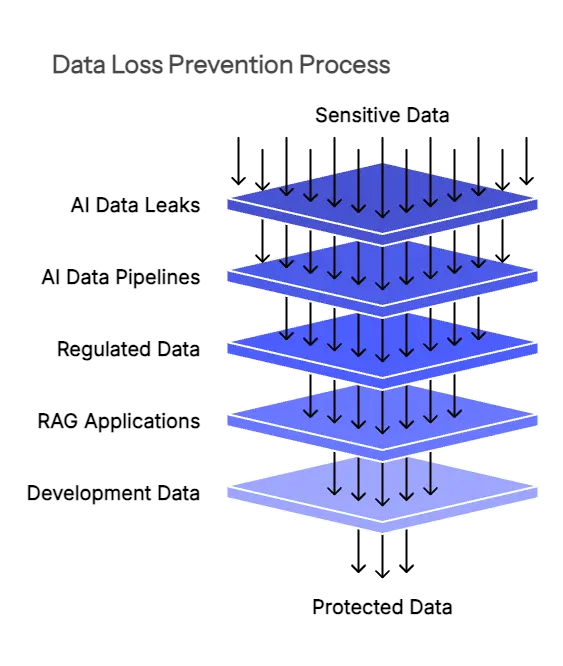
The most valuable data loss prevention use cases focus on where sensitive information moves and how it can be exposed:
- Preventing AI data leaks: Detect and mask PII, PHI, or confidential information before employees send it to public LLMs. Protecto’s GPTGuard applies real-time masking while preserving context.
- Securing AI data pipelines: Protect sensitive information during ingestion, RAG, embedding, and prompt construction. Protecto’s Secure AI Data Pipelines solution supports masking before vector database storage and LLM prompt construction.
- Protecting regulated data: Privacy Vault detects 200+ PII, PHI, and PCI entity types across 50+ languages and tokenizes sensitive values.
- Securing RAG applications: Mask sensitive information before enterprise documents enter vector databases or AI prompts.
- Protecting development and migration data: High-Volume Data Masking supports bulk masking for cloud migrations, data lakes, and AI training preparation.
Best Practices for Building an Effective DLP Strategy
A strong DLP strategy combines visibility, protection, and continuous oversight, with the following practices providing a practical foundation:
- Identify sensitive data: Discover and classify PII, PHI, PCI, intellectual property, and confidential information before creating DLP policies.
- Protect data across environments: Apply controls across endpoints, cloud applications, AI prompts, RAG systems, and data pipelines.
- Use context-aware protection: Prefer masking or tokenization where blocking legitimate workflows could reduce productivity.
- Monitor and audit activity: Maintain detailed logs of detections, policy actions, access, and unmasking events.
- Review policies regularly: Update DLP controls as business processes, AI applications, regulations, and data flows evolve.
- Test before deployment: Validate policies against real workflows to minimize false positives while maintaining effective data leakage prevention.
Conclusion
Data loss prevention has evolved from controlling file transfers to protecting sensitive information across endpoints, cloud applications, AI prompts, RAG systems, and data pipelines. Effective DLP combines discovery, classification, context-aware detection, policy enforcement, masking, and auditability. As AI expands the number of places sensitive data can travel, organizations need controls that protect information without disrupting legitimate workflows. DLP is now a core data security control.
FAQs on Data Loss Prevention
Why is DLP important for AI applications?
AI applications can process sensitive prompts, documents, and retrieved information. DLP helps identify and protect sensitive content before it reaches an LLM, vector database, AI agent, or external application.
What data should organizations protect with DLP?
Organizations should prioritize PII, PHI, PCI data, financial information, intellectual property, credentials, customer records, proprietary source code, confidential documents, and other information subject to contractual or regulatory requirements.
What should businesses consider when choosing DLP software?
Evaluate sensitive-data detection accuracy, coverage across endpoints and cloud environments, AI and API support, policy flexibility, false-positive rates, integration capabilities, audit trails, scalability, deployment options, and regulatory requirements.
Can DLP protect data in development and testing environments?
Yes. Organizations can use masking or tokenization to reduce exposure when production data is copied into development, testing, analytics, migration, or AI training workflows.
What does modern DLP need to protect against AI data leakage?
Modern DLP should detect sensitive information across prompts, documents, RAG pipelines, APIs, vector databases, and AI agents.
