
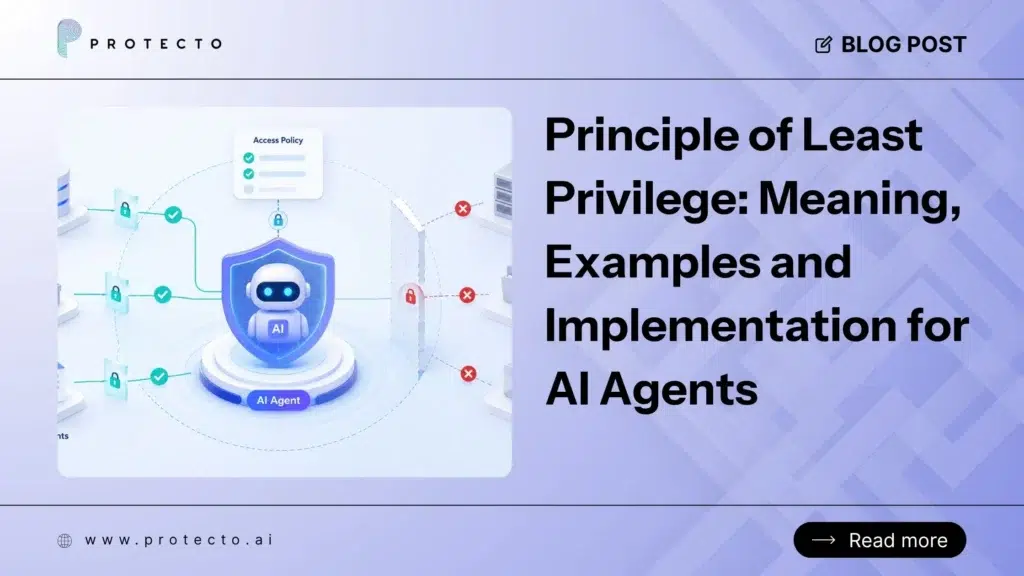
Every unnecessary permission increases an organization’s attack surface. Microsoft reports that more than 600 million identity attacks occur every day, making identity and access controls one of the most critical layers of enterprise security.
As AI agents increasingly act on behalf of users, the principle of least privilege becomes essential for ensuring they can access only the data, tools, and systems required for a specific task.
Combined with AI data pipeline security and runtime security for LLM applications, least privilege helps reduce unnecessary exposure while enabling AI to operate safely.
When Do AI Agents Become Employees With Unlimited Keys?
Traditional applications execute predefined workflows. AI agents do not.
They reason, select tools, retrieve enterprise knowledge, call APIs, and chain multiple actions together. That flexibility also creates a new security challenge. Every permission assigned to an AI agent becomes another opportunity for unintended data exposure.
The principle of least privilege makes sure that users, applications, workloads, and AI agents receive only the permissions necessary to complete a defined task. Nothing more.
Unlike static applications, AI agents constantly make decisions during execution. They may access HR records to answer a benefits question, retrieve CRM information for a sales request, or query financial systems for reporting. Without carefully designed least privilege access control, the same agent could unintentionally retrieve payroll data, customer PII, or confidential legal documents simply because it has broad database permissions.
This shift makes least privilege cybersecurity an operational requirement rather than a compliance checkbox.
Why Traditional Access Models Fall Short for AI Agents?
Many enterprises still rely on Role-Based Access Control (RBAC). While RBAC works well for predictable human workflows, it struggles when AI agents dynamically combine tools, context, and enterprise knowledge.
Consider the differences:
| Traditional Applications | AI Agents |
| Execute predefined workflows | Dynamically plan tasks |
| Access known systems | Interact with multiple tools and APIs |
| Human decisions determine actions | AI independently selects actions |
| Roles remain relatively static | Context changes with every prompt |
| Limited data movement | Continuous retrieval and generation |
The challenge is not simply granting least privilege access. It is ensuring permissions change as the agent’s objective, user, and context change.
This is precisely why modern AI environments increasingly complement traditional RBAC with contextual authorization models.
For organizations building agentic AI, this naturally connects with Attribute-Based Access Control (ABAC) and Context-Based Access Control (CBAC), both of which evaluate identity, purpose, requested resource, and runtime context before allowing access.
The Four Principles Behind Effective Least Privilege for AI
The principle of least privilege in cybersecurity extends beyond limiting user accounts. For AI systems, it governs every interaction between agents, tools, models, and enterprise data.
1. Limit Every Permission by Purpose
Every permission should correspond to a specific business objective. For example:
- A customer support agent should retrieve ticket history; it should not access payroll records.
- A finance agent should summarize invoices; it should not modify CRM opportunities.
Purpose-driven permissions dramatically reduce the blast radius if an AI workflow behaves unexpectedly.
2. Make Permissions Temporary
Standing permissions create standing risk. Instead, organizations should grant access only during execution. Once an AI agent completes a workflow, elevated permissions should automatically expire. This significantly reduces exposure from compromised credentials or prompt manipulation.
3. Protect Sensitive Data Before Access Decisions
Least privilege does not eliminate sensitive data. It limits who can see it. This makes data protection equally important.
For example, Protecto’s Privacy Vault detects more than 200+ PII, PHI, and PCI entity types across 50+ languages, replacing sensitive values with context-preserving masked values while allowing AI workflows to continue without exposing raw information. Authorized users can later unmask information based on policy, while everyone else continues working with protected data.
Rather than relying solely on permissions, enterprises reduce risk by ensuring AI agents rarely encounter sensitive data in its original form.
4. Continuously Verify Access Decisions
An AI agent that was authorized five seconds ago may no longer be authorized now. This is why modern least privilege access control increasingly evaluates:
- User identity
- Business purpose
- Requested resource
- Session context
- Organizational policy
- Regulatory requirements
Every request becomes an authorization decision rather than an assumption.
Principle of Least Privilege Examples in Enterprise AI
Understanding theory is useful. Seeing it applied makes its value much clearer.
| AI Use Case | Excessive Permission | Least Privilege Approach |
| HR Copilot | Reads all employee records | Accesses only records for authenticated employees |
| Customer Support Agent | Retrieves entire CRM | Accesses only the customer’s account currently being served |
| Healthcare AI Assistant | Reads complete EHR database | Retrieves only records associated with the treating clinician |
| Finance Agent | Can approve payments | Generates recommendations while approvals remain with authorized personnel |
| Sales AI | Reads all customer contracts | Accesses contracts assigned to the requesting account executive |
These principles of least privilege examples demonstrate an important shift. The objective is no longer simply protecting databases. It is controlling every interaction between AI agents and enterprise knowledge.
Building Least Privilege Into AI From Day One
Many organizations attempt to implement least privilege after deploying AI applications. By then, permissions are often scattered across APIs, vector databases, identity providers, and orchestration frameworks, making them difficult to govern consistently. A more effective approach is to build least privilege access control into the architecture from the outset.
Start by identifying what each AI agent is expected to accomplish. Then define the minimum datasets, APIs, and tools required for that task. Permissions should be scoped to a specific objective, time-bound wherever possible, and continuously evaluated during execution.
Sensitive data should also be protected before it reaches the model, ensuring that even authorized AI workflows operate on masked or tokenized information unless access to raw data is explicitly required.
This is where Protecto’s Context-Based Access Control (CBAC) strengthens traditional access models. Unlike static role-based permissions, CBAC evaluates who is requesting access, why the request is being made, and what context the AI agent is operating in before making an authorization decision.
Combined with Privacy Vault, organizations can enforce context-aware access while ensuring sensitive information remains protected throughout AI workflows.
Common Mistakes That Undermine Least Privilege

Even organizations with mature security programs can weaken the principle of least privilege through poor implementation. Some of the most common pitfalls include:
- Granting broad permissions to simplify deployment.
- Relying solely on RBAC for autonomous AI agents.
- Assigning permanent privileges instead of just-in-time access.
- Ignoring API and third-party tool permissions.
- Failing to audit AI agent activities and access requests.
Addressing these issues early helps reduce unnecessary risk while supporting secure AI adoption at scale.
Conclusion
As AI agents become more autonomous, access management must evolve alongside them. The principle of least privilege is no longer limited to human users or traditional applications. It now governs how AI agents retrieve data, invoke tools, and interact with enterprise systems.
Organizations that successfully implement least privilege combine identity-aware authorization, continuous verification, and privacy-preserving data protection to ensure AI agents receive only the access they need, exactly when they need it.
By complementing least privilege access with context-aware controls such as Protecto’s CBAC and sensitive data protection through Privacy Vault, enterprises can confidently scale AI initiatives without increasing unnecessary data exposure.
FAQs on Principle of Least Privilege
How does least privilege access reduce the risk of prompt injection attacks?
Least privilege limits what an AI agent can access even if a prompt injection attack succeeds. Instead of exposing entire databases or connected applications, the compromised agent is restricted to the minimum data and tools required for its assigned function.
What is the key difference between least privilege access and Zero Trust?
Least privilege defines the minimum permissions required to perform a task, while Zero Trust continuously verifies every access request. Least privilege is one of the foundational principles that enables a Zero Trust architecture.
How often should organizations review AI agent permissions?
Permissions should be reviewed continuously through automated policy enforcement and periodically through governance audits, especially after introducing new tools, data sources, or AI workflows.
How can organizations implement least privilege without slowing down AI innovation?
By automating policy enforcement, using context-aware authorization, applying just-in-time permissions, and masking sensitive data before it reaches AI models, organizations can strengthen security while maintaining productivity.
What KPIs indicate that a least privilege strategy is working?
Key indicators include fewer privileged accounts, reduced excessive permissions, lower unauthorized access attempts, improved audit outcomes, faster access reviews, and fewer policy violations across AI environments.
