Protecto vs Limina AI
AI workflows need more than masking.
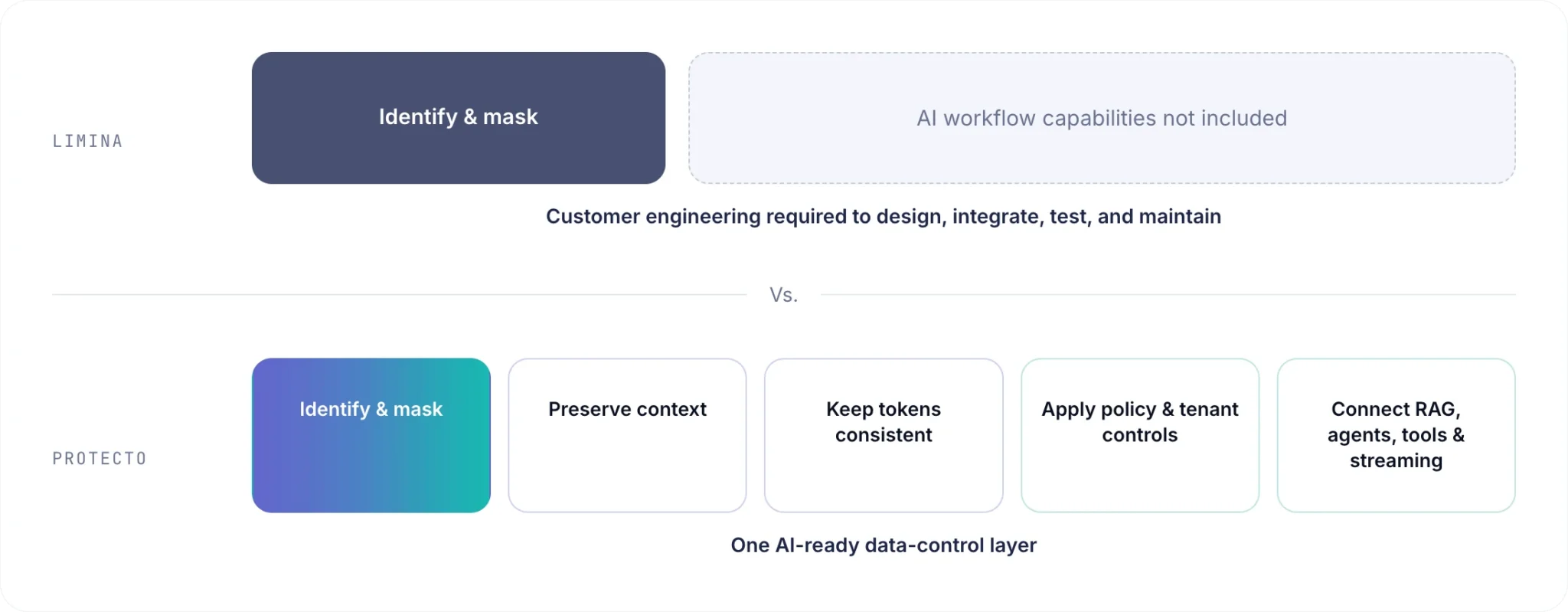
Limina AI, formerly Private AI, identifies and masks sensitive data. Protecto identifies and masks too, then carries that protection through the rest of the workflow: consistent tokens across sessions, policy-based unmasking per user and agent, and native connections into RAG, tool calls, and streaming responses.
If you are building AI agents, masking covers the first step only.

Summary
Both find the sensitive data. Only one is built for what happens next.
Limina delivers a strong privacy-processing component. Protecto delivers the data-control layer that an AI workflow runs on.
- Advanced identification and masking: agentic data classification built for typos, broken words, mixed languages, unstructured conversation, and business-sensitive content beyond traditional PII
- Context-preserving protection: sensitive values are protected while the meaning and relationships AI needs to reason effectively are retained
- Consistent tokenization: the same customer stays the same token across sessions, retrieved documents, tool calls, and asynchronous flows
- Complete AI runtime controls: policy-based masking and unmasking, tenant management, session continuity, and selective data reveal by user, agent, tool, and task
- Ready for AI integration: APIs and gateways with reference architectures and sample code for RAG, agents, tool calls, streaming, and long sessions
- Proven at enterprise volume: 13M+ long-form texts processed per day and 50M+ records handled in production
- SOC 2 and ISO 27001 certified; HIPAA BAA, GDPR, CCPA, PCI DSS, DPDP
How they compare
Protecto or Limina for Agentic AI data security?
Limina identifies and masks PII, PHI, and PCI with a traditional NER-based approach. Protecto does that too.
The difference shows up after masking. In an agentic system the same record is retrieved into a prompt, chunked into a vector store, passed to a tool, held in memory across a long session, and returned in a streamed response. Each of those handoffs needs the token to stay consistent, the meaning to survive, and the reveal decision to be made per user and per agent. Limina leaves that orchestration to your engineering team. Protecto ships it.
Limina gives you one privacy component. Protecto gives you the complete AI data layer.
Add to your stack
Add Protecto where your AI workflow needs runtime control
Limina covers identification and masking. Protecto covers identification and masking, plus every workflow layer above it.
Context-preserving protection
Sensitive values are protected while the meaning and relationships the model needs to reason effectively are retained. Markers and redaction strip that signal out. Protecto keeps masked data usable, not just safe.
Consistent tokens across the whole workflow
The same entity maps to the same token across sessions, retrieved documents, tool calls, and asynchronous flows, so the AI still understands that two mentions refer to one customer.
Policy-based selective reveal
Unmasking is decided by user, tenant, agent, tool, and task. An authorized CRM tool receives the real email address in the same run where the LLM never sees it.
AI integration without custom orchestration
Connect through APIs and gateways, with reference architectures and sample code for RAG, agents, tool calls, streaming, and long sessions. No orchestration layer for your team to design, integrate, test, and maintain.
Why AI teams choose Protecto
Built for the data path AI teams actually ship
Agentic classification for messy input
Real AI inputs are not clean records. Protecto classifies typos, broken words, mixed languages, unstructured conversation, and business-sensitive content that falls outside traditional PII lists. Identification is the first step, not the finished system.
Same customer across the workflow
A customer appears in a prompt, a retrieved document, a tool response, and a later conversation turn. Protecto keeps the identity consistent so the AI understands the relationship.
A tool needs the original value
An LLM does not need a customer's email address, but an authorized CRM tool does. Protecto reveals only the required value to the authorized tool.
Tool metadata stays intact
Masking a function name, tool ID, or parameter schema can break an agent mid-run. Protecto protects sensitive runtime values without changing the tool-call structure.
Proven accuracy and deployment speed
Enterprise evidence for regulated AI workflows.
- Superior F1 score vs AWS Comprehend and Microsoft Presidio in an independent benchmark by UT Dallas / DataXpert.
- 99% recall and 96% precision including Arabic-language content at a Middle East bank.
- 85% semantic accuracy retained after masking in an enterprise bank case study, so downstream reasoning holds up.
- POC completed in under one week for a health analytics customer.
- 13M+ long-form texts processed per day and 50M+ records handled, with 5,000+ downstream enterprise customers protected through a single Automation Anywhere deployment.
Comparison
Protecto vs Limina capability matrix
For production AI systems the question is not only whether sensitive data is found. It is what the data can still do afterward, who is allowed to see it, and how much of the surrounding system you have to build yourself.
| Capability | Protecto | Limina |
|---|---|---|
| Identification and masking | ||
| Detects PII, PHI, and PCI | ✓ | ✓ |
| Classification approach | Agentic classification for complex AI inputs | Traditional NER-based approach |
| Handles typos, broken words, and mixed languages | ✓ | ✕ |
| Masking method | Context-preserving for AI reasoning | Markers, redaction, and synthetic replacements |
| Meaning and relationships retained after masking | ✓ | ✕ |
| AI runtime controls | ||
| Token consistency scope | Sessions, RAG, tools, and asynchronous flows | Within supported request or connection scope |
| Session continuity across long conversations | ✓ | ✕ |
| Selective unmasking | Policy-based by user, tenant, agent, tool, and task | Re-identification API |
| Tenant management | ✓ | ✕ |
| Tool-call structure preserved during masking | ✓ | ✕ |
| AI integration | ||
| API integration | ✓ | ✓ |
| Gateways for AI traffic | ✓ | ✕ |
| Reference architectures and sample code for RAG, agents, tool calls, streaming | ✓ | ✕ |
| Customer engineering required to design, integrate, test, and maintain orchestration | ✕ | ✓ |
| Outcome | ||
| What you deploy | AI-ready data-control layer | Privacy-processing component |
Coming from Limina AI?
Identify better. Mask intelligently. Make protected data usable across AI.
Protecto adds to your existing stack through APIs and gateways. No platform replacement, no data migration, and no custom orchestration layer for your team to build and maintain.
In this page
Building AI agents with sensitive data?
Limina stops at identify and mask. Protecto governs the entire path, from the input your users send to the values your tools receive. No platform replacement, no data migration, and no orchestration layer for your team to build and maintain.
- SOC2 Certified
- HIPAA Compliant
- GDPR Ready
- ISO 27001