
Here is a number that should stop every CISO cold. Gartner projects that by 2028, 25% of enterprise GenAI applications will face five or more security incidents per year, nearly triple the 9% recorded in 2025. The acceleration is not slowing.
Meanwhile, research by OpenText and the Ponemon Institute finds that 79% of organizations have not yet reached full AI maturity in cybersecurity, meaning most enterprises are deploying generative AI without the foundational controls needed to govern it.
This gap between deployment speed and security readiness is exactly why AI threat modeling has moved from a nice-to-have exercise to an operational necessity. Traditional threat modeling frameworks such as STRIDE and PASTA were designed for static software architectures. They do not account for prompt injection, context window poisoning, agentic chaining, or the fact that an LLM can leak training data through a seemingly innocent conversation.
This guide walks through a practical approach to AI threat modeling for GenAI systems, grounded in real attack surfaces, real regulatory pressure, and real tools that can close the gap.
Why Traditional Threat Modeling Falls Short?
Classic threat modeling assumes a system with deterministic behavior. You model inputs, outputs, API boundaries, and trust zones. But a GenAI system introduces a fundamentally different reality: the model itself is an attack surface.
Consider what changes:
- Non-deterministic outputs: The same prompt can produce different responses. You cannot write unit tests that guarantee safe behavior.
- Indirect injection surfaces: Attackers do not need to compromise your infrastructure. They can inject malicious instructions into the data your model retrieves from a vector database or a web page.
- Data leakage through inference: Models memorize training data. An attacker with enough queries can extract personally identifiable information that was never explicitly provided.
- Agentic autonomy: AI agents do not just respond to prompts. They call APIs, query databases, write files, and execute actions. A compromised agent becomes a privileged insider.
AI threat modeling must therefore expand its scope. It is no longer enough to model the application layer. You must model the model itself, its training data, its retrieval pipeline, its output behavior, and the permissions it inherits from the systems it touches.
A recent Netskope report revealed that 72% of enterprise GenAI usage is shadow IT, with employees using personal accounts on enterprise devices. This means most AI threat modeling efforts that focus solely on sanctioned tools miss the majority of the risk surface.
Mapping the GenAI Attack Surface
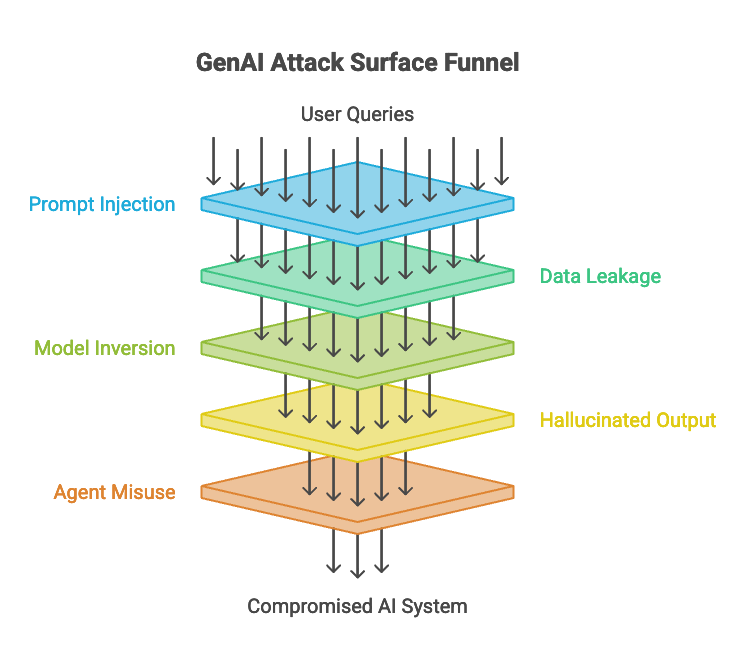
An effective AI threat modeling exercise starts by mapping where data lives, how it flows, and where it can be intercepted. For a typical enterprise RAG pipeline or agentic system, the surface breaks down into five zones:
Zone 1: The Prompt and Input Layer
This is where users submit queries. Threats include prompt injection attacks (direct and indirect), jailbreaking, and prompt leaking. An attacker who injects instructions into a document that gets ingested into your vector database can hijack every subsequent query that retrieves that context.
Zone 2: The Retrieval and Context Layer
In a RAG architecture, the model retrieves external data to augment its response. If that data contains sensitive information that was not properly masked, it enters the model’s context window and can appear in the output. This is why secure RAG, masking before vector DB storage and before prompt construction, is critical.
Zone 3: The Model Layer
The LLM itself is a black box. Threats include model inversion (extracting training data), membership inference (determining if specific data was in the training set), and model extraction (stealing the model weights). These attacks are harder to execute but carry the highest impact.
Zone 4: The Output Layer
Even if your inputs and context are clean, the model can hallucinate sensitive information, generate biased or non-compliant content, or expose internal logic through verbose error messages.
Zone 5: The Agent Action Layer
AI agents that can execute actions, write to databases, send emails, and trigger workflows introduce a new class of threats. An agent with overly broad permissions can be weaponized through a compromised prompt.
Each zone requires a different control. And here is the hard truth: most enterprises are only protecting Zone 1 (basic prompt filtering) and hoping the rest works out.
Building the Threat Model: A Practical Framework
Instead of reusing STRIDE or PASTA wholesale, adapt them to the GenAI context. Here is a simplified yet effective AI threat-modeling framework designed for enterprise GenAI deployments.
Step 1: Inventory Every AI Interaction Point
You cannot protect what you cannot see. Catalog every place where data enters or exits an AI pipeline: chat interfaces, API endpoints, RAG ingestion pipelines, agent tool calls, and training data sources.
The LayerX Enterprise Report found that nearly 90% of web-based GenAI usage is invisible to organizations. That invisibility is the single biggest threat modeling failure.
Step 2: Classify Data Sensitivity Before It Touches the Model
Every piece of data that enters an AI pipeline should be classified before the model sees it. Use a tool like Protecto’s DeepSight, a native AI sensitive data detection engine that identifies 200+ PII, PHI, and PCI entity types across 50+ languages.
DeepSight goes beyond pattern matching to reason through obfuscated, scrambled, and context-dependent data, catching what legacy tools miss.
Step 3: Define Trust Boundaries for AI Systems
Traditional trust boundaries assume a human in the loop. With AI agents, that assumption breaks. Define explicit boundaries: what data can the model access directly? What actions can an agent take autonomously? Where does human approval kick in?
Protecto’s CBAC (Context-Based Access Control) addresses this by making data access decisions at inference time, considering who is asking, why, and the context in which they are operating, rather than relying on static roles.
Step 4: Model the Failure Scenarios
For each inventory item, ask: What is the worst that can happen? Data leaking to a public LLM? An agent deleting production records? A customer receiving another customer’s data? Document these scenarios and rank them by likelihood and impact.
Step 5: Implement Controls at the Point of Risk
Controls should sit where the risk materializes, not in a separate security layer that data passes through later. For example, GPTGuard from Protecto masks sensitive data in real time before it reaches a public LLM, preserving context so the AI remains accurate while ensuring data never leaves the enterprise boundary.
The Role of Data Privacy in AI Threat Modeling
AI threat modeling is incomplete without a data privacy layer. The Ponemon study found that only 41% of organizations have AI-specific data privacy policies. This is a gap that regulatory frameworks are rapidly closing.
Under the EU AI Act, GDPR, HIPAA, DPDP (India), and PDPL/SAMA (Saudi Arabia), enterprises must demonstrate that their AI systems process data lawfully, minimize data exposure, and provide audit trails. AI threat modeling must account for each regulation’s requirements:
- Data minimization: Tokenize PII before it enters the model. Protecto’s Privacy Vault uses entropy-based tokenization: tokens derived from system-level noise rather than predictable algorithms, ensuring consistent tokenization across systems. Hence, cross-system joins work without raw sensitive data.
- Right to erasure: If a data subject requests deletion, the tokenized representation must be purgeable without breaking downstream systems.
- Audit trails: Every data access decision, every tokenization event, and every de-tokenization request must be logged. This is baked into Protecto’s architecture; full audit trails are a first-class feature, not an afterthought.
For organizations processing high volumes of data for AI training, Protecto’s High-Volume Data Masking can handle billions of rows via API for data lake migrations and training data preparation, using the same tokenization engine as Privacy Vault and optimized for batch workloads.
Conclusion
The time for reactive AI security is over. Threat modeling is no longer optional; it is foundational. Organizations deploying GenAI without comprehensive threat models are operating blind, exposing themselves to prompt injection, data exfiltration, and regulatory penalties.
The tools exist: AI-native detection, context-aware access control, privacy-preserving tokenization. The question is not whether to implement them, but how quickly.
FAQs on AI Threat Modeling
How does AI threat modeling differ from traditional application threat modeling?
AI threat modeling accounts for non-deterministic model behavior, retrieval pipelines, and agent autonomy that traditional frameworks cannot address in GenAI environments.
What are the main attack surfaces in enterprise GenAI systems?
Enterprise GenAI systems face risks at prompt input, retrieval layers, model inference, output generation, and autonomous agent action zones, requiring targeted modeling.
How can AI threat modeling prevent data leakage in RAG pipelines?
AI threat modeling identifies sensitive data exposure points in RAG systems and recommends masking data before storing it as vectors to prevent unauthorized context-window leaks.
How does AI threat modeling address the risks of shadow AI use?
AI threat modeling extends coverage to unsanctioned GenAI tools, identifying hidden data flows that bypass enterprise controls and create major exposure points.
Why should enterprises adopt AI threat modeling before GenAI deployment?
Early AI threat modeling prevents costly remediation by uncovering vulnerabilities in training data, retrieval systems, and agent permissions during initial design phases.
