
Selecting the right AI vendor security solutions has become one of the most critical decisions organizations face today. A study from Gartner suggests that organizations with regular audits and assessments of AI system performance and compliance are three times more likely to achieve greater GenAI value.
Before committing to any LLM, Retrieval-Augmented Generation (RAG), or Agentic AI vendor, organizations must deploy a rigorous AI vendor risk questionnaire. A well-designed AI vendor risk assessment questionnaire ensures partners meet the highest standards of security, transparency, and regulatory compliance.
Why Traditional Vendor Assessment Frameworks Fail
Generic vendor security assessment checklists verify encryption standards and SOC 2 compliance but remain silent on critical AI-specific concerns: model lineage, training data provenance, and autonomous decision-making safeguards.
According to the OWASP Foundation’s Top 10 for Large Language Models, prompt injection remains the most prevalent attack vector. Yet most traditional questionnaires fail to ask vendors about prompt-injection defense mechanisms or incident-response procedures.
The gap widens with RAG systems. When an LLM retrieves information from enterprise data, the vendor’s handling of access controls, credential management, and data masking becomes absolutely critical. Traditional frameworks overlook these mechanisms entirely. Similarly, Agentic AI systems enable autonomous decision-making that role-based access control cannot adequately govern, necessitating entirely new evaluation approaches.
Building Your AI Vendor Risk Questionnaire: LLMs
When evaluating Large Language Model vendors, your best AI vendor security assessment questionnaire for LLM GenAI must prioritize transparency regarding model architecture and training practices:
Essential Questions:
- What foundation model powers your solution (e.g., GPT-4, Claude 3)?
- Have you fine-tuned or distilled the model? If yes, which datasets were used?
- Do deployed models produce deterministic outputs across identical inputs?
- If outputs vary stochastically, what are your temperature and top-p settings?
Your questionnaire must address prompt injection resilience. Ask vendors about input validation techniques, rate-limiting mechanisms, and their responses to identified vulnerabilities. Ask for evidence of compliance with the NIST AI Risk Management Framework and demand SOC 2 Type II certification, with an emphasis on the security section.
Addressing RAG-Specific Security Risks
RAG systems introduce layered complexity: document ingestion, embedding generation, vector database storage, retrieval ranking, prompt construction, and inference. Your AI Vendor Security Assessment must ask sophisticated questions about each layer.
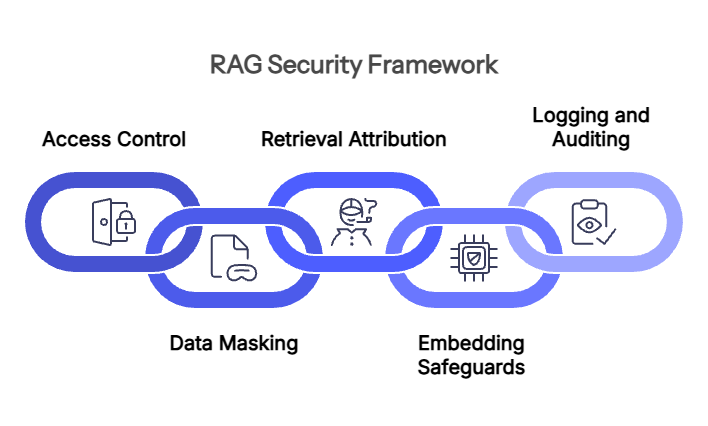
Critical RAG Security Questions
- Does the vendor capture and enforce access control lists (ACLs) from source systems?
- Is sensitive data masked before vector database storage and before LLM prompt construction?
- Can vendors produce retrieval attribution reports that show which documents contributed to the answers?
- How are embeddings generated, and what safeguards prevent sensitive data leakage through embeddings?
- What logging and audit trails exist for every document retrieved and every masking decision applied?
Protecto’s Secure RAG solution demonstrates how to mask data before vector database storage and before LLM prompt construction, setting a benchmark you should demand from any vendor. This level of sophistication ensures sensitive information never flows into embedding or inference models.
Evaluating Agentic AI and Autonomous Decision-Making
Agentic AI systems require fundamentally different evaluation approaches. Traditional role-based access control cannot govern autonomous decision-making, so your AI vendor risk questionnaire must ask:
- What authentication protocol does the vendor use? OAuth 2.0? Mutual TLS?
- Can agent identities be impersonated through credential reuse?
- How frequently are credentials rotated, and what is the maximum age of credentials?
- Does the vendor prevent lateral movement if agent credentials are compromised?
The most sophisticated aspect involves context-aware access control. This means vendors should make access decisions dynamically at inference time, considering agent identity, stated purpose, operational context, and data classification. Protecto’s CBAC (Context-Based Access Control) solution proves this is practical, securing 50,000+ users with isolated policies per tenant through real-time decision-making when an agent requests access.
When evaluating vendors, ask whether their access control approach matches this level of sophistication. Ask for end-to-end permission enforcement across query, retrieval, reasoning, tool invocation, and data access stages. Additionally, ask about observability and monitoring. How does the vendor provide visibility into sensitive data flows? What alerts are triggered when security policies are violated? This transparency is non-negotiable for production deployments.
Regulatory Compliance and the EU AI Act
With the phased implementation of the EU AI Act, the AI vendor risk questionnaire must now include rigorous compliance checks that go far beyond traditional data protection inquiries.
The vendor should be required to state whether they classify their product as a high-risk AI system under the EU AI Act Annex III. If they do, the best AI vendor security assessment questionnaire must demand the risk classification rationale and supporting documentation.
The vendor must provide EU AI Act conformity assessment artifacts, including Annex IV technical documentation and the formal declaration of conformity. Your AI vendor risk assessment questionnaire must also confirm whether the vendor will supply the deployer documentation that customers need to satisfy Article 26 obligations.
This is a critical component of the vendor security assessment checklist for any organization operating in or serving EU markets.
Additionally, the questionnaire should request the GDPR Data Protection Impact Assessment (DPIA) that the vendor has conducted. The AI vendor risk questionnaire should also address works council requirements in EU jurisdictions, such as Section 87(1) of the German BetrVG or Article 27 of the Dutch WOR.
These questions are essential for a comprehensive AI Vendor Security Assessment that ensures full regulatory alignment across multiple jurisdictions.
Implementing a Systematic Vendor Evaluation Process
Phase 1: Risk Identification
Begin by identifying specific risks tied to your use case. LLM customer service creates prompt injection exposure. RAG over healthcare data creates compliance and attribution risks. Agentic AI for financial transactions requires robust access control and audit trails.
Phase 2: Customized Questionnaire
Tailor your vendor security assessment checklist to your risk profile. Assign weights based on organizational priorities. If you operate in healthcare, HIPAA compliance should receive higher weight than in retail.
Phase 3: Evidence-Based Responses
Request detailed, documented responses rather than yes-no answers. Demand references, certifications, audit reports, and proof-of-concept demonstrations. This transforms questionnaires from compliance exercises into actual security due diligence.
Phase 4: Scoring and Ranking
Create a quantitative scoring rubric. Calculate overall risk scores for each vendor. This approach prevents bias and creates a documented justification for procurement.
Phase 5: Technical Validation
Conduct follow-up interviews with top candidates. Request demonstrations or proof-of-concept implementations. Have your security team test systems against known attack patterns.
Conclusion
The AI vendor risk questionnaire has evolved from administrative paperwork into a strategic necessity. Organizations deploying rigorous vendor evaluation processes grounded in established standards gain significant advantages: avoiding costly security incidents, navigating regulatory compliance smoothly, and building trustworthy AI systems.
By embedding these best practices, sophisticated questioning, and alignment with recognized frameworks such as NIST, OWASP, and GDPR into your AI vendor risk assessment, you ensure that AI investments are secure, compliant, and strategically aligned. Protecto stands ready to support this journey with advanced data privacy solutions specifically designed for the AI era, helping you maintain the highest vendor security standards for your AI partnerships.
FAQs on AI Vendor Risk Questionnaire
What questions should I ask LLM vendors about model lineage?
Ask vendors for exact foundation model identification, version numbers, fine-tuning datasets used, published model cards, and whether outputs remain deterministic across identical inputs. Request documentation of training data sources and any custom modifications applied to the base model.
What makes RAG security different from standard LLM security?
RAG systems require additional evaluation of access control preservation, data masking before vector database storage, prompt construction, retrieval, attribution capabilities, and complete audit trails. Traditional LLM security questions overlook critical RAG-specific risks related to data exposure during the embedding and retrieval stages.
What specific questions should I ask about AI agent authentication?
Ask vendors about the authentication protocols used (OAuth 2.0, mTLS, HSM), whether agent identities differ from human user identities, the credential rotation frequency and maximum age, and the mechanisms in place to prevent lateral movement if agent credentials are compromised. Verify agents cannot be impersonated through credential reuse or theft.
What should I ask about sensitive data detection capabilities in RAG systems?
Evaluate whether vendors detect 200+ PII/PHI/PCI entity types in 50+ languages, handle typos and obfuscated data, recognize context-dependent sensitivity, support custom entity types, and maintain near-zero false positives. Ask for benchmarks comparing their detection accuracy against AWS Comprehend and Microsoft Presidio.
