
AI models rarely become a governance problem because of the model alone. The real risk often emerges from what surrounds it: the data it receives, the decisions it influences, the systems it can access, and the people accountable for its outcomes. That makes AI model governance a lifecycle discipline, not simply a model approval process. Even NIST’s AI Risk Management Framework treats governance as a function that cuts across the entire AI lifecycle.
A practical AI model governance framework therefore needs more than policies. It needs defined roles, risk-based controls, continuous monitoring, and clear evidence that every model is being used within approved boundaries.
What Exactly Does AI Model Governance Control?
A model can be technically accurate and still create unacceptable business or regulatory risk. AI model governance, therefore, covers more than model performance.
It establishes controls across the model lifecycle, including:
- Model inventory: What models exist, where they are deployed, what they do, and who owns them.
- Risk classification: How much oversight a model requires based on its purpose, data, impact, and regulatory exposure.
- Data governance: Whether training, testing, retrieval, and inference data are appropriate, authorized, accurate, and protected.
- Validation: Whether the model performs as intended and whether limitations are documented.
- Approval: Who can authorize deployment, material changes, or continued operation.
- Monitoring: Whether performance, security, privacy, bias, and other risks remain within defined thresholds.
- Change management: What happens when a model, dataset, prompt architecture, vendor, or intended use changes.
- Retirement: How models are safely decommissioned and their data, access, and dependencies handled.
This lifecycle perspective aligns closely with the NIST AI Risk Management Framework, which organizes AI risk management around four functions: Govern, Map, Measure, and Manage. NIST also emphasizes that governance should operate across the AI lifecycle rather than as a one-time activity.
Why Does Model Governance Need to Extend Beyond the Model?
The biggest governance mistake is treating the model as the entire system.
An enterprise model may receive data from a CRM, retrieve documents from a vector database, call external tools, generate a decision, and send the result to another application. Risk can enter at any of these points.
This is why AI model governance must connect with data and runtime controls. Protecto’s AI data pipeline security approach, for example, addresses sensitive data across discovery, protection, processing, governance, and delivery rather than focusing only on the model endpoint.
The need for robust model governance is becoming more concrete as Stanford’s 2025 AI Index reported 233 AI-related incidents in 2024, a 56.4% increase from 2023. The figure does not prove that governance failures caused those incidents, but it demonstrates why organizations need stronger processes for identifying and managing AI risks as deployment expands.
What Should an Effective AI Model Governance Framework Contain?
A useful AI governance framework should translate broad principles into operational decisions. A practical structure looks like this:
| Governance layer | Core question | Example controls |
| Model inventory | What AI models are being used? | Registry, owner, version, purpose |
| Risk assessment | What could go wrong? | Impact assessment, risk tiering |
| Data controls | What information does the model process? | Classification, lineage, masking |
| Validation | Does the model work as intended? | Accuracy, robustness, bias and security testing |
| Approval | Can this model enter production? | Review gates and sign-offs |
| Runtime controls | What can the model access or do? | Access policies, monitoring, output controls |
| Monitoring | Has the risk profile changed? | Drift, incidents, performance thresholds |
| Change management | What changes require reassessment? | Version controls, revalidation |
| Retirement | When should the model stop operating? | Decommissioning and access removal |
For organizations operating in regulated markets, the framework should also map applicable legal requirements.
Who Should Own AI Model Governance?
AI model governance cannot sit entirely with the data science team. Model risk is distributed across technical, business, legal, privacy, and security functions.
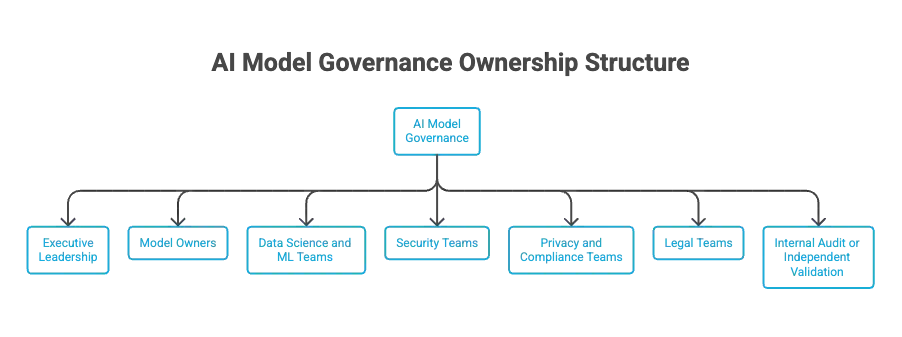
A strong ownership structure typically includes:
- Executive leadership: Sets risk appetite and ensures governance has authority and resources.
- Model owners: Remain accountable for the model’s purpose, performance, limitations, documentation, and lifecycle.
- Data science and ML teams: Build, test, validate, document, and monitor models.
- Security teams: Address threats such as unauthorized access, prompt injection, data leakage, model abuse, and compromised integrations.
- Privacy and compliance teams: Determine applicable privacy, regulatory, retention, and documentation requirements.
- Legal teams: Review contractual, intellectual property, regulatory, and liability considerations.
- Internal audit or independent validation: Provides challenge and assurance that governance controls actually operate as designed.
The important principle is separation of responsibilities. The person developing a high-impact model should not be the only person deciding whether that model is safe to deploy.
Which Controls Make AI Model Governance Enforceable?
Policies describe what should happen. Controls determine whether it actually happens.
The strongest AI model governance best practices connect written requirements with technical enforcement. Sensitive data is one important example. Protecto’s Privacy Vault can detect 200+ PII, PHI, and PCI entity types across 50+ languages, tokenize sensitive information, and support controlled de-tokenization for authorized users.
For enterprise AI chat, GPTGuard applies real-time data masking before sensitive information reaches an LLM, supporting organizations that need to control employee use of models without simply blocking AI access.
Model governance also becomes more complex when AI agents can access tools and enterprise systems. Protecto’s CBAC provides context-based authorization by considering who is requesting access, why it is needed, and the operating context, with audit trails and dynamic masking or unmasking.
This distinction matters because governance should not depend entirely on the model following instructions. Controls need to exist around the model.
How Should Organizations Implement AI Model Governance?
Implementation works better when organizations begin with visibility rather than immediately writing dozens of policies.
1. Build an AI and model inventory
Record every internally developed, third-party, open-source, and embedded AI model. Capture ownership, purpose, provider, version, data sources, users, integrations, geographic deployment, and business impact.
2. Classify models by risk
Create tiers based on factors such as the decisions influenced, sensitivity of data, affected individuals, autonomy, regulatory exposure, and potential harm.
Higher-risk models should receive stronger validation, approval, monitoring, and human oversight.
3. Map data and dependencies
Document where training, testing, retrieval, prompt, and output data originate and where they go. This is where AI model governance intersects directly with data governance and privacy.
4. Establish approval gates
Define minimum evidence required before development, testing, production deployment, and major model changes. Do not approve models solely because they meet an accuracy target.
5. Monitor after deployment
Track model performance, data drift, anomalous behavior, security events, privacy violations, access patterns, and incidents. AI risk management is continuous rather than a one-time assessment.
6. Reassess material changes
A new model version, dataset, vendor, use case, geography, or integration can change the risk profile. Governance should automatically trigger reassessment when defined change thresholds are crossed.
What Should an AI Model Governance Checklist Include?
Use this AI model governance checklist before treating a governance program as operational:
- Every AI model is inventoried and assigned an accountable owner.
- Each model has a documented purpose and approved use case.
- Risk classification is completed and periodically reviewed.
- Training, testing, retrieval, and inference data sources are documented.
- Sensitive data is identified and protected before model processing.
- Model performance and limitations are independently reviewed where appropriate.
- Security and privacy testing is documented.
- Human oversight requirements are defined for consequential decisions.
- Production access is controlled and auditable.
- Runtime prompts, context, tools, and outputs are monitored where relevant.
- Model changes trigger defined review and revalidation requirements.
- Incidents have documented escalation and response procedures.
- Governance evidence is retained for audits and regulatory review.
- Models have documented retirement and decommissioning procedures.
Conclusion
Effective AI model governance connects accountability, risk assessment, data protection, access controls, validation, and continuous monitoring across the model lifecycle. The strongest AI model governance policies do not merely document responsibilities; they establish enforceable controls and evidence. That distinction determines whether governance can withstand regulatory scrutiny, operational change, and increasingly autonomous AI systems.
FAQs on AI Model Governance
What should an AI model governance framework include?
A practical AI model governance framework should include model inventory, risk classification, ownership, data governance, validation, approval gates, access controls, monitoring, incident management, change management, and retirement procedures.
What controls should be included in AI model governance policies?
Effective AI model governance policies should define controls for data access, model validation, security testing, human oversight, deployment approval, monitoring, incident response, documentation, model changes, and decommissioning.
How should organizations classify AI models by risk?
Risk classification should consider the model’s intended use, affected individuals, decision impact, data sensitivity, autonomy, regulatory exposure, and potential harm. Higher-risk applications should receive stronger validation, oversight, monitoring, and approval requirements.
What should organizations monitor after an AI model goes live?
Monitoring should cover performance, data or concept drift, unexpected behavior, security events, privacy violations, access patterns, incidents, and defined risk thresholds. For high-risk AI, ongoing monitoring is explicitly part of the EU AI Act’s lifecycle requirements.
