
Artificial intelligence is reshaping how enterprises process information, but it is also redefining where sensitive data is exposed. Every prompt, retrieval request, API call, and AI-generated response creates another opportunity for personal or confidential information to move beyond its intended boundaries.
According to Cisco’s 2026 Data Privacy Benchmark Study, 90% of organizations say AI has expanded the scope of their privacy responsibilities, while 93% plan to increase investment in privacy and data governance over the next two years.
These findings underscore a fundamental shift: protecting AI models alone is no longer enough. Organizations must prioritize AI data pipeline security by safeguarding data throughout its entire journey, from ingestion to inference and every interaction in between.
AI Security Starts with the Data Journey, Not the Model
When organizations discuss AI security, the conversation often focuses on protecting models from attacks such as prompt injection or jailbreak attempts. While these threats are important, they represent only one part of the risk landscape.
In reality, every enterprise AI application relies on a continuous flow of data. Customer records, employee information, financial transactions, healthcare documents, and proprietary business knowledge all move through multiple systems before an AI model generates an output. Each transfer creates a new opportunity for sensitive information to be exposed.
This is why AI data pipeline security should be viewed as an architectural discipline rather than a standalone security feature. Instead of asking whether a model is secure, enterprises should ask whether every stage of the data pipeline is protected.
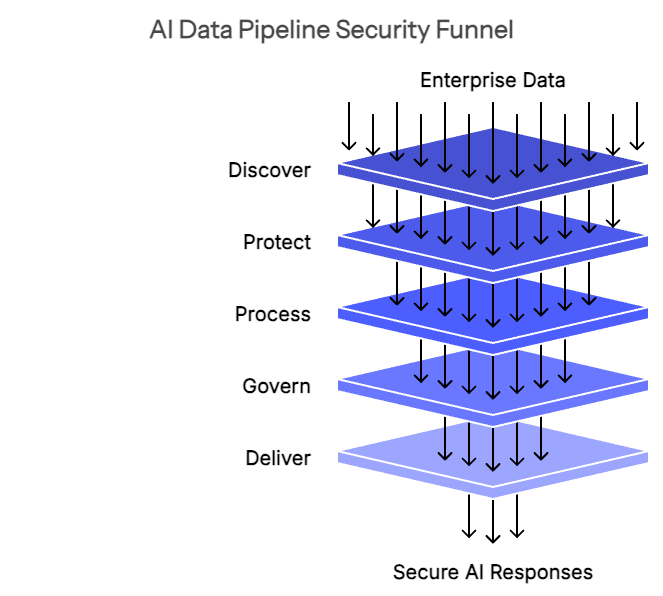
The table below illustrates the five critical checkpoints where data protection in AI pipelines should be embedded.
| AI Pipeline Stage | What Happens | Primary Security Objective |
| Discover | Enterprise data is identified and prepared | Detect sensitive information before AI uses it |
| Protect | Sensitive data is masked or tokenized | Reduce exposure without sacrificing utility |
| Process | AI models, RAG systems, and agents access data | Secure prompts, retrieval, and inference |
| Govern | AI agents interact with enterprise systems | Apply dynamic, context-aware access controls |
| Deliver | AI responses are generated and consumed | Prevent sensitive data leakage and maintain compliance |
Stage 1: Visibility Comes Before Protection
Effective AI data pipeline security begins with understanding what data your AI systems are about to process. As enterprises connect documents, databases, and knowledge repositories to LLMs, sensitive information often exists in unstructured text, multilingual content, or proprietary business records that traditional discovery tools can miss.
Moreover, Cisco’s 2025 Cybersecurity Readiness Index explains that 60% of organizations lack visibility into the prompts employees submit to generative AI applications, limiting their ability to identify data exposure risks before information reaches AI systems.
Building secure AI data pipelines starts with discovering and classifying sensitive information at the source. Protecto DeepSight strengthens enterprise AI data security through AI-native, context-aware detection that identifies PII, PHI, PCI data, and custom business identifiers across complex datasets. By establishing visibility first, organizations can apply privacy controls before sensitive data enters AI workflows.
Stage 2: Keep Sensitive Data Out of AI Models
Once sensitive information is identified, the next step is reducing unnecessary exposure. Rather than sending raw personal data directly to AI models, organizations should replace sensitive values with privacy-preserving tokens before creating prompts, embeddings, or RAG workflows. This approach strengthens data protection in AI pipelines while preserving AI performance.
Protecto Privacy Vault helps organizations build secure AI data pipelines by detecting over 200 PII, PHI, and PCI entity types across 50+ languages and replacing them with context-preserving tokens. Authorized users can restore the original data only when required, while AI systems continue processing protected information.
This privacy-first approach reduces compliance risk, minimizes the attack surface, and enables enterprises to scale AI without exposing sensitive data.
Stage 3: Secure Every Prompt, Retrieval, and AI Interaction
Protecting sensitive data before AI processing is only half the challenge. During inference, AI systems continuously retrieve enterprise data, construct prompts, and generate responses, creating multiple opportunities for information leakage. This risk is particularly high in Retrieval-Augmented Generation (RAG), where sensitive content may be stored in vector databases or included in prompts.
Protecto helps organizations build secure AI data pipelines by protecting data throughout RAG workflows. Combined with GPTGuard, enterprises can securely interact with ChatGPT, Gemini, Claude, and other LLMs while masking sensitive information in real time before it leaves the organization.
Stage 4: AI Agents Need Context, Not Static Permissions
As enterprises adopt AI agents, traditional role-based access control (RBAC) becomes increasingly difficult to enforce. AI agents can chain multiple actions, access various tools, and dynamically retrieve data, making static permissions insufficient for modern AI environments.
Instead, organizations need context-aware policies that evaluate who is requesting access, why it is needed, and what information should be exposed. This approach strengthens enterprise AI data security without limiting AI functionality.
Protecto CBAC (Context-Based Access Control) enables real-time authorization for AI agents by making access decisions at inference time. Dynamic data masking, controlled unmasking, and comprehensive audit trails ensure that users and AI agents access only the information required for their specific tasks, supporting stronger AI data pipeline security across complex workflows.
Stage 5: Security Continues After the Model Responds
A secure AI pipeline does not end when an LLM generates an answer. Responses may still expose customer records, confidential business information, or regulated data if appropriate safeguards are not in place. Continuous monitoring, output inspection, and audit logging help ensure that sensitive information is shared only with authorized users.
This final layer of data protection in AI pipelines also supports compliance with regulations such as GDPR, HIPAA, DPDP, and CCPA by providing traceability across AI interactions.
Together, Privacy Vault, DeepSight, GPTGuard, and CBAC create a layered approach to AI data pipeline security, helping organizations secure personal data before, during, and after model use while enabling responsible AI adoption at enterprise scale.
How Does Protecto Secure the Entire AI Data Pipeline?
Rather than relying on isolated security controls, Protecto embeds privacy across every stage of the AI lifecycle.
| AI Pipeline Challenge | Protecto Solution |
| Discover sensitive data | DeepSight |
| Tokenize and protect PII | Privacy Vault |
| Secure enterprise AI chat and RAG | GPTGuard |
| Govern AI agent access | CBAC |
| Mask large datasets for AI training | High-Volume Data Masking |
This integrated approach helps organizations build secure AI data pipelines that balance innovation, compliance, and operational efficiency. Whether deploying generative AI, RAG applications, or autonomous AI agents, Protecto enables enterprises to protect sensitive information without disrupting AI performance.
Conclusion
As enterprise AI adoption accelerates, securing the model alone is no longer enough. Effective AI data pipeline security requires protecting sensitive information at every stage, from discovery and tokenization to AI processing, access control, and output governance.
By embedding data protection in AI pipelines into the architecture, organizations can reduce privacy risks, simplify compliance, and confidently scale AI innovation. With integrated solutions such as Privacy Vault, DeepSight, GPTGuard, and CBAC, Protecto helps enterprises build secure AI data pipelines that protect personal data without compromising AI performance or business agility.
FAQs on AI Data Pipeline Security
Why is AI data pipeline security important for enterprises?
It helps organizations prevent the exposure of sensitive data, meet regulatory requirements, reduce breach risk, and ensure that AI systems process only authorized information, without compromising business operations or customer trust.
How do enterprises secure AI data pipelines?
Enterprises secure AI data pipelines by discovering sensitive data, tokenizing personal information, securing RAG workflows, implementing context-aware access controls, monitoring outputs, and maintaining comprehensive audit logs.
What role does tokenization play in AI data pipeline security?
Tokenization replaces sensitive information with non-sensitive tokens before AI processing, allowing models to function normally while significantly reducing the risk of exposing personal or regulated data.
Why is sensitive data discovery the first step in securing AI pipelines?
Organizations cannot protect data they cannot identify. Discovering PII, PHI, PCI, and confidential business information enables security teams to apply appropriate privacy controls before AI processing begins.
What is the difference between AI model security and AI data pipeline security?
AI model security focuses on protecting models from attacks, while AI data pipeline security protects sensitive information throughout its lifecycle before, during, and after AI model interactions.
