
AI governance often breaks down before the first serious AI incident occurs. The problem is usually not the technology itself, but the absence of clear boundaries around how employees use it, what information they can share, and which decisions still require human oversight.
That matters as workplace AI adoption accelerates. The 2024 Work Trend Index Annual Report from Microsoft and LinkedIn found that 75% of global knowledge workers were already using AI at work in 2024. Hence, organizations must understand how an AI acceptable use policy offers a practical way to turn that AI adoption into defined rules for tools, data, access, oversight, and accountability.
What Is an AI Acceptable Use Policy?
An AI acceptable use policy is an organizational policy that defines how employees and other authorized users can use artificial intelligence systems. Unlike a broad AI ethics statement, it focuses on operational behavior, establishing clear boundaries around tools, data, access, oversight, and accountability.
IBM’s 2025 Cost of a Data Breach research found that 63% of breached organizations either lacked an AI governance policy. It makes a clearly defined AI acceptable use policy an important operational layer for managing AI risk.
It should establish:
- Which AI tools can employees use
- What information can be entered into those tools
- Which AI use cases require approval
- When human review is mandatory
- How AI-generated content should be verified
- How AI incidents and policy violations are reported
- Who owns AI governance and enforcement
A strong generative AI acceptable use policy should also address LLMs, copilots, RAG applications, AI agents, APIs, and third-party AI services where relevant.
The Policy Should Answer: “What Can I Do With AI?”
Many policies become ineffective because they state broad principles without explaining what employees should do in specific situations.
A practical generative AI acceptable use policy can classify AI activity according to risk:
| Area | Generally acceptable | Requires controls or approval | Prohibited |
| Productivity | Drafting, summarizing, brainstorming | External communications | Fabricating records |
| Data | Public information | Internal or confidential data | Unauthorized sensitive data |
| Development | Code assistance with approved tools | Production code | Uploading credentials or secrets |
| Decisions | Low-risk recommendations | High-impact decisions with review | Unauthorized automated decisions |
| AI tools | Approved enterprise tools | New vendors or models | Unapproved use of sensitive data |
The exact classifications should reflect the organization’s industry, contractual obligations, regulatory requirements, and risk tolerance. That is why an AI acceptable use policy template for an enterprise should be adapted rather than copied unchanged from another organization.
AI Acceptable Use Policy Template
A practical AI acceptable use policy template should provide employees with clear rules rather than abstract principles. The following structure can be adapted to an organization’s requirements.
1. Purpose
Purpose:
This policy establishes requirements for the responsible, secure, and appropriate use of artificial intelligence within the organization. It is intended to support productive AI use while protecting company information, customer data, intellectual property, and other sensitive information.
2. Scope
Scope:
This policy applies to employees, contractors, temporary workers, and other authorized users who access or use AI systems for organizational purposes.
3. Approved AI Tools
Approved tools:
Employees may use AI applications approved by the organization. New AI tools, models, plugins, APIs, or integrations must undergo the organization’s established security, privacy, legal, and compliance review before use with company information.
4. Acceptable Use
Employees may use approved AI tools for activities such as:
- Brainstorming and ideation
- Drafting and editing
- Summarizing non-sensitive information
- Research using appropriate sources
- Coding assistance where permitted
- Low-risk productivity tasks
5. Restricted and Prohibited Data
Employees must not enter sensitive information into an AI system unless the system has been explicitly approved for that data classification.
This includes, where applicable:
- Personally identifiable information
- Protected health information
- Payment card information
- Credentials and API keys
- Confidential customer information
- Proprietary source code
- Trade secrets and intellectual property
- Regulated or legally protected information
Here, Protecto’s Privacy Vault can support the policy requirement with a technical control rather than relying entirely on employee judgment, as it can detect more than 200 PII, PHI, and PCI entity types across 50+ languages and tokenize sensitive information while preserving context.
6. Human Oversight
Human review is required when AI output could materially affect customers, employees, finances, legal matters, security, compliance, or other high-impact decisions. Users remain responsible for reviewing AI-generated content before relying on, publishing, or distributing it.
7. Security Requirements
Users must not intentionally attempt to bypass AI security controls, expose confidential information, upload malicious content, or provide credentials to unauthorized AI systems.
Organizations should also address prompt sanitization and LLM runtime security when defining technical requirements around AI interactions.
8. Incident Reporting
Suspected data leakage, unauthorized AI use, prompt injection attack, policy violations, or other AI security incidents must be reported through the organization’s established security or compliance process.
9. Enforcement and Review
Violations may result in appropriate disciplinary or contractual action. The policy should be reviewed periodically and updated when AI capabilities, regulations, risks, or organizational use cases materially change.
This AI acceptable use policy template gives organizations a starting point, but the controls behind each rule determine whether the policy works in practice.
AI Acceptable Use Policy Examples: Turning Rules Into Action
The strongest examples of AI acceptable use policies are specific.
Instead of writing:
“Employees must protect confidential information when using AI.”
Use a rule such as:
“Employees must not enter customer PII, payment information, credentials, confidential source code, or regulated information into an AI service unless that service has been approved for the relevant data classification.”
Similarly, instead of simply stating “verify AI outputs,” define where verification is mandatory. For example:
- AI-generated legal analysis requires qualified human review.
- AI-generated financial recommendations require authorized review.
- AI-generated customer communications require appropriate review before distribution.
- AI-generated production code must follow the organization’s normal security and testing process.
These AI acceptable use policy examples reduce ambiguity because employees can identify the required action.
From AI Acceptable Use Policy Drafting to Enforcement
An AI acceptable use policy only works when its requirements can be enforced. A rule such as “do not send confidential customer information to an external LLM” cannot, by itself, identify sensitive data inside prompts, documents, or RAG retrievals.
Here, Protecto can ensure enforcement through DeepSight for data discovery, Privacy Vault for tokenization, GPTGuard for protecting enterprise AI chats, and CBAC for context-based access decisions.
This is the core of AI acceptable use policy drafting: policies define what should happen, while technical controls help ensure it actually does.
A Practical Six-Step Implementation Guide
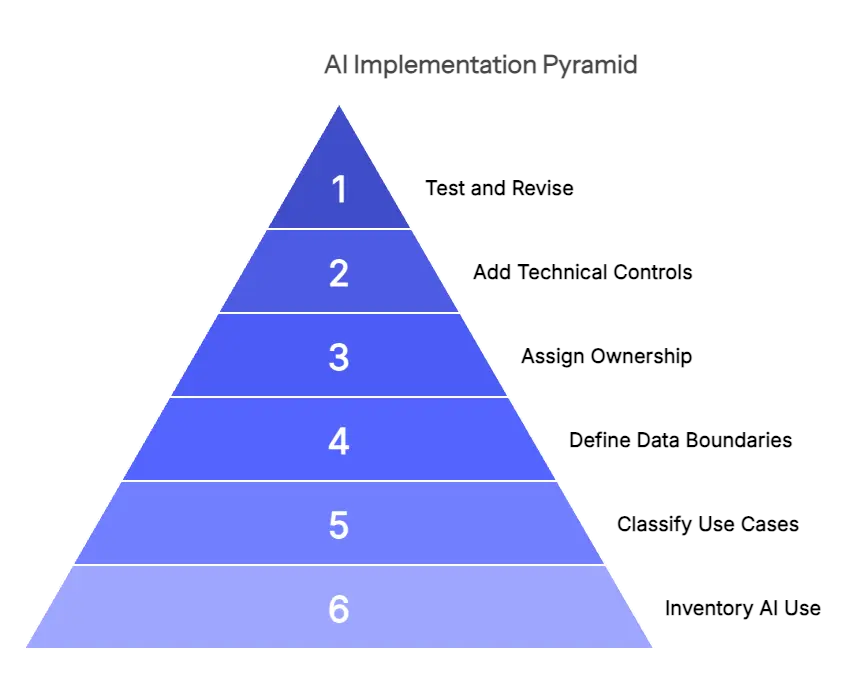
Once the AI acceptable use policy template is finalized, implementation can follow six steps:
1. Inventory AI use
Identify approved applications, public AI tools, APIs, copilots, RAG applications, and AI agents currently being used.
2. Classify use cases
Separate low-risk productivity use from applications involving regulated data, customers, employees, financial decisions, or autonomous actions.
3. Define data boundaries
Specify what information each AI system can process and establish explicit restrictions for PII, PHI, PCI, credentials, intellectual property, and confidential information.
4. Assign ownership
Give security, privacy, legal, compliance, IT, and business teams defined responsibilities for approval and oversight.
5. Add technical controls
Use sensitive-data discovery, tokenization, masking, access controls, prompt protection, and runtime monitoring where policy alone cannot prevent exposure. AI data pipeline security provides additional context on protecting data before, during, and after AI processing.
6. Test and revise
Use incidents, policy violations, new AI capabilities, and LLM red teaming to identify weaknesses. Testing should cover prompt injection, sensitive-data leakage, excessive permissions, and unsafe tool access. Protecto’s LLM red teaming guidance specifically addresses prompt injection, PII leakage, and tool abuse.
Conclusion
An AI acceptable use policy should not become another document employees acknowledge and forget. It should establish clear boundaries around AI tools, data, decisions, human oversight, and security.
A well-designed AI acceptable use policy template provides the governance layer. Technical controls provide enforcement. Together, they give enterprises a practical framework for expanding AI use while reducing unnecessary exposure of sensitive information.
FAQs on AI Acceptable Use Policy
What should an AI acceptable use policy prohibit?
An AI acceptable use policy should prohibit unauthorized sharing of PII, PHI, credentials, payment data, confidential information, trade secrets, and proprietary code with unapproved AI systems.
What should an AI acceptable use policy template include?
An AI acceptable use policy template should cover scope, approved tools, acceptable use, prohibited data, human oversight, security controls, incident reporting, accountability, enforcement, and periodic review.
Should employees be allowed to use ChatGPT at work?
They can be, but organizations should distinguish between approved enterprise deployments and public AI services. Sensitive company data should only be processed through tools that meet the organization’s security and privacy requirements.
How often should an AI acceptable use policy be updated?
Review it at least annually and whenever there are significant changes to AI capabilities, regulations, approved tools, organizational use cases, security incidents, or data-handling requirements.
