
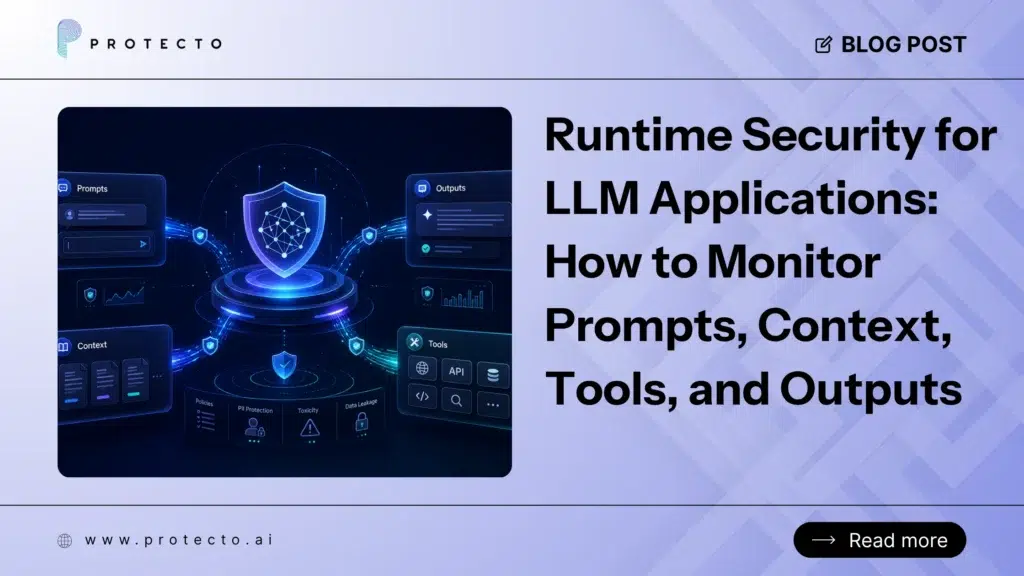
Large language models are becoming the operational layer behind enterprise AI, powering intelligent assistants, automated workflows, and AI agents that interact with sensitive business systems. But as LLMs process confidential prompts, retrieve enterprise context, and execute connected actions, every runtime interaction introduces new security risks.
Did you know that, according to McKinsey’s 2025 State of AI Global Survey, 88% of organizations already use generative AI in at least one business function, up from 78% in early 2024? This rapid adoption has made LLM runtime security a critical requirement for enterprises moving AI from experimentation into production.
Instead of relying only on model testing before deployment, organizations need continuous visibility across prompts, retrieved context, tool interactions, and outputs to prevent data exposure, unauthorized actions, and evolving LLM-specific threats.
Why Has Runtime Become the New AI Security Boundary?
Traditional application security was built around predictable software behavior. LLM applications work differently. They process natural language instructions, retrieve enterprise knowledge, interact with APIs, and make decisions based on constantly changing context.
Even a well-tested model can become vulnerable during real-world execution when:
- A malicious prompt overrides intended instructions
- Sensitive information enters the conversation flow
- A connected tool receives unauthorized commands
- Generated responses expose confidential data
This is why modern LLM application security needs to move closer to where AI decisions are made. Runtime monitoring creates a continuous security layer around every prompt, context window, retrieval action, tool call, and response.
The need for runtime visibility is becoming more urgent as AI adoption expands. Without runtime safeguards, enterprises risk losing control over how sensitive data moves through AI systems after deployment.
The Four Layers That Define Effective LLM Runtime Security
Strong LLM runtime security requires complete visibility across the entire AI interaction lifecycle. Protecting only inputs or only outputs leaves gaps that attackers can exploit.
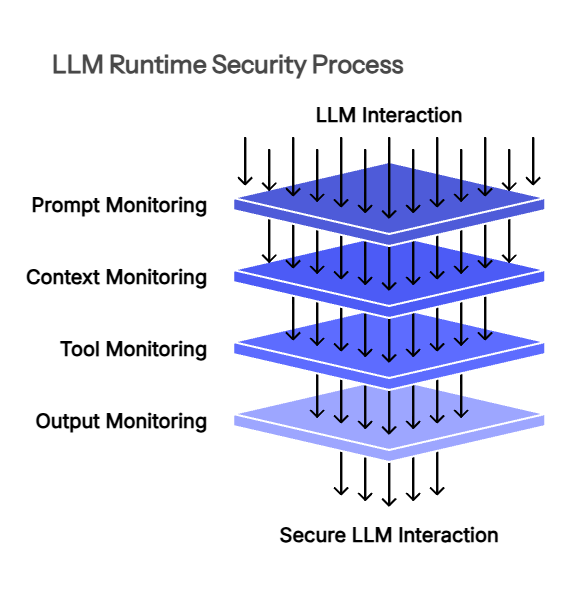
1. Prompt Monitoring: Securing the First Point of Interaction
Every LLM request starts with a prompt. These prompts may contain user instructions, business data, personal information, or hidden malicious commands.
Runtime prompt monitoring helps detect:
- Prompt injection attempts
- Sensitive data exposure
- Unauthorized instructions
- Policy violations
For enterprises using public or private LLMs, protecting prompts before they reach the model is essential.
Protecto’s GPTGuard supports this approach by helping organizations securely use AI chat systems by identifying sensitive data and applying privacy-preserving data masking before information reaches an LLM. It enables employees to use AI tools while reducing the risk of exposing confidential data.
2. Context Monitoring: Protecting the Information LLMs Depend On
Modern AI applications rarely depend only on user prompts. Retrieval-Augmented Generation (RAG) systems connect LLMs with documents, databases, and enterprise knowledge.
While this improves accuracy, it also increases security risks. The model may retrieve information that the user should not access or combine unrelated contexts in unsafe ways.
Effective runtime protection for LLM applications requires monitoring:
- What information enters the context window
- Which documents are retrieved
- Whether sensitive information should be masked
- If the user has permission to access the required data
Protecto Privacy Vault helps address this challenge by scanning sensitive information, applying intelligent data tokenization, and allowing controlled de-tokenization only for authorized users. It supports AI pipelines by keeping data usable while reducing unnecessary exposure.
3. Tool Monitoring: Controlling What AI Agents Can Actually Do
The rise of AI agents has changed the security conversation. LLMs are no longer limited to answering questions. They can call APIs, access applications, trigger workflows, and complete tasks.
This creates new risks:
- Agents accessing restricted systems
- Unauthorized tool execution
- Excessive permissions
- Uncontrolled multi-step actions
Traditional role-based access control was designed for human users, not autonomous AI workflows.
Protecto’s CBAC (Context-Based Access Control) addresses this challenge by making access decisions at inference time. Instead of relying only on static permissions, access decisions consider identity, purpose, and operational context before allowing AI agents to interact with sensitive information.
This strengthens LLM attack prevention by limiting what an AI system can access and execute in real-world operations.
4. Output Monitoring: Stopping Data Exposure Before It Happens
A secure AI workflow does not end after a response is generated. The final output is often where sensitive information leakage becomes visible.
LLM output monitoring analyzes generated responses before they reach users or external systems.
It helps identify:
- Personally identifiable information (PII)
- Protected health information (PHI)
- Confidential business data
- Unauthorized disclosures
- Compliance violations
With runtime output controls, organizations can identify risky responses and apply protective actions before exposure occurs.
Building a Complete LLM Runtime Security Framework
A complete security strategy connects every AI interaction layer rather than treating them separately.
| Runtime Layer | Security Risk | Required Protection |
| Prompts | Prompt injection attacks, sensitive inputs | Prompt inspection and data masking |
| Context | Unauthorized retrieval | Secure RAG and access control |
| Tools | Excessive AI permissions | Runtime authorization policies |
| Outputs | Sensitive data leakage | LLM output monitoring and response filtering |
This connected approach creates stronger runtime protection for LLM applications because security follows the entire AI workflow.
Moving Beyond Detection Toward Runtime Prevention
Monitoring alone is no longer enough. Enterprise AI environments require prevention capabilities that act before sensitive information leaves controlled environments.
Strong LLM runtime security should include:
- Sensitive data discovery
- Real-time masking
- Dynamic access control
- Secure AI pipelines
- Audit visibility
- Compliance enforcement
Protecto’s AI security infrastructure supports these requirements across different stages of AI adoption.
DeepSight provides AI-native sensitive data detection designed for complex, unstructured, and multilingual AI data pipelines. Privacy Vault enables tokenization and controlled access to sensitive information. GPTGuard helps secure enterprise AI chat adoption, while CBAC brings real-time access governance to AI agents.
Together, these capabilities support safer AI innovation without forcing businesses to choose between productivity and data protection.
Conclusion
As enterprises move from AI experimentation to production-ready applications, security strategies must evolve beyond traditional controls. LLMs now interact with sensitive data, business systems, external tools, and enterprise knowledge sources in real time, creating risks that cannot always be addressed before deployment. LLM runtime security provides the continuous visibility and protection needed to monitor every prompt, context exchange, tool action, and generated response.
By strengthening LLM application security with real-time monitoring, access governance, sensitive data protection, and monitoring of LLM outputs, organizations can reduce exposure risks while maintaining the speed and innovation that AI enables.
With the right approach to runtime protection for LLM applications, businesses can confidently scale AI adoption while keeping security, privacy, and compliance at the center.
FAQs on LLM Runtime Security
What risks can occur when LLM applications run without runtime protection?
Without runtime protection for LLM applications, enterprises may face prompt injection attacks, exposure of sensitive data, unauthorized tool use, insecure AI agent behavior, and the disclosure of confidential information in generated responses or external system interactions.
What is LLM output monitoring, and how does it reduce security risks?
LLM output monitoring analyzes AI-generated responses before they reach users or applications. It helps detect exposure of sensitive data, leakage of confidential information, inaccurate disclosures, and responses that violate enterprise security or compliance policies.
How does runtime protection improve security for RAG applications?
Runtime protection for LLM applications secures RAG pipelines by monitoring retrieved data, controlling access, and preventing sensitive information from entering prompts or outputs. This helps enterprises use internal knowledge securely with AI systems.
What should enterprises monitor in an LLM application?
Enterprises should monitor user prompts, retrieved context, AI agent actions, tool calls, API interactions, and generated responses. Complete runtime visibility helps identify threats across the entire AI workflow rather than in isolated components.
Why is pre-deployment testing not enough for LLM security?
Pre-deployment testing cannot predict every real-world prompt, user interaction, or AI agent decision. Runtime monitoring provides continuous protection by ensuring AI behavior remains secure as applications operate in changing environments.
