

AI models are becoming essential to enterprise innovation, but the sensitive data that powers them is creating new security and privacy challenges. Even when raw training datasets remain inaccessible, attackers may still identify whether specific information was used to train a model through membership inference attacks.
These emerging privacy attacks in machine learning analyze model behavior to uncover hidden patterns in training data, increasing the risk of membership inference attacks for organizations handling confidential information. A landmark study showed that membership inference techniques could successfully determine whether individual records were part of a machine learning model’s training dataset.
As AI adoption accelerates, understanding how membership inference attacks work and securing training data have become critical for building responsible, privacy-first AI systems.
The Hidden Privacy Challenge Inside AI Training Data
Traditional cybersecurity focuses on protecting databases, networks, and applications. AI introduces a different challenge because trained models can sometimes retain patterns from the data they were trained on.
A model does not usually reveal an entire training dataset. However, attackers may analyze confidence scores, prediction patterns, or responses to determine whether specific data was present during training.
For example, if a healthcare AI model behaves differently when processing a patient record it has previously seen, an attacker may infer that the patient’s information existed in the training data.
This makes membership inference attacks especially concerning for industries handling sensitive information, including healthcare, finance, insurance, and government services.
How Membership Inference Attacks Work: Understanding the Attack Path
To understand how membership inference attacks work, it helps to look at the information gap attackers try to exploit.
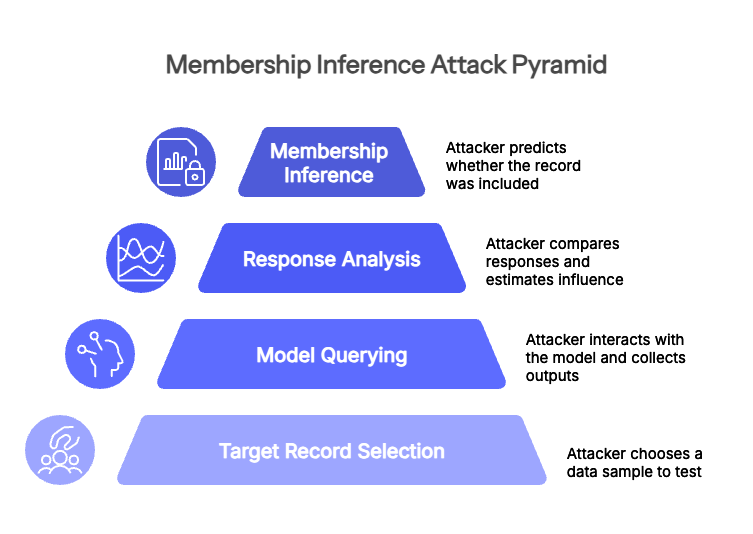
Machine learning models often respond differently to familiar and unfamiliar data. Models that are overtrained or poorly protected may show higher confidence when processing records they have already learned from.
A typical membership inference process involves:
Selecting a target record
An attacker chooses a specific data sample and wants to know whether it exists in the training dataset.
Querying the AI model
The attacker repeatedly interacts with the model and collects outputs, confidence scores, or behavioral signals.
Analyzing response patterns
The attacker compares responses and estimates whether the target information influenced model training.
Inferring membership
Based on these signals, the attacker predicts whether the record was included.
A 2023 research paper analyzing privacy risks in large language models showed that training data extraction attacks could recover portions of memorized data from certain language models, reinforcing concerns around data exposure in AI systems.
Why Do Membership Inference Attack Risks Matter for Enterprises?
The biggest concern is not just knowing that a record existed. The real problem is what that information reveals.
For example, discovering that someone’s data was used in a medical AI model could indirectly expose health-related information. Identifying a user inside a fraud detection model may reveal financial associations.
Here is how different membership inference attack risks affect enterprises:
| Attack Scenario | Potential Exposure | Enterprise Impact |
| Healthcare model inference | Patient presence in training data | Privacy violations and compliance concerns |
| Financial AI analysis | Customer or transaction membership | Increased fraud and confidentiality risks |
| Employee AI systems | Internal document exposure | Leakage of business-sensitive information |
| Public AI applications | User data identification | Loss of trust and regulatory scrutiny |
The rise of AI adoption has also expanded the attack surface. The Stanford AI Index Report 2025 highlighted continued growth in AI deployment across industries, underscoring the importance of responsible AI governance and privacy protection.
Membership Inference Attacks vs. Other Privacy Attacks in Machine Learning
While membership inference attacks receive significant attention, they are part of a broader category of privacy attacks in machine learning.
Other attacks include:
Model inversion attacks: Attempt to reconstruct sensitive features from model outputs.
Training data extraction attacks: Try to recover actual examples memorized by a model.
Model-stealing attacks: Attempts to replicate a model’s behavior via repeated queries.
What makes membership inference attack risks unique is that attackers do not need to recover the original information. Simply confirming whether information existed in training data can create privacy problems.
Why Traditional Security Controls Are Not Enough?
Firewalls, access permissions, and encryption protect conventional systems, but AI requires protection across the complete data lifecycle.
The challenge is that sensitive information can move through multiple AI stages:
- Data preparation
- Model training
- Fine-tuning
- Retrieval systems
- AI agent workflows
- User interactions
If sensitive information enters AI workflows without proper controls, organizations increase their exposure to membership inference attacks.
This is why modern AI security focuses on protecting data before it reaches models, rather than only protecting access after deployment.
Reducing Membership Inference Risks With Privacy-First AI Architecture
Reducing the impact of membership inference attacks requires organizations to minimize exposure of sensitive data from the outset.
Effective approaches include:
1. Sensitive Data Discovery Before AI Processing
Organizations need visibility into where sensitive data exists before using it for AI.
Protecto DeepSight is designed for AI-native detection of sensitive data across complex environments. It identifies sensitive information based on context rather than relying only on traditional pattern matching, helping organizations detect hidden privacy risks in AI pipelines.
2. Tokenization and Data Minimization
Removing unnecessary sensitive information reduces what models can potentially memorize.
Protecto Privacy Vault supports enterprise AI privacy by detecting 200+ PII, PHI, and PCI entity types across structured and unstructured data. It uses intelligent tokenization to replace sensitive values while maintaining AI usability through controlled de-tokenization for authorized users.
3. Secure Enterprise AI Usage
Employees increasingly interact with AI assistants and LLM applications. Without safeguards, sensitive information may be exposed to external AI systems.
Protecto GPTGuard MCP helps enterprises use AI chat securely by masking sensitive information before it reaches AI models, while preserving useful context to ensure accurate responses.
4. Safer AI Training Data Preparation
Large AI projects often require processing millions or billions of records.
Protecto High-Volume Data Masking helps organizations protect large-scale AI training datasets through scalable masking workflows designed for data lakes, migrations, and AI preparation pipelines.
Conclusion
As AI becomes embedded in enterprise operations, privacy cannot be treated as a final security checkpoint. It needs to be built into every stage where data interacts with AI.
Understanding how membership inference attacks work allows security teams to recognize why training data protection matters. The future of AI security depends on limiting unnecessary exposure, detecting sensitive information early, and ensuring models learn safely without compromising individual privacy.
Membership inference attacks show that protecting AI is not only about protecting models. It is about protecting the data, people, and organizations behind them. With privacy-first AI infrastructure, enterprises can continue innovating while reducing the risks created by emerging privacy attacks in machine learning.
FAQs on Membership Inference Attacks in AI
Why are membership inference attacks a serious risk for enterprise AI systems?
Enterprises face higher risks of membership inference attacks because their AI models often process confidential customer records, financial information, healthcare data, or business documents. If attackers confirm data membership, organizations may face privacy violations, regulatory issues, and loss of customer trust.
How do attackers know if specific data was used to train an AI model?
Attackers use repeated queries and analyze prediction behavior, confidence scores, or output patterns to determine whether a record influenced model training. Understanding how membership inference attacks work helps organizations identify vulnerabilities before attackers exploit sensitive AI systems.
How are membership inference attacks different from model inversion attacks?
Membership inference attacks determine whether specific data existed in a training dataset, while model inversion attacks attempt to reconstruct information about the original data. Both are important privacy attacks in machine learning that target weaknesses in AI model privacy.
What causes AI models to become vulnerable to membership inference attacks?
AI models become vulnerable to factors such as overfitting, excessive memorization, insufficient data protection, and poor privacy controls during training. Models that respond differently to known and unknown records often create opportunities for attackers to infer membership in the training set.
What role does AI data governance play in preventing membership inference attacks?
AI data governance establishes policies for managing, protecting, and monitoring information used in AI systems. Strong governance helps organizations control the use of sensitive data, reduce privacy vulnerabilities, and maintain visibility across AI training and deployment workflows.
