
Your RAG pipeline goes live on a Monday. By Friday, a customer query is surfacing another user’s account number in a response. Privacy-first AI stops that before the data reaches any model. More than half of organizations have already experienced an AI-related security incident, according to Check Point’s 2026 Cloud Security Report, and most don’t catch it until an audit forces the issue. Start with AI data privacy concepts and best practices.
Privacy-first AI means sensitive data is detected, masked, and tokenized before it reaches any model, including LLMs, RAG pipelines, and agents. Controls run at every point data moves: through prompts, vector indexes, API calls, and logs, so raw PII never touches the model and never crosses a jurisdiction boundary.
Where Does Privacy-First AI Break Down in Your Pipeline?
Privacy-first AI systems don’t fail at a single point. Most teams secure their storage layer and assume the rest follows. It doesn’t. Every transition in the pipeline creates a new exposure window: when data enters an index, when a prompt fires, when a response lands in a log. Legacy controls weren’t built for any of those.
| Pipeline Layer | What Leaks | Why Standard Controls Miss It |
| LLM prompts | PII, PHI, account data | Prompts are dynamic; legacy DLP doesn’t parse semantic context |
| RAG indexes | Document PII, internal records | PDFs indexed without redaction; one query surfaces raw values |
| API responses | Model outputs with inferred data | Output scanning rarely catches data inferred from context |
| Agent logs | Session history, tool calls | Logs retain raw values by default for debugging |
The IBM 2025 Cost of a Data Breach Report found that 97% of organizations that experienced AI-related breaches lacked adequate AI access controls.
What Does a Privacy-Preserving AI Architecture Actually Need?
A privacy-preserving AI architecture isn’t one tool. Most of the real exposure in production AI sits between your storage layer and your model, in embeddings, vector indexes, and agent tool calls that nobody scanned. Controls need to sit at those specific points, not just at the database where most teams stop. Everything in between stays unscanned. Agentic AI data privacy and compliance covers each of those layers.
- Detect sensitive entities at ingestion, not at output. PII in a RAG index compounds with every retrieval cycle
- Apply context-preserving tokenization so the LLM receives masked data that still carries structural meaning
- Set role-based access control at the agent level. Most teams only set it at the database, which misses where agents actually run
- Keep tamper-proof audit logs. Regulators and enterprise buyers want evidence of what moved, not assurances it didn’t
| Privacy Technique | How It Works | AI Accuracy Impact | Best For |
| Traditional masking | Replaces values with blanks or asterisks | High loss: LLM loses context and hallucinates | Static databases |
| Differential privacy | Adds calibrated noise to outputs | Moderate loss: degrades precision at scale | Aggregate analytics |
| Context-preserving tokenization | Replaces PII with structured, format-retaining tokens | Minimal loss: maintains semantic meaning | LLM prompts, RAG, agentic workflows |
| Federated learning | Trains locally without sharing raw data | Low loss, high compute cost | Model training phase only |
Why Standard Masking Isn’t Enough to Build Privacy-First AI
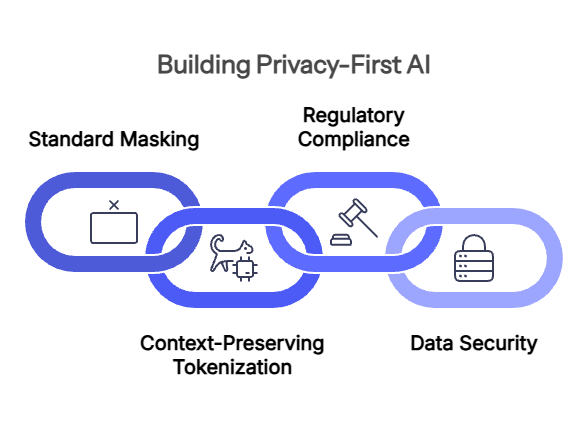
Standard masking strips the value out of a field. The model gets a blank where a name or account number used to be. It can’t reason with that. The tool call downstream expected an email address. It breaks. Nobody notices until hallucinations start showing up in model outputs.
- Redact a name to [NAME], and the model has an empty slot. It skips the field or generates a placeholder.
- Remove email format and the downstream tool call breaks. It was built for a structured address, not a blank token.
- Teams that hit this problem often turn off masking entirely to restore accuracy. That creates a bigger risk than the one they started with
Context-preserving tokenization replaces sensitive values with format-retaining tokens the model processes normally. Protecto’s deployment at a leading Middle Eastern bank maintained cosine similarity above 85% (a measure of how close the masked output was to the original) on fully masked data, with no raw values leaving the jurisdiction. India’s DPDP Rules enter full enforcement from May 2027, with penalties of up to INR 250 crore per violation. Most teams trying to build privacy-first AI today don’t have controls in place at the layer where exposure actually occurs.
How Protecto Helps Indian Enterprises Build Privacy-First AI
Protecto’s DeepSight Engine detects PII, PHI, and PCI across 50+ languages with above 99% recall, including multilingual and malformed text that legacy DLP misses. GPTGuard masks data in real time before prompts reach OpenAI, Gemini, or Claude. Privacy Vault deploys on-premises or on GCC Cloud in under four weeks, keeping all raw data inside your jurisdiction. SOC 2 certified, ISO 27001, HIPAA, and DPDP-ready, and trusted by Fortune 100 enterprises. Book a demo to see it in action on your stack.
Most AI teams in 2026 have a privacy policy on paper. Fewer have a live control at the prompt layer. That’s where most breaches start. What does production-level protection actually look like in a live stack? Protecto Privacy Vault shows you.
If you’re already running AI in production, the starting point isn’t a rebuild. It’s finding the specific layer where raw data moves unchecked. For most teams, that’s the RAG index or the agent tool call.
Start Building Privacy-First AI Today
Protecto’s team can map your current pipeline for data exposure in one session, covering prompts, RAG indexes, and agent tool calls. DPDP enforcement begins May 2027. The free trial includes a four-week pilot to get your pipeline compliant before that deadline. Start with DPDP-ready AI compliance to see where your stack stands today.
Frequently Asked Questions
What is privacy-first AI?
Privacy-first AI flips the default. Instead of asking how to protect data after the pipeline is built, the question is asked before the pipeline is built. Every architectural decision, from how data is indexed to how logs are stored, starts with one constraint: the model should receive only what it actually needs.
How does privacy-preserving AI differ from traditional data security?
Traditional data security was built for databases, firewalls, and static files. Privacy-preserving AI has to protect data as it moves through prompts, embeddings, and agent responses, none of which have a fixed schema or a clean boundary. Most legacy controls weren’t designed for that kind of movement.
What are the biggest risks when building AI without privacy controls?
Most risks don’t announce themselves. An engineer indexes a support ticket database without redacting names. A model returns a private document in response to an unrelated query. Neither looks like a breach at the time. Regulatory reviews and data subject access requests usually surface them months later.
How does context-preserving masking maintain AI accuracy?
Context-preserving tokenization replaces a phone number with a format-matching token of the same length and structure. JSON stays intact. Email fields stay consistent. The model processes the token normally and returns an accurate response. The original value reappears only when the vault maps it back.
What regulations require privacy-first AI in India?
India’s DPDP Act requires explicit consent before processing personal data, notification of a breach to the Data Protection Board within 72 hours of a serious incident, and erasure of data upon request. Full enforcement starts May 2027. Start a free trial to see how Protecto maps to each requirement.
