
API security is the practice of protecting the interfaces that connect your applications, models, and data from unauthorized access, abuse, and data theft. In AI applications, APIs carry prompts, model responses, customer PII, and agent instructions, which makes them the single most exposed layer of your AI stack. Securing them requires authentication, rate limiting, encryption, and a layer most teams miss: protection of the sensitive data in every API call.
What Is API Security?
API security means protecting Application Programming Interfaces from unauthorized access, abuse, data theft, and manipulation.
Think of APIs as messengers between systems. They let your app talk to your database, your AI model, your payment processor, and every third-party tool you use. In an AI environment, APIs handle even more: sending prompts to models, pulling context from data sources, connecting agents to external tools, and returning generated responses.
Strong API security ensures four things. Only authorized users and systems get access. Sensitive data stays protected in transit and at rest. Threats get detected before damage occurs. And your AI workflows remain compliant with regulations such as GDPR, HIPAA, and DPDP.
That last point matters more than most teams realize. API security is no longer just an engineering concern. It sits at the center of AI governance, privacy, and enterprise risk, which is why frameworks like the NIST AI Risk Management Framework now treat data flows and access control as core AI risks.
Why Is API Security in AI Applications Different?
Traditional software follows predictable paths. A request comes in, logic runs, a response goes out. AI breaks that pattern in three ways.
The data volume is enormous. AI systems consume and generate massive amounts of data, and almost all of it moves through APIs. Salt Security’s H1 2026 research found that 66% of organizations saw their API count grow by more than 50% in a single year, largely driven by AI adoption.
The payload is unpredictable. A traditional API expects structured fields. An AI API accepts free-form natural language that can contain anything: a customer’s medical history, a pasted contract, or a hidden attack instruction. You cannot validate it with a simple schema.
The model itself is an asset. Attackers are not only after your data. A proprietary model represents millions in training investment, and poorly secured APIs are the most direct path to extracting it or manipulating its behavior.
And the cost of getting this wrong is now well documented. IBM found that shadow AI, meaning unsanctioned AI tools running without security oversight, was a factor in 20% of breaches and added an average of $670,000 to breach costs. The most common AI-related breach vectors? Compromised apps, APIs, and plug-ins in the AI supply chain.
What Are the Common API Security Risks in AI Systems?
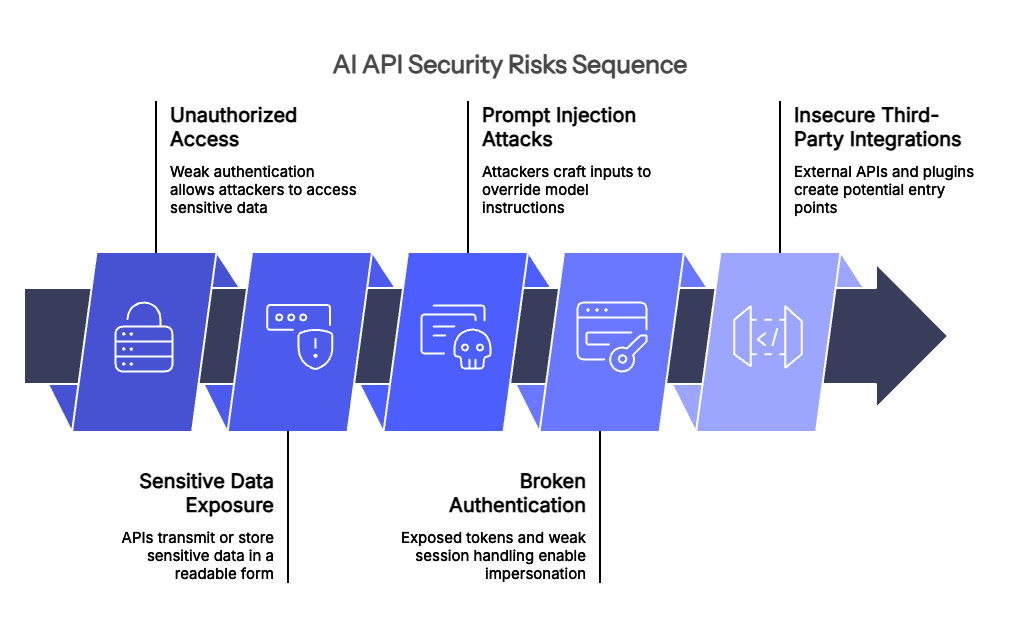
Here are the five threats that matter most for teams deploying AI at scale.
-
Unauthorized Access
Weak authentication lets attackers retrieve customer information, steal API keys, modify prompts, or query your models directly. Token-based authentication and role-based access control reduce this risk, but AI needs more. Standard RBAC stops at the door. It cannot control what an AI agent does with data once it is inside the context window, which is where Context-Based Access Control (CBAC) extends protection to the moment of each request.
-
Sensitive Data Exposure
AI applications process PII, healthcare records, financial data, and internal documents. If APIs transmit or store that data in a readable form, one breach means regulatory violations and real harm. The first step is knowing where that data lives. Most enterprises do not. Sensitive data discovery tools scan your data stores and pipelines to find PII and PHI before it leaks through an API you forgot existed.
-
Prompt Injection Attacks
Prompt injection is the fastest-growing AI-specific API risk. Attackers craft inputs that override the model’s instructions and extract hidden data or trigger unintended actions. A malicious payload can arrive through the user-facing API directly or hide inside documents your AI retrieves. Input screening at the API layer helps, but it needs to be paired with deeper controls because clever attackers can bypass filters.
-
Broken Authentication
Exposed tokens, weak session handling, and static, long-lived keys enable attackers to impersonate legitimate users. The fixes are well established: OAuth 2.0, multi-factor authentication, JWT validation, and frequent key rotation. The discipline is what’s usually missing, not the technology.
-
Insecure Third-Party Integrations
Modern AI tools rely on external APIs, plugin ecosystems, vector databases, and SaaS platforms. Every connection is a potential entry point, and in multi-agent AI systems, a compromise in one integration can cascade across the whole workflow.
How Do You Improve API Security for AI?
Knowing what API security is gets you halfway. Here is what actually fixing it looks like.
Use strong, short-lived authentication. Replace static keys with tokens that expire quickly. A stolen credential that dies in minutes does far less damage than one that lives for months.
Apply rate limiting. AI inference is expensive, which makes your endpoints attractive targets for abuse and denial-of-service attacks. A request ceiling per client keeps systems stable and slows automated attacks.
Encrypt everything in transit. TLS on every connection, no exceptions. Intercepted traffic should be unreadable.
Mask sensitive data before it moves. This is the layer most API security programs skip, and it is the one that limits damage when everything else fails. Protecto’s Privacy Vault tokenizes PII and PHI before it enters your AI pipeline, replacing real values with context-preserving tokens. The model remains accurate because tokens retain their semantic meaning, but a breached API exposes tokens, not people.
For teams using LLMs through chat or RAG, GPTGuard applies the same protection in real time: it detects sensitive data in prompts, masks it before the LLM sees it, and monitors responses for leakage.
This approach has held up at a serious scale. Automation Anywhere used Protecto to secure AI features for 3,000+ enterprise clients, protecting more than 1 million AI interactions and preventing any data breaches.
Audit, monitor, and test continuously. Inventory every API you run, because you cannot protect what you do not know exists. Monitor traffic in real time for anomalies. And bring in ethical hackers regularly: 78% of API attacks use known OWASP API Top 10 methods, which means most of what will hit you is testable in advance.
What Does the Future of API Security in AI Look Like?
AI systems are becoming more autonomous, and that changes the security model.
When AI agents call tools, query databases, and act on behalf of users without a human in every loop, every API call becomes a potential action, not just a data exchange. The trends shaping the next few years reflect that shift: context-aware authorization that evaluates each request in real time, privacy-preserving AI pipelines where sensitive data is masked by default, automated compliance monitoring, and secure agent-to-agent communication.
The organizations treating this as an architectural priority today, rather than a patch later, are the ones that will deploy AI confidently while competitors stall in security reviews. The pattern in Protecto’s customer deployments bears this out: teams that build data leak prevention into the API layer from day one ship AI features faster, because security stops being the blocker in every release.
If you want to see what that looks like for your own AI stack, book a demo with Protecto and walk through it with the team.
FAQs
What is API security in simple terms?
API security is the practice of protecting the connections between your applications, AI models, databases, and third-party tools from unauthorized access, abuse, and data theft.
Why is API security especially important for AI systems?
AI APIs carry the most sensitive content in your business: prompts containing customer data, model responses, and agent instructions. A compromised AI API exposes the data flowing through it, not just the endpoint itself.
What is the biggest API security risk in AI applications?
Sensitive data exposure and prompt injection lead the list. Both exploit the fact that AI APIs handle free-form natural language that traditional validation cannot fully screen out.
How does data masking strengthen API security?
Masking replaces sensitive values with tokens before data travels through your APIs. If an API is breached, attackers obtain tokens rather than real PII. Context-preserving tokenization keeps AI accuracy intact.
How does Zero Trust apply to AI APIs?
Zero Trust continuously verifies every user, device, and request rather than trusting anything within the network. For AI, that extends to agents: each data request gets evaluated in context rather than approved by a static role.
What compliance regulations affect API security in AI?
GDPR, HIPAA, CCPA/CPRA, DPDP, and PDPL all govern how personal data moves through systems, including AI pipelines. Frameworks like the NIST AI RMF add AI-specific governance expectations on top.
