
Every enterprise wants AI to work with real business data, but very few want that data exposed. This challenge is becoming more urgent as organizations deploy Retrieval-Augmented Generation (RAG), AI agents, and enterprise copilots that routinely access customer records, financial information, and healthcare data.
Cisco’s 2025 Data Privacy Benchmark Study found that 64% of organizations worry about inadvertently sharing sensitive information, and half of them are inputting data into generative AI tools. As enterprises integrate AI more deeply into business workflows, secure de-tokenization has become just as important as data tokenization for protecting sensitive data while enabling trusted access.
AI Needs More Than Data Protection. It Needs Controlled Data Recovery
For years, organizations have relied on data tokenization to substantially reduce the risk of exposing personally identifiable information (PII), protected health information (PHI), and payment card data.
Replacing sensitive values with secure tokens allows applications, analytics platforms, and AI models to continue functioning without directly processing confidential information.
However, tokenization addresses only half the security challenge. Business operations often require authorized users to access the original data.
A customer support representative may need to verify an account number, a clinician may require a patient’s medical history, or an AI assistant may need to personalize a response before presenting it to an authenticated employee. This controlled recovery process is where de-tokenization becomes essential.
Rather than treating it as a simple reversal of data masking, modern enterprises view de-tokenization as a governed security process. Every request to recover sensitive information must be authenticated, authorized, logged, and evaluated against organizational policies before access is granted.
What Is De-Tokenization?
At its core, de-tokenization is the process of securely restoring tokenized data to its original value after verifying that the requesting user or application has the necessary permissions.
Unlike encryption, where authorized users decrypt information directly with cryptographic keys, tokenization stores the original data separately and replaces it with a surrogate value. The relationship between the token and the original record is maintained inside a secure token vault, making the token itself meaningless if intercepted.
This architecture enables reversible tokenization, where the original information remains recoverable under tightly controlled conditions. The actual recovery process is known as token redemption, and it should occur only when business needs and security policies align.
For AI applications, this distinction matters because most workflows do not require constant access to raw PII. Instead, AI models can operate effectively on tokenized data, while sensitive values are revealed only at the final stage of an approved workflow.
From Tokenization to Token Redemption
| Stage | What Happens | Security Objective |
| Sensitive data is detected | PII, PHI, or PCI is identified before processing | Prevent unnecessary exposure |
| Data tokenization | Original values are replaced with secure tokens | Protect sensitive information during storage and AI processing |
| Token mapping is stored | Original values remain inside a secure token vault | Centralize control and minimize attack surface |
| The access request is evaluated | Identity, role, purpose, and policy are verified | Ensure only authorized access |
| Token redemption | Approved users receive the original value through secure de-tokenization | Balance usability with privacy |
| Activity is recorded | Every redemption event is logged | Support compliance, auditing, and forensic investigations |
This workflow highlights an important principle: de-tokenization is not a routine database operation. It is a policy-driven security decision.
Why the Token Vault Is Central to Secure Token Redemption
A secure token vault is more than a repository for token mappings. It acts as the policy enforcement layer that determines whether token redemption should occur. Every request for de-tokenization is evaluated against predefined security controls before the original data is revealed.
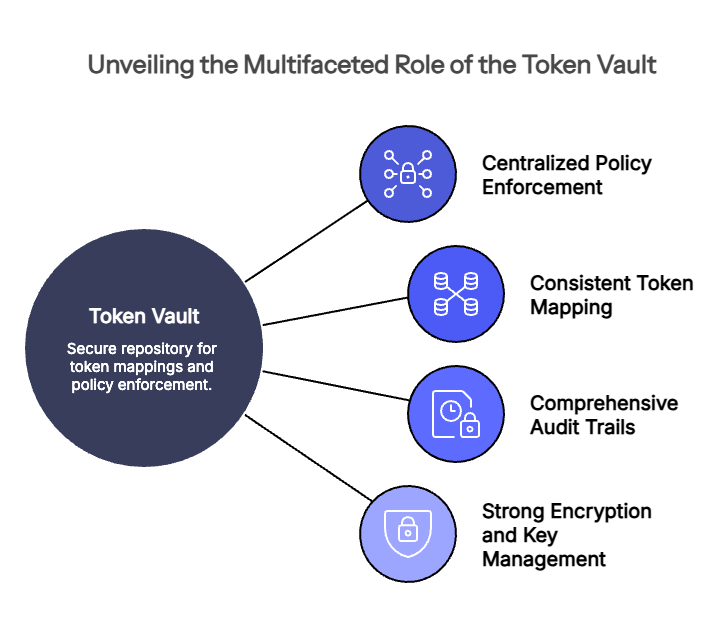
An enterprise-grade token vault should provide:
- Centralized policy enforcement ensures only authorized users or AI applications can redeem tokens.
- Consistent token mapping across databases, AI pipelines, and business systems, preserving data relationships without exposing raw PII.
- Comprehensive audit trails that record every redemption request ensure complete compliance with regulations like GDPR, HIPAA, PCI DSS, and India’s DPDP Act.
- Strong encryption and key management to safeguard token mappings against unauthorized access.
Why Do AI Workflows Demand a Different Approach?
Unlike traditional applications, AI systems rarely process data in a single, linear workflow. A single prompt can trigger document retrieval, vector database searches, API calls, multiple AI agents, and external large language models before a response is generated. Every additional interaction increases the number of points where sensitive data could be exposed if handled improperly.
This architectural shift is significant. Gartner states that by 2027, more than 40% of AI-related data breaches will result from the misuse of generative AI across organizational boundaries, highlighting the growing need for stronger data governance in AI ecosystems.
To reduce this risk, organizations increasingly tokenize sensitive information before it enters RAG pipelines, AI agents, or enterprise copilots. The original data remains isolated and is revealed only through controlled token redemption after identity, context, and access policies have been verified.
This approach enables AI systems to deliver meaningful outputs while minimizing unnecessary exposure of PII and supporting compliance across complex, multi-step AI workflows.
Enterprise Best Practices for Secure De-Tokenization
As AI systems become more autonomous, de-tokenization should be treated as a governed security function rather than a routine data operation. The following practices help organizations reduce risk while ensuring sensitive information remains accessible when genuinely needed.
- Adopt least-privilege access: Limit token redemption to users, applications, or AI agents with a verified business need. Temporary, context-aware permissions reduce the risk of unnecessary exposure.
- Keep the token vault isolated: Separate the token vault from AI models, vector databases, and application layers. This prevents a compromise in one system from exposing both tokens and their original values.
- Log every redemption event: Maintain immutable audit trails that capture who requested the tokenization, when it occurred, and why. This simplifies compliance with regulations such as GDPR, HIPAA, PCI DSS, and DPDP.
- Integrate with enterprise identity systems: Connect the tokenization policies with identity providers like Okta or Microsoft Entra ID to enforce consistent authentication and authorization.
- Continuously review access policies: As AI applications evolve, regularly reassess who can redeem tokens and under what conditions to prevent privilege creep.
These practices ensure that de-tokenization supports both enterprise productivity and regulatory compliance without compromising data privacy.
How Does Protecto Enable Secure De-Tokenization for Enterprise AI?
Protecto enables secure de-tokenization through Privacy Vault, an enterprise-grade solution purpose-built for AI workloads. Unlike conventional vaults, it combines context-preserving tokenization with policy-driven data access, allowing AI applications to operate on protected data without sacrificing accuracy.
Privacy Vault supports consistent tokenization across enterprise systems, helping organizations maintain data integrity across analytics, RAG, and AI workflows. For enterprise AI chat, GPTGuard masks sensitive information before it reaches public LLMs. At the same time, Context-Based Access Control (CBAC) dynamically determines when original data can be revealed based on user identity, purpose, and context.
Together, these capabilities help organizations deploy AI securely while meeting regulatory and governance requirements.
Conclusion
As AI ecosystems become more interconnected, protecting sensitive data requires more than simply masking it. Secure de-tokenization ensures that original information is revealed only when authorized, enabling enterprises to balance AI innovation with privacy, compliance, and operational efficiency.
By combining robust data tokenization, a secure token vault, and policy-driven token redemption, organizations can confidently deploy AI without increasing data exposure.
Ultimately, secure de-tokenization is not just a security control. It is a foundational capability for building trustworthy, enterprise-ready AI systems.
FAQs on De-Tokenization
When should an organization perform token redemption?
Token redemption should occur only when an authenticated user or application has a legitimate business need to access the original data. Access policies, identity verification, and audit logging should always govern it.
What role does a token vault play in enterprise AI security?
A token vault securely stores the relationship between tokens and original sensitive data. It ensures that only authorized requests can retrieve the original values, reducing the exposure of PII across AI workflows.
Can multiple enterprise systems share the same token?
Yes. Consistent data tokenization ensures that the same sensitive value maps to the same token across databases, CRM platforms, analytics systems, and AI applications, enabling secure cross-system analysis.
What are the biggest risks of an unsecured token vault?
A poorly protected token vault can expose token mappings, weaken access controls, and compromise audit integrity. Strong encryption, key management, and strict authorization policies are essential to maintaining security.
Can tokenization replace encryption in enterprise security?
No. Data tokenization and encryption serve different purposes and are often used together. Tokenization minimizes exposure of sensitive data, while encryption protects data both at rest and in transit.

