Short answer: GDPR does not require personal data to stay in the EU. It lets data leave only with a valid transfer mechanism. Data residency for LLMs comes down to three options: use the EU region of a hosted API, tokenize before the API call, or run the model yourself. Only the third keeps data out of the US in the literal sense.
A procurement lead at a European customer sends your team a one-line requirement: “keine Daten in die USA.” No personal data in the United States. Your product calls a hosted LLM, and the best models are served from US data centers. Somebody has to say whether the product can still be sold to that customer.
That answer depends on three things: where inference runs, where prompts and logs sit afterward, and what you do about the transfer rules. This guide walks through each, compares the three options, and covers what self-hosting does and does not fix. It is part of our wider guide to GDPR-compliant AI.
Does GDPR require personal data to stay in the EU?
No. GDPR does not say data must stay in the EU. It says data can leave only with a valid transfer mechanism, such as an adequacy decision or standard contractual clauses (SCCs). These sit under Chapter V of the regulation.
The reason many European enterprises keep data in region anyway is the legal history. Schrems II struck down Privacy Shield, and the EU-US Data Privacy Framework is still being tested in court. Some enterprises have made a simpler decision: keep personal data in the EU and stop arguing about transfer mechanisms.
GDPR does not require residency. Your regulator or your customers may still ask for it, and for AI that creates a hard constraint, because the best frontier models are served from US data centers.
One scope note first. GDPR scope does not depend on where your servers sit. You are in scope if you have an EU establishment, or if you offer goods or services to people in the EU or monitor their behavior there, whether you are in Frankfurt or San Jose. This guide describes EU GDPR; review UK requirements separately.
Why is data residency harder with LLMs?
With a normal SaaS tool, you ask where the data is stored. With an LLM you have to ask two more questions, because a prompt moves and then leaves traces.
The first is where inference runs, meaning the country where the model reads your prompt. The second is where your prompts, sessions, and logs sit afterward. US, EU, China, or “worldwide” each means a different set of engineers and governments who can read your clear text.
Those questions apply to more than the vendor’s servers. Personal data can live in four places:
| Where data lives | Where residency matters |
|---|---|
| Model weights, from training or fine-tuning on data that contained personal information | Hard to delete once data is in. Keep raw personal data out of training sets |
| Prompt, completion, and session logs | Kept by the vendor for days to months, in whatever country the vendor runs. Covered by your data processing agreement (DPA) and retention terms |
| Context at inference time: your prompt, system prompt, and retrieved documents | Exists only for the call unless logged. Lowest risk if the vendor does not retain it |
| Your own stores: RAG indexes, embeddings, chat history, caches | Yours to place and yours to delete. Fully your responsibility as controller |
Before you pick an EU endpoint, read three things in the vendor’s terms:
- Training opt-out. Is use of your data for model improvement off by default on your tier, and is that written into the DPA?
- Retention window. Check which endpoints, features, and data categories the zero-retention commitment covers, and whether abuse-monitoring logs sit outside it. Know the number of days for anything that is kept.
- Sub-processors and region. Where are the servers, who else can see the logs, and can you pin inference to an EU region?
If the answers are good, a hosted API is a processor relationship like any other SaaS tool. If the answers are vague, it is a disclosure you cannot control. If the vendor cannot put “we do not train on your data and we delete prompts within N days” in writing, treat every prompt as a disclosure to a third party.
No training and zero retention are two different commitments. Zero retention is usually a separate setting, often needs vendor approval, and may not cover every feature or stored application state. Verify the exact service and configuration you are on.
What are the three data residency options for LLMs?
There are three ways to resolve the conflict between EU residency and US-hosted models. The table shows how each works and what it costs you.
| Option | How it works | Trade-off |
|---|---|---|
| EU region of a hosted API | Pin inference to an EU endpoint, sign the vendor’s DPA, and check whether support access or logs leave the EU | Still a US-headquartered processor. Support access and abuse logs may cross borders |
| Tokenize before the API | Identifiers never leave. Only tokens and the surrounding text cross the border | Works with any model. Still subject to transfer rules, so keep a mechanism in place. Needs the vault in-region |
| Run the model yourself | Open-weight model in your own EU VPC, private cloud, or air-gapped environment | Full control over where data is processed. You own the ops and the GPU bill. Every other obligation still applies |
Option 1: Use the EU region of a hosted API
You pin inference to an EU endpoint, sign the vendor’s DPA, and check whether support access or logs leave the EU. The weakness is the vendor’s structure: a US-headquartered processor is still one, and support access and abuse-monitoring logs may cross borders even when inference stays in the EU. The vendor questions above are where this option is won or lost.
Option 2: Tokenize before the API
Tokenization replaces each personal value in a prompt with an opaque token that carries the type, keeps the shape, and stays consistent for the same value across the document. The model works on the tokens. Real values come back only for people and systems that are authorized to see them.
For residency, that means identifiers never leave. Only tokens and the surrounding text cross the border. If a vendor retains or trains on your prompts, they retain tokens. The real values never left your boundary. It also works with any model.
Here is a support ticket before and after:
| Before | After |
|---|---|
| Hi, this is Sarah Whitfield, account 4471-8820. My card ending 3310 was charged twice on March 3. Call me at +44 7700 900123. | Hi, this is <PER>rk4m2</PER>, account <ACCT>k93f1</ACCT>. My card ending <CARD>p42</CARD> was charged twice on <DATE>d8m1</DATE>. Call me at <PHONE>q27x8</PHONE>. |
The model can still summarize, classify, and draft a reply. It knows there is a person, an account, and a duplicate charge. It does not know who.
Watch out. Tokenizing cuts the risk of a transfer. It does not by itself take the transfer out of Chapter V, because you can still detokenize the data and the surrounding text may still point at a person. Tokenized data sent to a US API carries far less risk, and the mapping stays in the EU or on your own servers. But it is still a transfer of personal data from your side. Keep the transfer mechanism (SCCs or adequacy) and the DPA in place, and write down why the residual risk is low.
Option 3: Run the model yourself
You run an open-weight model in your own EU VPC, private cloud, or air-gapped environment. You get full control over where data is processed. You also own the operations and the GPU bill.
This is the only option that answers “keine Daten in die USA” literally. Tokenizing before a US API lowers the risk of the transfer. It does not keep the data out of the US.
Can you combine the options?
The second and third options compose. Many teams run a smaller model on-prem for detection and masking, then send tokenized prompts to a frontier model for the heavy reasoning. The identifiers stay home. The intelligence goes wherever it is best.
The same pattern holds for RAG with EU data residency and for fine-tuning open-source models on EU data. Tokenize the corpus before you embed it or train on it. The index and the fine-tune set then hold pseudonymous data. The mapping stays in the vault, in region, under your keys.
Where should the token vault run?
If you use tokenization, the vault is the crown jewels. For GDPR the token-to-value mapping is the crown jewels. It is the thing that links pseudonymous records back to identified people.
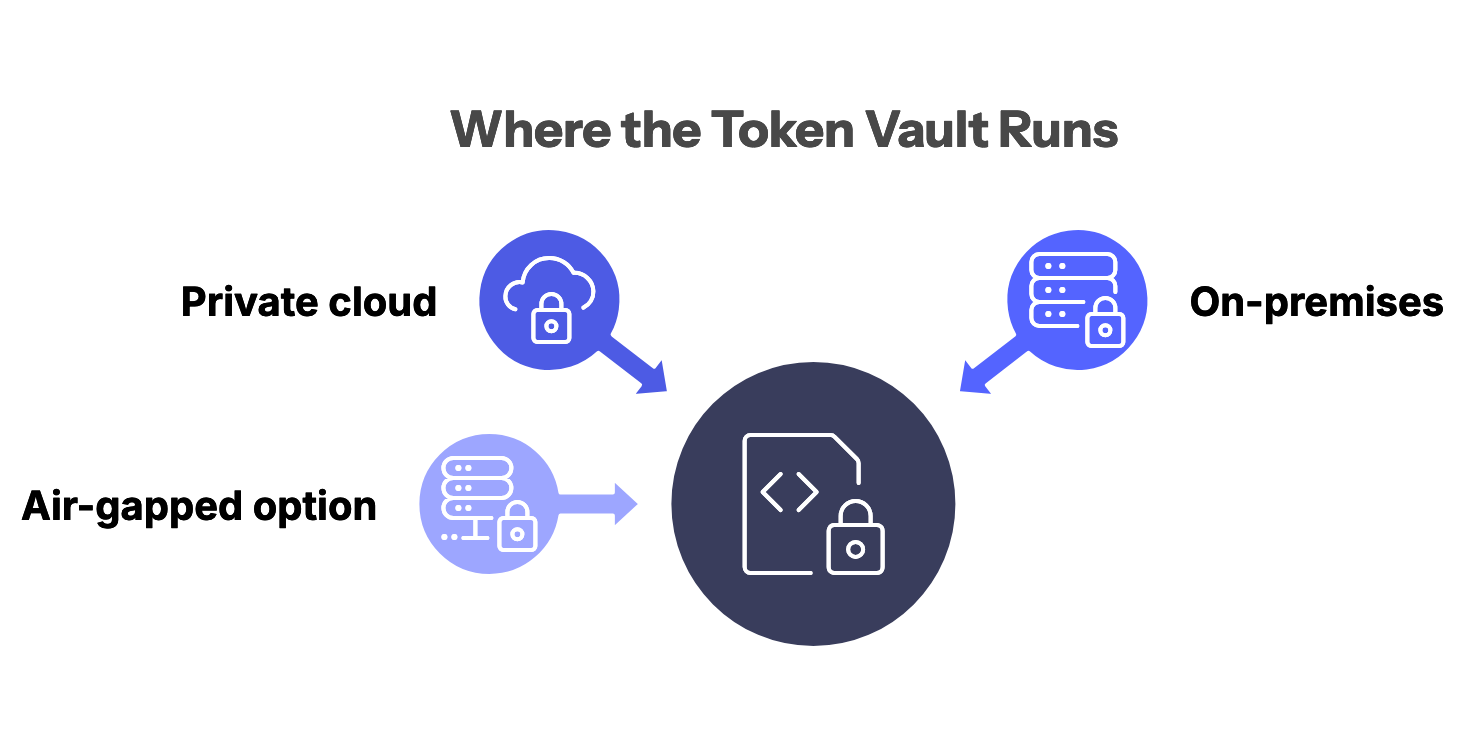
It should sit inside your own infrastructure, in the region the data belongs to. Protecto Vault runs in your private cloud or on-premises, with an air-gapped option, so the mapping never leaves your boundary while the tokenized text goes wherever the AI needs it to go.
Tokenized data is still personal data in your hands, because you hold the key. The CJEU held in 2025 that pseudonymized data may not be personal data for a recipient who has no realistic means to re-identify people (EDPS v SRB, Case C-413/23 P). But that takes a case-by-case look at what the recipient holds and what the surrounding text gives away. Treat tokenization as a safeguard that cuts your exposure and supports compliance, not as a way out of your obligations. The detail is in does AI redaction meet GDPR.
Is self-hosting a GDPR exit?
No. Running the model in your own VPC settles one question: where the data is processed. Every other control still applies.
Purpose, lawful basis, minimization, retention, who may detokenize, and what each agent and tool receives do not change because the GPU is yours. Two examples show why:
- An employee who pulls customer records through an internal agent with no policy on what they may see is a leak.
- A partner integration that takes the full record when it needs two fields is a leak.
Neither crossed a border, and both can be reportable. Residency is one piece of the problem, and the smaller piece. The other controls are in the guide to GDPR-compliant AI.
Agents show the same thing. An agent passes parts of a CRM record to a search tool and an email tool. Each tool call that carries personal data is a disclosure, wherever the model runs. The question is whether this tool needed this field. A payments tool needs the account number. The calendar tool does not.
Data residency checklist
Use this list before you commit to an architecture. It draws on the full GDPR-for-AI checklist.
- ☐ Inference region, log location, and sub-processors are listed
- ☐ Vendor training is off, the retention window is known, and the contract and settings match
- ☐ If personal data leaves the EEA: transfer mechanism in place, plus a destination assessment and extra safeguards where needed
- ☐ Identifiers are tokenized before they leave your boundary
- ☐ Token vault runs in your infrastructure, in region, under your keys
- ☐ Documents are tokenized before embedding or fine-tuning
- ☐ Detokenization is a policy decision per user and per destination, and every event is logged
- ☐ Each tool or MCP server an agent calls gets only the fields it needs
FAQs
Does GDPR require data to stay in the EU?
No. GDPR lets personal data leave the EU only with a valid transfer mechanism, such as an adequacy decision or standard contractual clauses. Many European enterprises keep data in region anyway, because Schrems II struck down Privacy Shield and the EU-US Data Privacy Framework is still being tested in court.
Does tokenizing before a US API keep data out of the US?
No. Tokenizing lowers the risk of the transfer, because identifiers never leave and only tokens and the surrounding text cross the border. It does not by itself take the transfer out of Chapter V, so keep a transfer mechanism in place. Only self-hosting answers “no data in the US” literally.
Does self-hosting an LLM make me GDPR compliant?
No. Self-hosting settles where the data is processed. Purpose, lawful basis, minimization, retention, access control, and what each agent and tool receives still apply.
Where to start
Pick the option that matches the requirement you were given. If a regulator or customer wants a literal answer, run the model yourself. If you need frontier models and want identifiers to stay home, tokenize first and keep the vault in region. In every case, the other controls still apply.
See how Protecto supports data sovereignty for AI.