
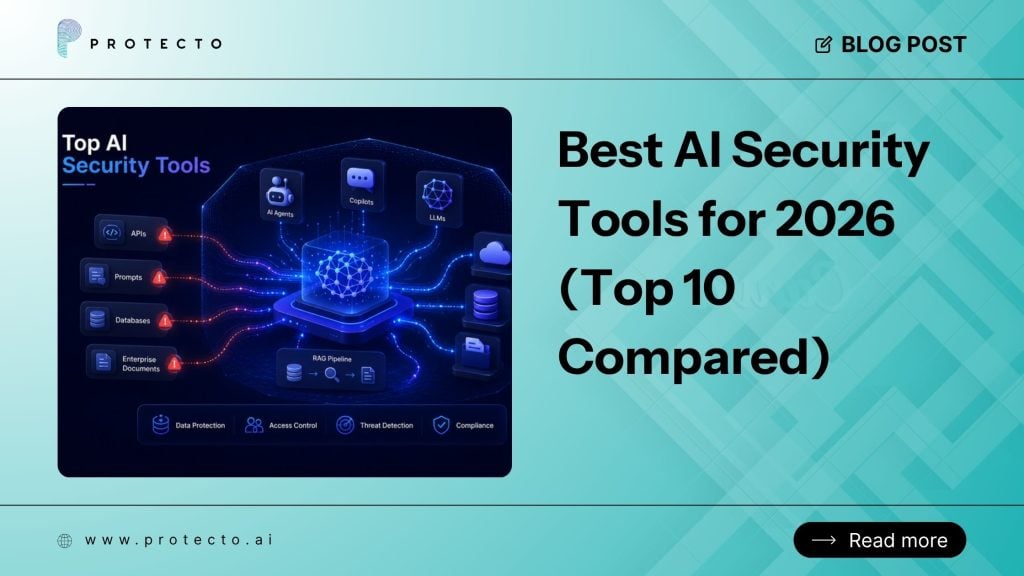
Enterprises today are looking to grow faster by adopting artificial intelligence. Teams are now building AI copilots, automating workflows with AI agents, and using Retrieval- Augmented Generation (RAG) to search internal knowledge bases. However, with every successful AI deployment, there is one very important question.
How do you keep sensitive enterprise data from becoming a potential AI security risk?
AI systems are known to continuously process a range of inputs, including APIs, databases, prompts, customer data, and proprietary business information. Confidential data can easily be exposed to the public and Large Language Models (LLMs). They can be accessed by an unauthorized AI agent or even stored in locations that violate compliance department rules if they are not properly safeguarded.
In fact, an IBM report shows that the average global cost of a data breach was over $4.88 million in 2024. This large number illustrates how poor data governance can prove to be an expensive mistake.
This is exactly where modern AI security tools can make a difference. The best AI security platforms aim to help organizations innovate safely by protecting sensitive information.
In this guide, we will examine the leading AI security tools and present a comprehensive list to help businesses make the right decision when choosing solutions in 2026.
Top 10 AI Security Tools Compared
Generative AI has seen rapid growth, creating a new category of enterprise security platforms. AI security tools today do more than scan for malware; they secure AI models, protect sensitive data from attacks, and help businesses comply with privacy regulations.
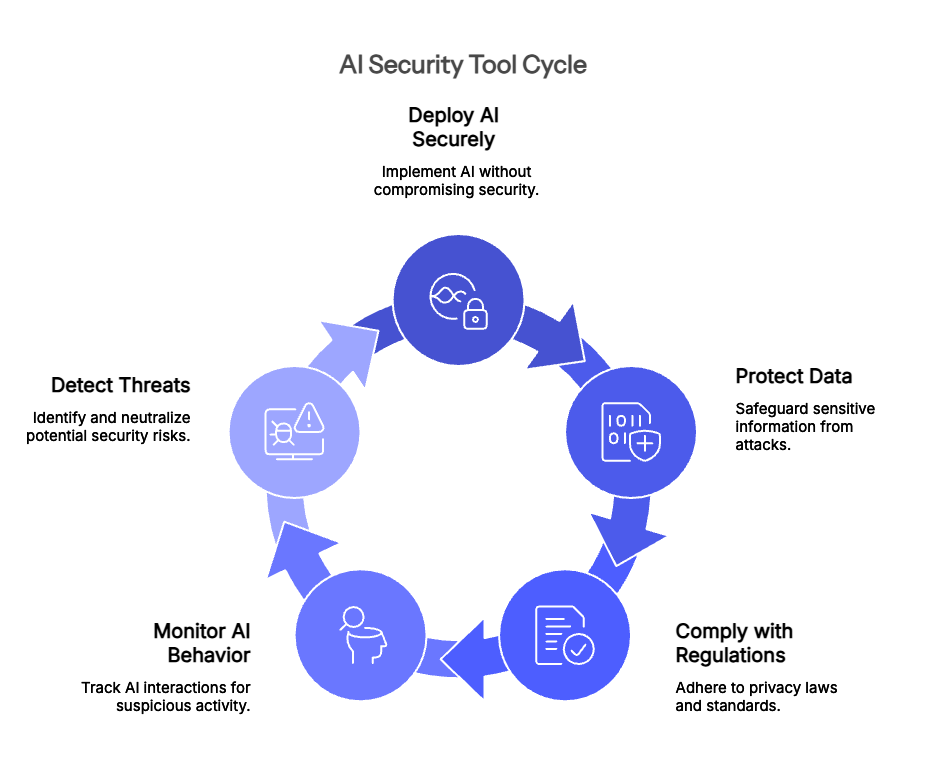
Here is a list of the top AI security tools that work well in different areas, right from securing AI applications to protecting AI data pipelines.
1. Protecto AI
Protecto AI is a tool that helps organizations deploy AI securely without slowing down innovation. It is not like traditional security tools that block access; in fact, it enables safe AI adoption by protecting sensitive data before it even reaches the Large Language Models (LLMs).
It is best for end-to-end enterprise AI security and data privacy. Its portfolio includes offerings such as Privacy Vault, GPTGuard, CBAC (Context-Based Access Control), and DeepSight, as well as high-volume data masking. It helps create a complete and robust security layer for AI applications, agents, and Retrieval-Augmented Generation (RAG) systems.
Here are the key features of the platform:
- It helps to detect more than 200 PII, PHI, and PCI entity types.
- Offers context-preserving tokenization for AI accuracy
- Enterprise AI data loss prevention
- Secure RAG protection
- Compliance with HIPAA, GDPR, DPDP, PCI DSS, and SOC 2 support
Protecto is a great choice for large Enterprises, financial institutions, or healthcare organizations that are looking to build secure AI applications.
2. Microsoft Purview
Microsoft Purview is a platform that extends data governance and compliance into AI-powered applications. Businesses that already have Microsoft 365 can classify sensitive information, monitor how employees interact with Microsoft, apply data loss prevention (DLP policies, and gain access to other AI services.
Since it is integrated with the Microsoft ecosystem, it undoubtedly makes deployment straightforward for existing Microsoft customers. It is best for organizations invested in Microsoft technologies and with Microsoft Copilot and Microsoft 365 environments.
The key features of this platform are:
- AI governance
- Data classification
- Insider risk management
- Compliance reporting
- Microsoft Copilot protection
3. Palo Alto Networks AI Runtime Security.
Runtime AI protection is also essential, considering that AI applications become customer-facing over time. Palo Alto Networks secures AI applications during execution by monitoring API traffic, model interactions, and runtime behavior to detect suspicious activity.
It is a great platform that can help identify malicious prompts, unauthorized access attempts, and abnormal AI behavior before they affect the production environment.
The best features of this platform include API security, threat detection, runtime AI protection, prompt monitoring, and continuous policy enforcement. It is great for Enterprises that run production AI applications at scale.
4. Lakera Guard
One of the greatest risks of generative AI is prompt injection attacks. Lakera Guard can be a great asset, as it helps identify malicious prompts before they reach Large Language Models (LLMs).
Prompts are analyzed in real time. Moreover, the platform blocks attempts to manipulate system instructions, bypass AI safety controls, and extract confidential information.
5. HiddenLayer
HiddenLayer is one of the top AI security tools, focusing on securing AI and machine learning models. It focuses on prompts and user interaction while also protecting the model itself against adversarial attacks, unauthorized modifications, and model theft.
Some of the key features include:
- ML model monitoring
- Model integrity checks
- Runtime security
- Adversarial attack detection
- Threat intelligence
6. Wiz AI Security
Wiz AI can help an organization discover AI assets, identify misconfigurations, monitor cloud-based AI workloads, and reduce exposure across multiple environments. Considering that AI infrastructure is expanding, having the visibility that Wiz AI offers makes AI governance easier.
Some of the important features include AI asset discovery, risk prioritization, identity analysis, cloud posture management, and continuous monitoring.
7. NVIDIA AI Enterprise Security
When an organization uses NVIDIA AI Enterprise, it can have strong security while building AI workloads on NVIDIA infrastructure. This platform comes with secure AI development capabilities, workload isolation, confidential computing support, and infrastructure-level protections.
It is a great option for organizations that operate in GPU-intensive AI environments.
8. SentinelOne Purple AI
SentinelOne is a platform that uses generative AI to help security analysts investigate and mitigate threats faster. Moreover, Purple AI automates incident analysis, summarizes alerts, and assists with threat hunting.
Although it is not a complete AI application security platform, it helps improve the Security Operations Center’s efficiency.
9. CrowdStrike Falcon
CrowdStrike Falcon is a platform that supports AI-driven threat detection and enterprise workload protection. It is not entirely exclusive to AI security; Falcon strengthens the border security posture surrounding AI developments.
Some key features include endpoint protection, threat intelligence, cloud workload protection, and AI-powered detection.
10. Cisco AI Defense
Great for enterprise AI governance and visibility, Cisco AI Defense helps organizations discover AI applications, enforce security policies, monitor AI usage, and mitigate potential risks from shadow AI.
Cisco AI Defense focuses primarily on securing employee interactions with public AI services. It also helps to maintain governance across enterprise networks. It is best suited for large enterprises implementing enterprise-wide AI governance.
Quick Comparison of the Best Security Tools
| Tool | Best For | Key Strength |
| Protecto AI | Enterprise AI security | AI data privacy, Secure RAG, tokenization, AI agent security |
| Microsoft Purview | Microsoft ecosystem | Compliance and AI governance |
| Palo Alto AI Runtime Security | Production AI | Runtime monitoring |
| Lakera Guard | LLM protection | Prompt injection defense |
| HiddenLayer | Machine learning | Model security |
| NVIDIA AI Enterprise | AI infrastructure | GPU and confidential computing |
| Wiz AI Security | Cloud AI | Cloud-native AI visibility |
| SentinelOne Purple AI | Security operations | AI-assisted SOC workflows |
| CrowdStrike Falcon | Enterprise cybersecurity | Endpoint and cloud protection |
| Cisco AI Defense | AI governance | Shadow AI visibility and policy enforcement |
Conclusion
When businesses are looking to expand their AI initiatives, deciding between the many options can be confusing. Businesses must choose a solution that protects sensitive data, supports compliance, secures AI agents, and mitigates AI risks without limiting innovation.
Frequently Asked Questions
What are AI security tools?
AI security tools are software solutions that aim to protect AI systems. They help an organization deploy and securely manage AI across the enterprise.
What are generative AI security tools?
Generative AI security tools are platforms designed to secure AI models such as ChatGPT, Claude, and other LLMs. They help protect prompts, sensitive data, AI agents, and Retrieval-Augmented Generation (RAG) pipelines.
Can AI security tools prevent prompt injection attacks?
Yes, AI security tools can be great at preventing a prompt injection attack. Modern AI security tools can help detect and block prompt injection attempts, jailbreak attacks, and other threats before they even interact with the AI models.
Which industries can benefit from AI security tools?
Deploying AI security tools is beneficial for many industries, including healthcare, banking, financial services, government, retail, manufacturing, and SaaS. It can help protect sensitive data and AI applications.
How often should organizations evaluate their AI security tools?
Businesses need to review their AI security tools regularly. It is even more necessary after introducing new AI models, expanding AI use cases, updating compliance requirements, or responding to emerging AI threats.
