
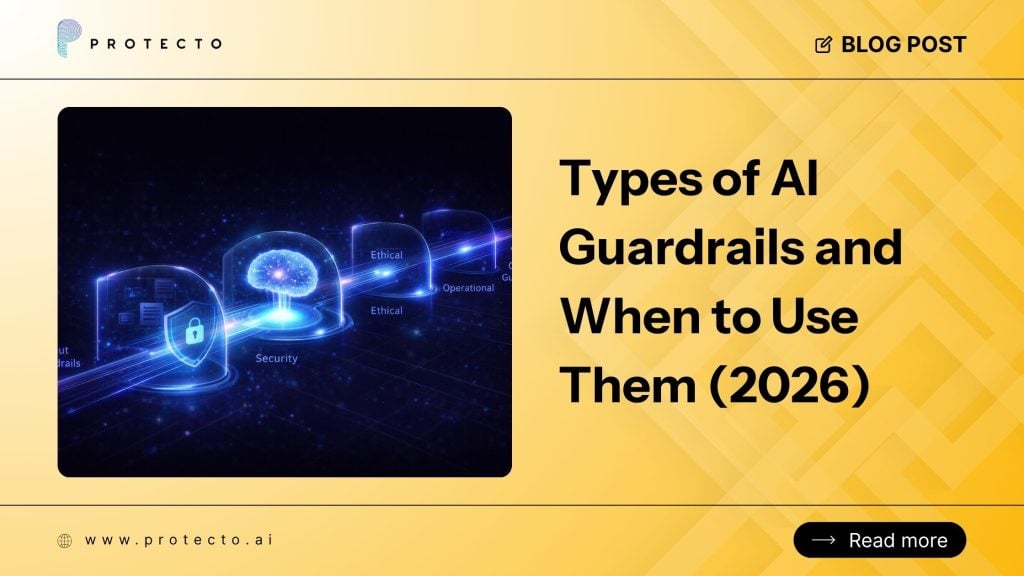
The types of AI guardrails are input guardrails, output guardrails, security guardrails, ethical guardrails, and operational guardrails, each positioned at a different failure point across an inference pipeline. AI guardrails should run across the input, execution, and output layers because different risks appear before the model receives a prompt, while the model or agent is acting, and after the response is generated.
Gartner’s research found that 30% of generative AI projects don’t survive past the proof-of-concept stage, with weak risk controls cited as the leading reason. Most of those projects weren’t badly built. The models worked. The gaps were in what sat around them.
| Guardrail Type | Pipeline Position | Risk It Covers | Example Controls |
| Input guardrails | Before the model receives the prompt | Prompt injection, PII in prompts | PII masking, data masking, prompt filtering |
| Output guardrails | After the model generates a response | Hallucinations, data leakage, and toxic content | Output scanning, PII redaction, toxicity detection |
| Security guardrails | Across the full inference pipeline | Jailbreaks, agent boundary failures | Prompt defense, access control, jailbreak detection |
| Ethical guardrails | Model outputs tracked over time | Bias, discriminatory patterns | Fairness scoring, bias monitoring, toxicity moderation |
| Operational guardrails | System access and tool use | Compliance violations, unrestricted agent actions | Audit trails, rate limits, approval workflows |
Confirm the exact implementation scope directly with your provider.
Input Guardrails
Your users don’t think about where their data goes. A healthcare support rep pastes a patient’s date of birth and policy number into a prompt. An analyst drops a client contract into a document assistant. Nobody flags it. The model processes it. The third-party API has it now.
Input guardrails sit between the user and the model. PII masking swaps sensitive entities with structured tokens before the prompt moves. What the model receives doesn’t include the original values; it only includes a placeholder for it to reason about.
For teams operating under GDPR, HIPAA, or India’s DPDP Act, that difference is the entire compliance gap. For data leakage prevention, input guardrails such as data masking and PII tokenization are usually the first controls to apply because they stop sensitive data before it reaches the model.
A form field submission arrives with instructions buried inside it. Override the system prompt. Output internal credentials. The model follows instructions. That is what it does. An input classifier running before the prompt reaches the model is what catches this prompt injection risk. Without one, you’re depending on the model to refuse on its own judgment under adversarial pressure.
Topic scoping also happens here. A customer service bot answering competitor pricing questions isn’t a model failure. It’s a missing input boundary that nobody defined before launch.
Output Guardrails
A model’s response isn’t automatically safe.
Output guardrails sit between generated text and the end user. The targets are different from the input controls. You’re not looking at the user’s message. You’re looking at what the model produced, which includes claims the model hallucinated, content the model reconstructed from training data, and responses that technically answer the question but violate your application’s scope.
Data leak prevention at the output layer runs before responses leave the system and is checked against an authorized knowledge base. In legal and financial deployments, someone usually pushed for it after a tool returned something confident and specific that turned out to be wrong. Healthcare teams arrive at the deployment conversation with it already on the requirements list.
Your downstream pipeline expects valid JSON, but the model returns a paragraph containing a JSON block. Some applications handle that gracefully. Most don’t.
PII redaction runs at the output layer too. The Stanford SAIL Blog documents how LLMs reproduce memorized training data verbatim under specific prompt conditions, and the prompt that triggers it doesn’t need to contain sensitive data to begin with.
Security Guardrails
Security guardrails cover the space between the input and output layers, where more deliberate attacks tend to operate. At the execution layer, runtime guardrails score agent actions, tool calls, retrieved context, and response paths before the system completes the task.
Jailbreaking refers to prompt injection attempts specifically designed to cause a model to discard its safety protocols entirely. OWASP’s 2025 LLM top 10 lists prompt injection as the primary threat vector for production AI deployments.
Multi-agent architectures make this harder to manage. One security engineer at a financial services firm had guardrails configured on the first agent. The second agent in the pipeline was running without them, and the security review didn’t cover the handoffs between agents. What reached the user had passed through boundaries nobody had looked at.
Context-based access control directly ties into this layer. A successful injection into a RAG pipeline without access enforcement can retrieve documents that the querying user lacks clearance to access. The model doesn’t know it’s crossing an access boundary. Protecto’s CBAC scopes what reaches the context window to what the user or agent is actually permitted to access.
Ethical Guardrails
A model can produce hundreds of individually acceptable responses and still be systematically disadvantageous to a specific group across thousands of decisions. No single session surfaces that.
Ethical guardrails use fairness classifiers and distributional output analysis. The bias problems they catch don’t show up in individual responses. A thousand outputs from the same model, scored across demographic variables, can look very different from what a single session review would have picked up. Most teams aren’t looking at that data in the first months of a deployment, and the pattern keeps running while they aren’t.
Toxicity moderation covers hate speech, abusive language, and content that cuts against regional norms. Getting the sensitivity threshold wrong is easier than most teams expect. The miscalibration usually shows up in the complaints queue before anywhere else.
Operational Guardrails
The model can technically do quite a lot. Operational guardrails define what it’s actually authorized to do inside your environment. For an AI IT agent that can run scripts on endpoints, operational guardrails should include approval workflows, command allowlists, rollback controls, rate limits, audit trails, and restricted endpoint access.
This layer enforces regulatory requirements at runtime. GDPR, HIPAA, DPDP, and SOC 2 don’t accept context window activity as an explanation for data exposure. An AI governance framework that sits in a PDF enforces nothing when the model is running. The constraint has to exist within the system’s operating boundaries.
Rate limiting and anomaly detection also run at this layer. Unusually high query volumes against specific sensitive records. Off-hours activity from an agent that’s supposed to be inactive. Access control patterns across multi-agent pipelines that nobody mapped out before deployment. These signals don’t surface at the content layer. They only become visible when someone actively monitors system behavior, which most teams don’t do in the first months of a deployment.
Should AI Guardrails Run at the Input, Execution, or Output Layer?
AI guardrails should run at all three layers: input, execution, and output. Input guardrails stop unsafe prompts, PII, and prompt injection before the model sees them. Execution guardrails control agent actions, tool use, retrieval access, and runtime decisions. Output guardrails scan responses for hallucinations, toxic content, policy violations, and sensitive data before the user sees them.
Using only one layer creates blind spots. Input filtering cannot catch every unsafe model response, and output scanning cannot stop an AI agent from using the wrong tool or accessing restricted context during execution.
Conclusion
Input guardrails, output validation, security controls, ethical monitoring, and operational enforcement each address a different failure mode. Most teams find the gap they missed earlier than they expected, and it’s rarely where they were looking.
Protecto’s AI guardrails span the entire pipeline without degrading model accuracy. Book a demo to see how each layer applies to your deployment.
Frequently Asked Questions
What are the main types of AI guardrails?
The main types of AI guardrails are input, output, security, ethical, and operational. The types of guardrails in AI that matter most in any given deployment depend on where the pipeline is most exposed. A regulated healthcare deployment prioritizes input masking and output validation. A multi-agent financial services workflow has a different problem, and the security and operational layers are where the gaps usually are.
What’s the difference between AI guardrails and model alignment?
Alignment shapes the model’s default behavior during training. Guardrails in AI enforce your specific rules at inference time, in addition to the defaults. A well-aligned model still needs guardrails. Alignment doesn’t know your data residency rules, your user access tiers, or which records that particular agent should never be retrieving. Those constraints have to be built into the deployment layer, not assumed from training.
Do AI guardrails affect model performance?
They add latency. Context-preserving masking keeps overhead lower than full redaction since the model still receives something it can reason about. Most teams running customer-facing deployments find themselves revisiting what runs synchronously fairly early on, usually after the first week of live traffic reveals where the bottlenecks actually are.
Which deployments need security guardrails most urgently?
Multi-agent deployments and anything with tool access or RAG capabilities. Security reviews tend to cover the user-facing endpoint thoroughly. The boundaries between agents in a pipeline are a different part of the architecture, each one its own ungoverned surface unless someone built controls there before the deployment went live. That gap has a way of showing up before anyone scheduled a review for it.
Which guardrails protect against data leaks?
Data masking, PII tokenization, output scanning, access control, and audit trails help protect against data leaks. Toxicity detection is useful for harmful language, but it does not directly prevent sensitive data exposure on its own.
What guardrails do AI agents need before using tools or scripts?
AI agents that use tools or run scripts need strict operational and security guardrails, including command allowlists, human approval for high-risk actions, restricted system access, audit trails, rollback options, and anomaly detection.

