
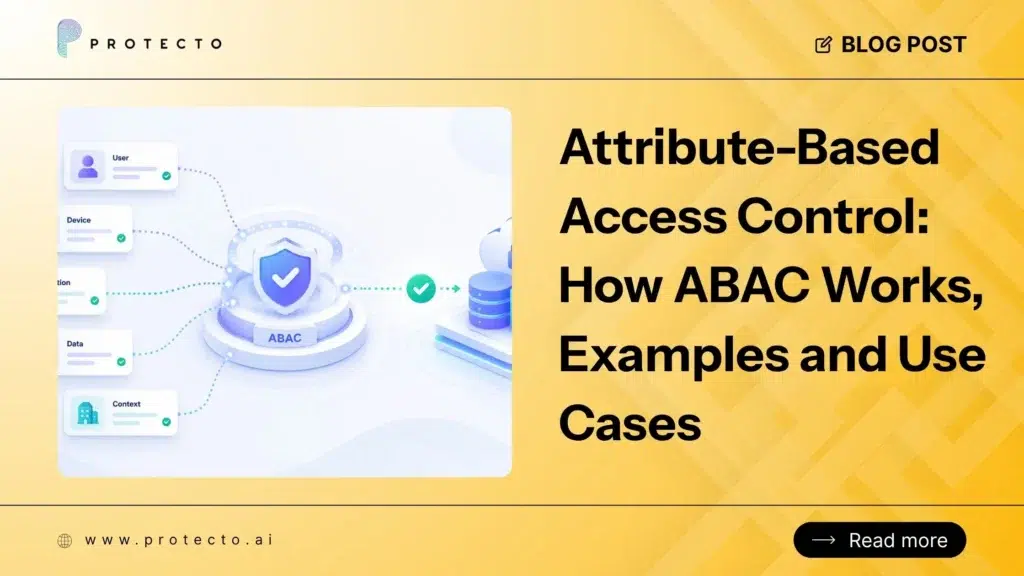
Access control has become significantly more complex as enterprises adopt cloud platforms, AI applications, and distributed workforces. A user’s identity alone is no longer enough to determine whether they should access sensitive data.
Factors such as device posture, data sensitivity, location, and business context all influence the right decision. This shift is driving widespread adoption of attribute-based access control, a model that evaluates multiple attributes before granting access.
In fact, NIST explains that ABAC is a scalable approach for better efficiency, scalability, and security. Thus, understanding how ABAC works has now become necessary for modern enterprise systems.
Why Are Traditional Authorization Models Reaching Their Limits?
Enterprise IT has changed more in the past decade than in the previous two combined. Employees work across multiple locations, business applications are distributed across public and private clouds, third-party integrations exchange sensitive information continuously, and AI systems increasingly retrieve and process enterprise data on behalf of users. These changes have fundamentally altered how access decisions are made.
Traditional authorization models were designed for environments where users, applications, and data operated within clearly defined boundaries. Access could be granted once and trusted until permissions changed. That assumption no longer reflects how modern enterprises operate.
Consider a financial analyst working across multiple business applications. During the course of a single day, they may access customer records through a CRM platform, retrieve financial reports from a cloud data warehouse, collaborate through productivity suites, and interact with AI-powered assistants that summarize confidential documents. Each interaction introduces different levels of sensitivity, risk, and compliance requirements.
Treating all these requests identically simply because they originate from the same user creates unnecessary exposure. Modern authorization requires decisions that account for changing business conditions instead of static user identities.
This shift has led enterprises to move away from permission-centric authorization toward policy-driven decision-making, laying the foundation for the attribute-based access control model.
Attribute-Based Access Control Shifts the Focus from Users to Decisions
Unlike traditional authorization approaches that assign fixed permissions to predefined roles, attribute-based access control evaluates every request independently. Instead of assuming access should always be granted because of a user’s role, the model considers the characteristics surrounding each request before making a decision.
These characteristics, known as attributes, provide contextual information about the requester, the resource, the requested action, and the environment in which the request occurs.
This seemingly simple shift changes the purpose of authorization.
Rather than answering a single question: “Who is requesting access?”
The system evaluates a broader set of questions.
- What information is being requested?
- How sensitive is the resource?
- Which operation is being performed?
- Is the request originating from a trusted device?
- Does the request satisfy organizational security policies?
- Are the surrounding conditions consistent with acceptable business risk?
By evaluating multiple variables simultaneously, the attribute-based access control model allows organizations to make significantly more precise authorization decisions without continually redesigning user roles or permission groups.
Understanding the Attribute-Based Access Control Model
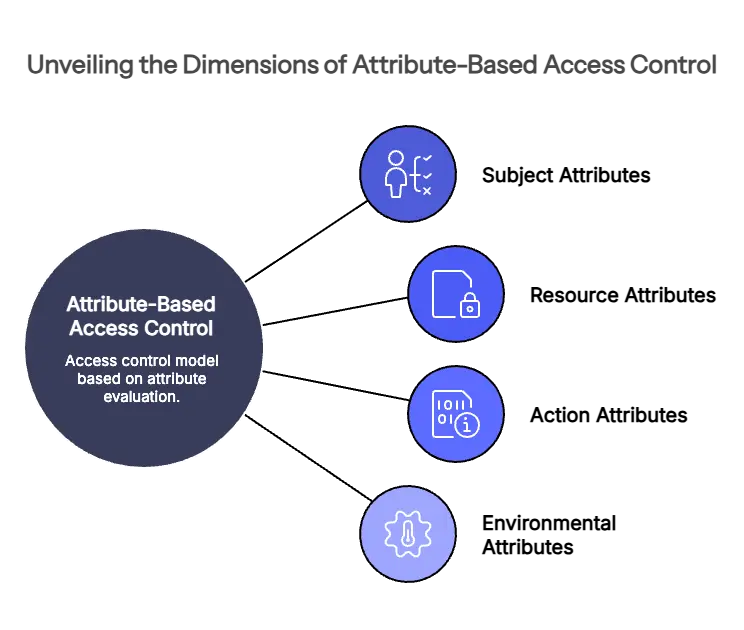
Every authorization decision within the attribute-based access control model is built upon four categories of attributes. Individually, these attributes provide isolated pieces of information. Collectively, they provide the context required to determine whether access should be granted.
| Attribute Category | Purpose | Enterprise Example |
| Subject Attributes | Describe the requester | Department, security clearance, employment type |
| Resource Attributes | Describe the protected asset | Data classification, ownership, confidentiality level |
| Action Attributes | Describe the requested operation | Read, edit, download, delete |
| Environmental Attributes | Describe runtime conditions | Device posture, location, IP address, network, time of request |
Unlike Role-Based Access Control (RBAC), where permissions are largely predefined, attribute-based access control evaluates these attributes every time an access request is made. This enables policies to adapt dynamically as organizational conditions change.
Authorization Becomes More Effective When Policies Replace Static Permissions
Understanding the attribute-based access control model is only the first step. The real intelligence lies in how organizations translate these attributes into enforceable business rules. Instead of assigning permanent permissions to users, attribute-based access control policy enables enterprises to evaluate every request against predefined conditions that reflect business requirements, security objectives, and regulatory obligations.
This policy-driven approach transforms authorization from a static administrative task into a continuous decision-making process, allowing organizations to maintain strong security controls without sacrificing operational flexibility.
ABAC vs. RBAC: Understanding the Difference
Although Role-Based Access Control remains one of the most widely adopted authorization models, it addresses a fundamentally different problem.
RBAC determines who should generally have access based on predefined organizational roles. Attribute-based access control, on the other hand, determines whether a specific request should be allowed under the current circumstances.
| Capability | RBAC | ABAC |
| Access Decisions | Based on predefined roles | Based on multiple contextual attributes |
| Policy Flexibility | Moderate | High |
| Runtime Context | Limited | Comprehensive |
| Zero Trust Alignment | Partial | Strong |
| Cloud Scalability | Moderate | Excellent |
For many organizations, the most effective strategy is not replacing RBAC altogether but extending it with attribute-based access control policies that provide fine-grained authorization where traditional roles fall short.
Where Attribute-Based Access Control Delivers the Greatest Value?
The flexibility of attribute-based access control makes it applicable across industries where access decisions depend on more than a user’s role. Rather than creating hundreds of specialized roles, organizations can enforce consistent security policies using contextual attributes.
Some common attribute-based access control examples include:
- Healthcare: Healthcare providers can grant clinicians access to electronic health records based on their specialty, active treatment relationship, device trust, and location while ensuring compliance with HIPAA requirements.
- Financial Services: Banks can restrict access to customer financial data based on transaction sensitivity, employee clearance, geographic location, and regulatory obligations, reducing the risk of unauthorized data exposure.
- Government: Agencies handling classified information can dynamically authorize access according to security clearance, project assignment, network classification, and operational requirements.
- Cloud and SaaS Platforms: Enterprises can secure cloud-native applications by evaluating user identity alongside device posture, IP address, authentication strength, and resource sensitivity before granting access.
This need is becoming more pronounced as enterprise data becomes increasingly distributed. According to IBM’s Cost of a Data Breach Report 2024, 40% of breaches involved data stored across multiple environments, highlighting the importance of authorization models that can consistently enforce access policies across diverse environments.
Extending ABAC for AI-Driven Enterprises with Protecto
While attribute-based access control strengthens enterprise authorization, AI applications require decisions that account for runtime context, purpose, and autonomous workflows.
Protecto addresses this with Context-Based Access Control (CBAC), enabling real-time authorization for AI agents based on identity, intent, and operational context. To protect sensitive data across AI pipelines,
Privacy Vault detects and masks over 200 PII, PHI, and PCI entity types in 50+ languages, with controlled unmasking for authorized users only.
For RAG applications and LLM workflows, Secure RAG safeguards sensitive information before it reaches vector databases or language models, helping organizations build compliant, AI-ready infrastructure.
Conclusion
As enterprise environments become increasingly distributed and AI-driven, authorization can no longer rely on static permissions or predefined roles alone. Attribute-based access control provides the flexibility to evaluate every access request based on real-time context, enabling organizations to strengthen security, simplify compliance, and reduce unnecessary access risks.
However, as AI agents begin retrieving data, invoking tools, and making autonomous decisions, authorization must evolve beyond attributes to incorporate runtime context and intent.
FAQs on ABAC
How does the attribute-based access control model make authorization decisions?
The attribute-based access control model evaluates subject, resource, action, and environmental attributes against predefined policies. Access is granted only when the request satisfies all applicable business and security conditions.
What should security leaders evaluate before implementing an attribute-based access control model?
Leaders should assess data classification maturity, identity governance, attribute quality, policy management capabilities, compliance requirements, integration with existing IAM platforms, and organizational readiness for policy-driven authorization.
Can attribute-based access control reduce the operational burden of managing user permissions?
Yes. By replacing numerous static roles with policy-based decisions, attribute-based access control simplifies permission management while reducing administrative overhead and role proliferation.
How does attribute-based access control improve security in multi-cloud environments?
ABAC enables organizations to apply consistent authorization policies across cloud providers by evaluating contextual attributes rather than relying on platform-specific permission models.
Is traditional ABAC sufficient for securing AI agents and autonomous workflows?
While ABAC provides strong policy-driven authorization, AI agents often require additional runtime context, intent evaluation, and dynamic policy enforcement to govern autonomous actions effectively.
