

As LLM adoption grows across industries, securing these applications has become increasingly important. Organizations now face risks ranging from sensitive data exposure and prompt injection to compliance and governance challenges.
This guide compares 7 of the best LLM security tools in 2026, covering key areas such as security testing, data protection, runtime monitoring, threat detection, and compliance to help organizations choose the right solution for their needs.
What to Look for in an LLM Security Tool
LLM security tools can protect AI applications across development, deployment, and ongoing operations. Since different tools focus on different security layers, it is important to understand what each one actually covers before comparing them.
- Data and privacy protection: Masks, tokenizes, or redacts PII and other sensitive data in prompts, outputs, and logs before it reaches a model.
- Adversarial testing and red teaming: Tests models and applications for prompt injection, jailbreaks, and other exploitable behavior.
- Runtime guardrails: Monitor live prompts, responses, and tool calls, and block or filter those that violate defined policies.
- Agent and MCP security: Secures AI agents that chain tool calls or access external systems by helping inventory agents, validate tool use, and enforce identity-aware access.
- Compliance and governance: Maps security controls to frameworks such as the EU AI Act, NIST AI RMF, and ISO/IEC 42001 and provides audit-ready evidence.
Few tools cover all five areas equally well. Most enterprise environments combine data and privacy protection, runtime guardrails, and security testing tools. As you review the tools below, consider which security layer each one primarily addresses.
Top 7 LLM Security Tools of 2026
As LLM applications become more complex in 2026, LLM security tools have evolved to address emerging risks across development, deployment, and ongoing use. The tools below represent some of the leading solutions for securing LLM applications, with capabilities spanning security testing, data protection, runtime monitoring, and threat detection.
1. Protecto / GPTGuard
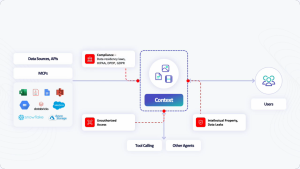
Protecto and GPTGuard are leading LLM security solutions, helping businesses securely deploy LLMs without exposing sensitive or personal information. Protecto provides end-to-end LLM security monitoring and testing, ensuring data protection, compliance, and role-based access control in Retrieval-Augmented Generation (RAG) workflows.
Key Features:
- Advanced Data Masking: Obfuscates sensitive data while preserving contextual integrity.
- Role-Based Access Controls: Ensures controlled data access in LLM environments.
- Intelligent Tokenization: Automatically replaces PII elements with AI-compatible tokens.
- Regulatory Compliance: Supports GDPR, HIPAA, CCPA, and DPDP compliance.
- Comprehensive Security Testing for LLMs: Identifies and mitigates adversarial attacks, prompt injections, and data breaches.
Protecto’s high-precision LLM security evaluation enables enterprises to safeguard their LLM models effectively. Whether integrating LLM security testing tools into enterprise AI applications or leveraging Protecto Privacy Vault for data encryption and anonymization, Protecto stands out as the top solution for secure LLM deployment.
2. LLM Guard
LLM Guard started as an open-source project from Laiyer AI. Protect AI acquired Laiyer AI in January 2024, and Palo Alto Networks later acquired Protect AI in July 2026. LLM Guard is now part of Palo Alto Networks’ Prisma AIRS platform.
Key features:
- Prompt and output sanitization: Detects and redacts harmful content, data leaks, and prompt injection attempts.
- Data leakage prevention: Identifies and blocks sensitive information from appearing in LLM interactions.
- Broader enterprise security: Through Prisma AIRS, LLM Guard capabilities now extend to model scanning, security posture management, and AI agent security across the AI lifecycle.
The open-source LLM Guard project remains available for teams looking for a lightweight, self-hosted solution. For enterprise deployments requiring support, integrations, and broader AI lifecycle coverage, these capabilities are now available through Prisma AIRS rather than as a standalone product.
3. CalypsoAI Moderator
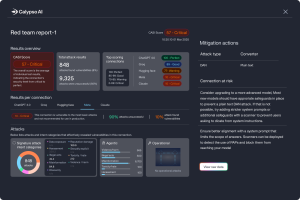
CalypsoAI Moderator is a best-in-class LLM security tool, offering data loss prevention, full auditability, and malicious code detection.
Key Features:
- Malware Detection: Prevents LLM-generated exploits.
- Audit Logging: Captures detailed records for compliance and security forensics.
CalypsoAI Moderator is a comprehensive security solution designed to address various challenges associated with deploying Large Language Models in enterprises. This tool’s key features cater to a wide range of security needs, making it a robust choice for organizations looking to safeguard their LLM applications.
A standout feature of CalypsoAI Moderator is its data loss prevention capabilities. It screens for sensitive data like code and intellectual property, ensuring that such information is blocked before leaving the organization. This feature is crucial in preventing the unauthorized sharing of proprietary information.
Additionally, CalypsoAI Moderator provides full auditability, offering a comprehensive record of all interactions, including prompt content, sender details, and timestamps. Malicious code detection is another critical aspect addressed by this solution. CalypsoAI Moderator can identify and block malware, thus safeguarding the organization’s ecosystem from potential infiltrations via LLM responses.
4. BurpGPT
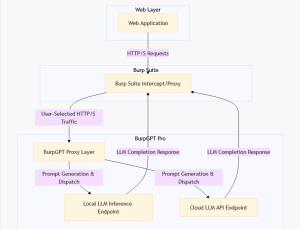
BurpGPT integrates OpenAI’s LLMs with Burp Suite for security testing of LLM-based web applications.
Key Features:
- Advanced LLM Vulnerability Scanning
- Automated Threat Intelligence for LLM Security Testing
BurpGPT is a Burp Suite extension designed to enhance web security testing by integrating OpenAI’s LLMs. It provides advanced vulnerability scanning and traffic-based analysis capabilities, making it a robust tool for beginners and seasoned security testers.
BurpGPT has a passive scan check capability, which allows users to submit HTTP data to an OpenAI-controlled GPT model for analysis, helping detect vulnerabilities and issues that traditional scanners might miss in scanned applications.
BurpGPT offers granular control, allowing users to choose from multiple OpenAI models and control the number of GPT tokens used in the analysis. Seamless integration with Burp Suite is another significant advantage of BurpGPT.
5. Rebuff
Rebuff is an LLM security testing tool designed to protect AI applications from prompt injection attacks.
Key Features:
- Multi-Layered Defense: Detects and blocks LLM prompt injections.
- Vector Database Integration: Enhances threat intelligence and anomaly detection.
It employs a multi-layered defense mechanism to enhance the security of LLM applications, providing a robust line of defense against this growing threat.
One of the critical features of Rebuff is its multi-layered defense approach. The tool incorporates four layers of defense to provide comprehensive protection against PI attacks, ensuring that multiple safeguards are in place to mitigate potential vulnerabilities.
Rebuff employs a dedicated LLM to analyze incoming prompts and identify potential attacks. This LLM-based approach allows for more nuanced and context-aware threat detection, enhancing the tool’s overall accuracy and effectiveness. Rebuff also leverages a vector database to store embeddings of previous attacks.
6. Garak
Garak is an LLM security testing framework that detects AI vulnerabilities across LLM-powered applications.
Key Features:
- Automated LLM Vulnerability Scanning
- Supports OpenAI, Hugging Face, Cohere, and more
Garak is an exhaustive LLM vulnerability scanner designed to find security holes in technologies, systems, apps, and services that use language models. It’s a versatile tool capable of simulating attacks and probing for vulnerabilities in various potential failure modes, making it an invaluable asset for organizations seeking to bolster their LLM security posture.
Garak can autonomously run a range of probes over a model, managing tasks like finding appropriate detectors and handling rate limiting. This automated approach allows for a full standard scan and report without manual intervention, streamlining the vulnerability assessment process.
Garak supports numerous LLMs, including OpenAI, Hugging Face, Cohere, Replicate, and custom Python integrations. Moreover, Garak possesses a self-adapting capability, allowing it to evolve and improve over time.
7. LLMFuzzer
LLMFuzzer is an open-source LLM security testing tool specializing in AI application fuzzing.
Key Features:
- Comprehensive Security Testing for LLMs
- Supports API-Based LLM Deployments
LLMFuzzer is an open-source fuzzing framework designed explicitly for large language models, with a primary focus on their integration into applications via LLM APIs. This tool is handy for security enthusiasts, pen-testers, or cybersecurity researchers keen on exploring and exploiting vulnerabilities in AI systems.
LLMFuzzer has robust fuzzing capabilities that are explicitly tailored for LLMs. It is built to test LLMs for vulnerabilities rigorously, ensuring these powerful models are thoroughly evaluated for potential security risks.
LLMFuzzer can test LLM integrations in various applications, providing a comprehensive assessment of the security posture of LLM deployments across different software environments. To identify vulnerabilities effectively, LLMFuzzer employs a wide range of fuzzing strategies. Its modular architecture allows for easy extension and customization according to specific testing needs.
Quick Comparison of the Top LLM Security Tools
A quick comparison can help you understand where each tool fits and which option best matches your LLM security requirements.
| Tool | Primary Focus | Key Capability | Best For |
| Protecto / GPTGuard | Data privacy and LLM security | Data masking, tokenization, access control, security testing | Enterprise LLM security and data protection |
| LLM Guard | LLM protection | Prompt sanitization and data leakage prevention | Self-hosted LLM security |
| CalypsoAI Moderator | Runtime security | DLP, audit logging, malware detection | Enterprise AI governance |
| BurpGPT | Security testing | LLM vulnerability scanning with Burp Suite | Web application security testing |
| Rebuff | Prompt injection protection | Multi-layered prompt injection detection | Protecting AI applications from prompt attacks |
| Garak | LLM vulnerability testing | Automated vulnerability scanning and attack simulation | LLM security assessments |
| LLMFuzzer | LLM fuzzing | API-based fuzzing and vulnerability testing | Security researchers and penetration testers |
The Rise of Agent and MCP Security
The biggest shift in LLM security is the move from securing individual prompts to securing autonomous agents. When an LLM can chain tool calls, query databases, and take actions through the Model Context Protocol (MCP) or similar frameworks, the risk is no longer limited to a single prompt. It becomes about what an agent could be tricked into doing across multiple steps.
When evaluating security tools for agentic use cases, look for:
- Native MCP support: MCP servers can be misconfigured and introduce risks that generic prompt scanners may miss.
- Tool-call validation: Security should cover tool calls, not just prompts and responses, so malicious instructions in retrieved content cannot trigger unintended actions.
- Identity-aware execution: An agent’s access to data and systems should depend on who it is acting for and the purpose of the request, rather than a static allow list.
Protecto’s context-based access control (CBAC) addresses this by evaluating purpose and context when an agent requests data, rather than relying only on fixed policies.
Final Thoughts
Organizations should evaluate LLM security tools based on their specific risk profile rather than looking for a single “best overall” tool. A tool that excels at red teaming may offer limited value for privacy protection, and vice versa. Align your selection with recognized frameworks such as the OWASP Top 10 for LLM Applications, while also considering agent and MCP-specific risks as autonomous AI systems become more common.
Protecto focuses on the data and privacy layer, helping keep PII, PHI, and other sensitive data out of prompts, outputs, retrieval systems, and logs while maintaining the lineage and audit trails needed for accountability. For more guidance, see our guide to AI data privacy best practices.
FAQs on Best LLM Security Tools
What are the best LLM security tools?
The best LLM security tools help organizations protect large language model applications against risks such as prompt injection, sensitive data leakage, malicious inputs, insecure outputs, and unauthorized access. Depending on the use case, organizations may use platforms such as Protecto, Lasso Security, CalypsoAI, Garak, LLM Guard, and other LLM security testing and monitoring tools.
What tools are best for securing large language model applications?
The right tool depends on the security requirement. Enterprises may need LLM security software for data loss prevention, prompt and response monitoring, vulnerability scanning, sensitive-data masking, access control, audit logging, or adversarial testing. A layered approach is generally more effective than relying on a single security control.
What is LLM security software?
LLM security software protects applications built with large language models by monitoring prompts, responses, APIs, data flows, and user access. It can help detect prompt injection, prevent sensitive data exposure, scan for vulnerabilities, enforce security policies, and maintain audit records.
What should enterprises look for in an LLM security solution?
An enterprise LLM security solution should support sensitive-data protection, prompt and response inspection, access controls, vulnerability testing, audit logging, policy enforcement, and integrations with existing AI infrastructure. Organizations should also evaluate scalability, deployment options, regulatory requirements, and support for RAG and AI-agent workflows.
What is LLM scanning software and what does it detect?
LLM scanning software evaluates LLM applications, prompts, responses, APIs, or models for security weaknesses. Depending on the tool, it can detect prompt injection, jailbreak attempts, sensitive-data leakage, harmful outputs, misconfigurations, and other vulnerabilities affecting LLM-powered applications.
How can enterprises secure LLM tool access?
Enterprises can secure LLM tool access by applying authentication, least-privilege permissions, contextual access controls, sensitive-data policies, monitoring, and audit logging. Security controls should also determine which users or AI agents can access specific tools, enterprise data sources, APIs, and RAG documents.
