
Security teams often evaluate ChatGPT by examining its outputs. The greater risk, however, lies in the information employees submit before the model generates a single response.
As generative AI becomes a big part of daily business operations, prompts increasingly contain confidential customer data, proprietary source code, legal documents, and strategic plans.
Gartner estimates that by the year 2027, more than 40% of AI-related data breaches will be caused by the misuse of generative AI across organizational boundaries rather than weaknesses in the technology itself.
That reality is changing how organizations approach ChatGPT security risks, shifting the conversation from AI capabilities to enterprise data governance.
The Conversation Is Not the Risk. The Data Behind It Is
Many discussions around ChatGPT security concerns begin with the assumption that the model itself is the primary threat. In reality, enterprise risk usually begins much earlier, with the information employees choose to share.
Unlike conventional business applications, ChatGPT accepts natural language inputs that may contain customer records, financial statements, intellectual property, source code, legal agreements, or personally identifiable information (PII). Once this information leaves approved enterprise environments without appropriate controls, organizations can lose visibility into how sensitive data is being handled.
This explains why today’s ChatGPT security risks for enterprises extend beyond cybersecurity. They also affect privacy, regulatory compliance, intellectual property protection, and corporate governance.
The challenge, therefore, is not preventing employees from using AI. It is ensuring they know how to use ChatGPT securely without exposing confidential business information.
Where Does Enterprise Risk Actually Emerge?
Most ChatGPT privacy risks arise during the movement of data rather than during AI generation itself. Every prompt, uploaded document, connected application, or generated response creates another opportunity for sensitive information to leave approved boundaries.
| Enterprise Activity | Potential Risk | Business Impact |
| Copying customer data into prompts | Exposure of regulated information | GDPR, HIPAA, DPDP compliance issues |
| Uploading contracts or financial reports | Disclosure of confidential business data | Intellectual property loss |
| Employees using personal AI accounts | Shadow AI with no enterprise oversight | Lack of auditability and governance |
| Connecting AI tools to enterprise applications | Excessive data access | Increased attack surface |
| Blindly trusting AI-generated outputs | Business and compliance errors | Operational and legal risk |
Viewed individually, these actions may appear harmless. Together, they create a pattern that security teams can neither monitor nor control without clear governance policies. This growing gap explains why enterprise ChatGPT security has become a strategic discussion among CISOs, legal teams, and business leaders alike.
Four Incidents That Changed How Enterprises Think About AI
Enterprise concern around ChatGPT data privacy is not driven by speculation. Several widely reported incidents prompted organizations to rethink how generative AI should be governed.
Samsung: When Productivity Exposed Proprietary Data
In 2023, as per Forbes, Samsung engineers inadvertently uploaded confidential source code, internal meeting notes, and semiconductor-related information into ChatGPT. Following the incident, Samsung restricted the use of ChatGPT across parts of the organization.
Apple: Protecting Product Confidentiality
Later the same year, according to The Wall Street Journal, Apple reportedly limited employee use of ChatGPT and GitHub Copilot over concerns that confidential product information and proprietary source code could be unintentionally shared with external AI platforms.
Amazon: A Governance Warning Rather Than a Breach
As per Business Insider, Amazon also advised employees not to submit confidential company information into ChatGPT after the company observed AI-generated responses that resembled internal data. Importantly, there was no confirmed data breach. Instead, the guidance reflected a precautionary approach toward protecting proprietary information.
JPMorgan Chase: Compliance Before Convenience
As per The Wall Street Journal, JPMorgan Chase restricted employee access to ChatGPT shortly after its public release, citing compliance and information security considerations. Rather than banning innovation, the decision illustrated how regulated industries often introduce governance controls before expanding AI adoption.
Collectively, these examples point to the same conclusion. Organizations are rarely responding to failures in the AI model itself. They are responding to the movement of sensitive enterprise data beyond approved security controls.
From Restricting AI to Governing It
The incidents involving Samsung, Apple, Amazon, and JPMorgan all point to the same conclusion. The challenge is not ChatGPT itself. It is the absence of controls around how enterprise data moves through AI systems.
This is why mature organizations are shifting away from blanket restrictions. Instead, they are adopting AI governance frameworks that allow employees to use AI productively while keeping sensitive information protected. The focus is no longer on asking whether employees should use ChatGPT, but on defining how to use ChatGPT securely at scale.
What Effective Enterprise Controls Look Like
Strong enterprise ChatGPT security does not rely on a single security tool. It combines governance, technical controls, employee awareness, and continuous monitoring.
| Security Control | Why It Matters |
| AI usage policies | Define what data employees can and cannot share with AI tools. |
| Sensitive data detection | Prevent PII, PHI, financial information, and source code from leaving approved environments. |
| Identity-aware access controls | Ensure users only access information relevant to their role. |
| Audit logging | Maintain visibility into AI interactions for compliance and investigations. |
| Continuous monitoring | Detect risky prompts, unusual activity, and policy violations before they escalate. |
These controls address ChatGPT security concerns without limiting legitimate business use cases.
How Can Enterprises Mitigate ChatGPT Security Risks?
Restricting ChatGPT is rarely a sustainable solution. As AI becomes a significant part of daily business operations, organizations need controls that protect sensitive data without limiting productivity.
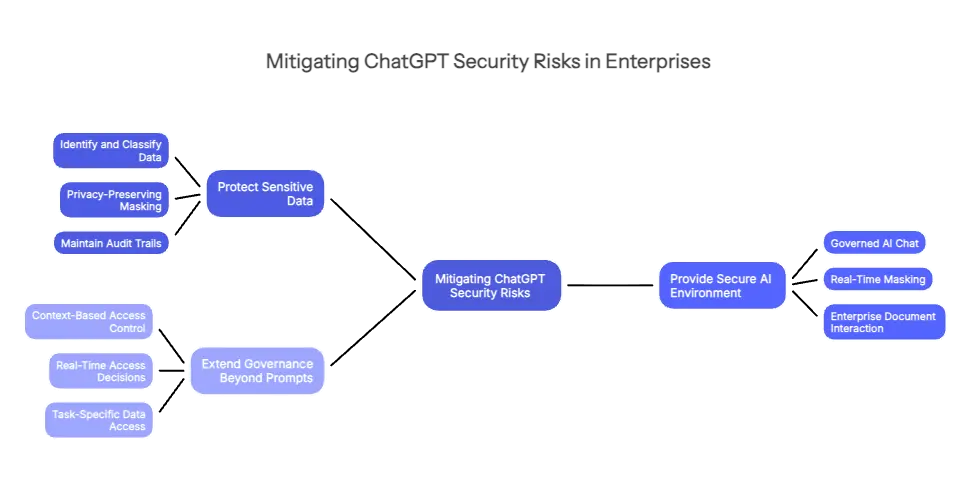
Protect sensitive data before it reaches the model.
Enterprises should identify and classify sensitive information, apply privacy-preserving masking before prompts are submitted, and maintain audit trails.
Provide a secure AI environment.
Instead of relying on public AI tools, organizations should offer governed AI chat. GPTGuard masks sensitive information in real time while enabling employees to interact with enterprise documents across multiple LLMs securely.
Extend governance beyond prompts.
As AI agents become more common, CBAC (Context-Based Access Control) enforces real-time, context-aware access decisions, ensuring users and AI agents only access data required for a specific task.
Conclusion
The conversation around ChatGPT security risks has moved far beyond whether enterprises should use generative AI. The real challenge is ensuring that innovation does not come at the cost of sensitive data, regulatory compliance, or customer trust.
As real-world incidents have shown, the greatest risks rarely stem from the AI model itself but from how organizations govern the data flowing through it.
Ultimately, enterprise ChatGPT security is not about restricting employee productivity. It is about enabling teams to use AI with confidence, knowing that confidential information remains protected, compliance requirements are met, and governance keeps pace with innovation.
FAQs on ChatGPT Security Risks
Why are ChatGPT privacy risks a growing concern for regulated industries?
Industries such as healthcare, finance, and government handle highly sensitive information that is subject to regulations like HIPAA, GDPR, DPDP, and PCI DSS. Uncontrolled AI usage can lead to unauthorized disclosure of protected data and regulatory penalties.
Should enterprises ban ChatGPT or implement AI governance?
For most organizations, governance is a more sustainable approach than outright bans. Secure AI adoption combines clear policies, data protection controls, employee awareness, and continuous monitoring instead of preventing AI usage altogether.
How do organizations prevent employees from using unauthorized AI tools?
Enterprises can reduce shadow AI by offering approved AI platforms, educating employees on acceptable use, monitoring AI activity, and implementing technical controls that protect sensitive information before it leaves corporate environments.
What security controls should every enterprise implement before rolling out ChatGPT?
Essential controls include AI usage policies, sensitive data detection, privacy-preserving masking, identity-aware access controls, audit logging, prompt monitoring, and regular governance reviews.
How should organizations secure AI-powered document search and RAG applications?
Enterprises should protect sensitive data before it is indexed, apply access controls to retrieval systems, monitor AI responses, and ensure users only retrieve information they are authorized to access.
