
Large language models (LLMs) have quickly moved from experimental tools to enterprise systems that summarize documents, automate workflows, power customer experiences, and operate AI agents. However, as adoption grows, attackers are finding new ways to manipulate models, extract sensitive information, and misuse connected tools.
The OWASP Top 10 for LLM Applications identifies prompt injection, sensitive information disclosure, and excessive agency as some of the most critical risks affecting AI deployments today.
This is where LLM red teaming becomes essential. Unlike traditional penetration testing, LLM red teaming focuses on how AI systems behave when users intentionally attempt to manipulate prompts, bypass restrictions, expose private data, or misuse integrated tools.
A mature security program requires structured AI red-team exercises, continuous testing, and a practical LLM red-teaming checklist that evolves with new threats.
Why Traditional Security Testing Falls Short for LLMs?
Traditional application security focuses on vulnerabilities in code, networks, and infrastructure. LLMs pose a distinct challenge because risks often manifest in natural-language interactions.
Attackers do not always need malware or stolen credentials. They can use carefully crafted prompts to influence model behavior, reveal confidential information, or trigger unauthorized actions.
Common generative AI security vulnerabilities include:
- Hidden prompt manipulation
- Exposure of sensitive training or retrieval data
- Unauthorized AI agent actions
- Data leakage through chat interfaces
- Weak access control around connected tools
- Insecure Retrieval-Augmented Generation (RAG) pipelines
These generative AI security risks require continuous validation because AI systems evolve as models, integrations, and enterprise use cases change.
According to McKinsey’s State of AI research, 78% of organizations reported using AI in at least one business function in 2024, rising to 88% in 2025, underscoring how quickly AI adoption is expanding across industries.
As adoption increases, enterprises need security programs that identify hidden AI security weaknesses before attackers discover them. A strong LLM red teaming program evaluates how safely the system behaves under adversarial conditions.
Building an Enterprise LLM Red Teaming Framework
Effective AI red teaming strategies combine security testing, privacy evaluation, governance, and continuous monitoring. Here is a practical LLM red-teaming checklist that enterprises can use to uncover hidden risks.
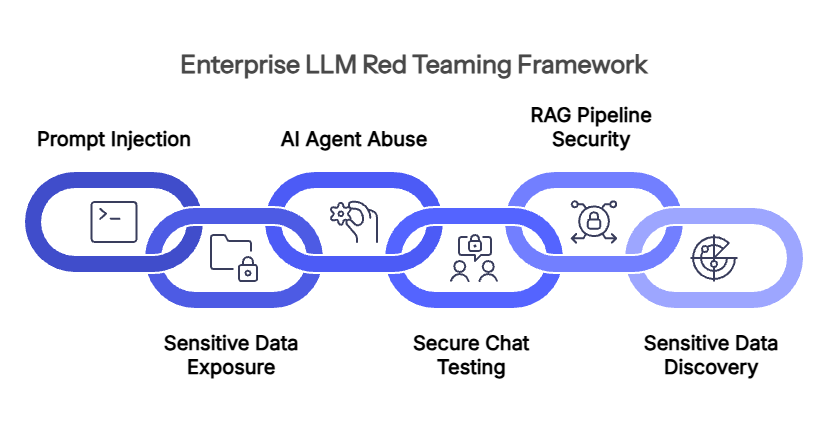
1. Prompt Injection Testing: Can Your LLM Be Manipulated?
Prompt injection remains one of the most discussed LLM security vulnerabilities because it targets how models interpret instructions. Instead of attacking software code, attackers attempt to override the model’s original instructions.
Red Team Tests to Perform:
Direct Prompt Injection
- Can users make the model ignore system instructions?
- Can they bypass security rules?
- Can they convince the model to reveal hidden prompts?
Indirect Prompt Injection
This occurs when malicious instructions are hidden inside external content, such as:
- Documents
- Emails
- Web pages
- Retrieved knowledge sources
In fact, Protecto helps secure AI workflows through Secure AI Data Pipelines, protecting sensitive information flowing through frameworks such as LangChain, LlamaIndex, Haystack, Semantic Kernel, and custom RAG pipelines.
2. Sensitive Data Exposure Testing: Is Your AI Revealing Private Information?
One of the most damaging security vulnerabilities in generative AI is the accidental leakage of sensitive data. LLMs often process large volumes of PII, PHI, financial data, customer records, intellectual property, and internal business documents.
Without proper controls, sensitive data may appear in prompts, responses, logs, or third-party AI services.
PII Leakage Red Team Checklist should test:
- Can users extract another person’s private information?
- Can the AI reveal sensitive information from uploaded documents?
- Are confidential records appearing in responses?
- Is sensitive data stored in logs?
- Does the AI detect hidden or modified sensitive information?
- Are privacy controls consistent across multiple AI applications?
These AI red team exercises help determine whether organizations have sufficient protection before deploying AI at scale.
Protecto’s Privacy Vault, a Data Privacy Vault for AI, helps enterprises reduce privacy risks by protecting sensitive information throughout AI workflows. Sensitive information can be replaced with secure tokens before entering AI pipelines, while authorized users can access the original information when needed.
3. AI Agent and Tool Abuse Testing: Controlling What AI Can Do
Modern AI systems are becoming action-oriented. AI agents can now search databases, access enterprise applications, call APIs, execute workflows, and retrieve sensitive files.
While this creates productivity benefits, it also introduces new AI security weaknesses. A compromised AI agent with excessive permissions can create significant operational risk.
Here is what the tool abuse red team checklist should include:
- Can an AI agent use tools beyond its permission level?
- Can a normal user manipulate an AI agent into performing administrator-level actions?
- Can the AI complete sensitive actions without approval?
- Can the AI complete sensitive actions without approval?
Traditional Role-Based Access Control (RBAC) was designed for predictable human interactions. AI agents operate differently because they dynamically request information, chain actions, and interact with multiple systems.
Protecto’s CBAC (Context-Based Access Control for AI Agents) enables real-time AI access decisions based on user identity, purpose of access, current context and authorization level.
4. Secure Enterprise AI Chat Testing
Many organizations face another growing challenge: employees using public AI tools without security oversight. This creates risks such as:
- Confidential documents are being uploaded externally
- Customer information entering public AI models
- Sensitive prompts leaving company environments
A complete LLM red teaming checklist should include testing how employees interact with AI assistants.
Protecto GPTGuard provides Data Loss Prevention (DLP) for enterprise AI chat. It allows employees to safely use LLMs like ChatGPT, Gemini, and Claude while protecting confidential information.
5. RAG Pipeline and Training Data Security Testing
RAG systems improve AI accuracy by connecting models with enterprise knowledge sources. However, they also introduce security challenges. Red teams should evaluate:
- What data enters vector databases
- Whether sensitive content is stored
- How retrieval permissions work
- Whether unauthorized users can access restricted information
Protecto Secure AI Data Pipelines help protect information flowing through LangChain, LlamaIndex, Haystack, Semantic Kernel, and custom RAG pipelines. Sensitive information can be masked before storage and before prompt construction, helping reduce AI data exposure.
6. Advanced Sensitive Data Discovery Testing
Basic pattern matching is often insufficient for AI environments. Sensitive information may appear as misspelled text, modified identifiers, mixed-language data, and hidden contextual information.
Protecto DeepSight provides AI-native sensitive data detection built for complex AI pipelines. It uses contextual understanding to identify sensitive information beyond simple patterns, helping organizations discover risks traditional tools may miss.
Creating a Continuous LLM Red Teaming Program
Effective LLM red teaming is not a one-time assessment. AI systems constantly change as:
- Models update
- Data sources expand
- New agents launch
- Business workflows evolve
A mature program should continuously track prompt injection attacks, sensitive data exposure, unauthorized access events, policy violations, AI agent behavior, and security improvements over time.
Conclusion
AI creates enormous opportunities, but it also introduces risks that traditional security programs were not designed to handle. Prompt injection, PII leakage, and tool abuse demonstrate why organizations need a structured LLM red-teaming checklist supported by robust privacy and security controls.
By combining ongoing AI red team exercises, modern AI red teaming strategies, and AI-specific safeguards, enterprises can identify vulnerabilities earlier and deploy AI systems more confidently.
Protecto helps organizations secure the next generation of AI with Privacy Vault, GPTGuard, CBAC, DeepSight, Secure AI Data Pipelines, and enterprise-ready solutions built to address today’s most critical LLM security vulnerabilities while enabling responsible AI innovation.
FAQs on LLM Red Teaming Checklist
How does LLM red teaming detect prompt injection vulnerabilities?
LLM red teaming detects prompt injection by testing whether malicious instructions can override system prompts, bypass restrictions, manipulate model behavior, or force unauthorized disclosure of sensitive enterprise information.
Why are prompt injection attacks considered major LLM security vulnerabilities?
Prompt injection attacks are critical LLM security vulnerabilities because they manipulate model instructions through natural language, potentially exposing confidential data, changing responses, or triggering unauthorized AI actions.
What are the most common generative AI security vulnerabilities found during testing?
Common generative AI security vulnerabilities include prompt injection, sensitive data exposure, insecure plugins, excessive AI agent permissions, weak access controls, training data leakage, and unsafe model responses.
Why is traditional penetration testing not enough for LLM applications?
Traditional testing focuses on software flaws, while LLM red teaming evaluates AI-specific risks like prompt manipulation, unpredictable outputs, sensitive data leakage, and unauthorized agent behavior.
How can organizations measure the correct success of AI red team exercises?
Organizations can measure success by tracking discovered vulnerabilities, blocked attacks, reduced data exposure, improved access control, safer AI responses, and stronger compliance readiness.
What is the difference between AI red teaming and AI security monitoring?
AI red teaming proactively tests potential attacks before they are exploited, while AI security monitoring continuously monitors deployed systems for suspicious behavior, violations, and emerging threats.
