
Every prompt, response, and training dataset can become a potential source of sensitive data exposure if enterprise AI systems are not designed with appropriate data controls.
Unlike traditional cyberattacks that target databases or infrastructure, model inversion attacks exploit the behavior of machine learning models to infer information about the data used to train or fine-tune them
As organizations embed large language models into customer support, internal assistants, analytics, and knowledge management, the attack surface shifts from where data is stored to how models process and reveal information. In fact, according to Cisco’s 2024 Data Privacy Benchmark Study, 48% of organizations admitted to entering non-public company information into generative AI tools, raising concerns about AI data exposure.
Hence, understanding model inversion attacks in LLMs helps enterprises mitigate emerging AI privacy attacks and build secure, responsible AI systems.
The Hidden Privacy Challenge Behind Enterprise AI Models
As enterprises move from experimenting with AI to embedding large language models into everyday operations, the relationship between data and security is changing.
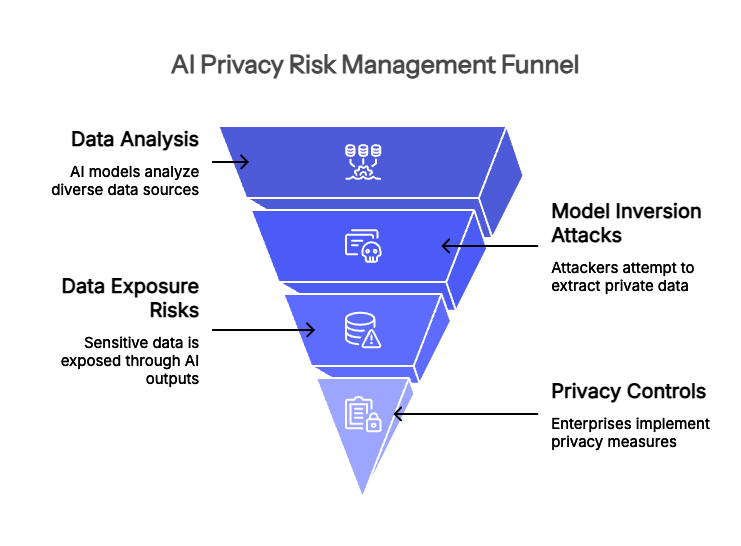
AI models are no longer just processing information from a fixed database. They are analyzing documents, learning from interactions, connecting with enterprise systems, and generating responses based on massive amounts of information.
This creates a new challenge for security teams. Sensitive data exposure may not always happen through a traditional breach. In some cases, privacy risks can emerge from how an AI model learns, stores patterns, and responds to future queries.
This is where model inversion attacks become an important security consideration. These attacks attempt to extract or reconstruct information about the data used to train or fine-tune an AI model by analyzing its outputs. Instead of accessing the original dataset directly, attackers use repeated interactions with the model to infer private attributes, confidential details, or sensitive patterns.
The concern is growing as businesses increase their adoption of AI. According to McKinsey’s The State of AI in 2025 report, 88% of organizations reported using AI in at least one business function, showing how quickly AI systems are becoming integrated into enterprise workflows.
For organizations that have adopted AI and are handling huge volumes of sensitive data, model inversion attack risks can involve exposure of:
- Personally identifiable information (PII)
- Protected health information (PHI)
- Financial and payment data
- Customer interactions and behavioral insights
- Internal research or proprietary business information
The complexity increases further with LLM-powered applications, where models interact with retrieval systems, AI agents, and internal knowledge bases. Managing these risks requires enterprises to think beyond traditional cybersecurity and focus on protecting data throughout the complete AI lifecycle.
Reducing these risks requires enterprises to protect sensitive information before it enters AI workflows. Protecto Privacy Vault helps organizations secure AI pipelines by detecting sensitive data, applying intelligent tokenization, and allowing models to operate without unnecessary exposure to raw PII, PHI, or confidential information.
It thus enables businesses to continue building powerful AI applications while maintaining stronger privacy controls.
Are Model Inversion Attacks Different From Traditional Data Breaches?
For years, enterprise security strategies have focused on protecting where data is stored, such as databases, cloud environments, applications, and internal networks.
Traditional data breaches usually happen when attackers gain unauthorized access to these systems and extract sensitive information directly. However, the rise of large language models has introduced a more complex security challenge in which sensitive information may be exposed through the behavior of the AI system itself.
Unlike conventional breaches, model inversion attacks do not always require attackers to access the original dataset. Instead, adversaries study a model’s responses, outputs, or patterns to infer information about the data used during training or fine-tuning.
It creates a different type of risk because the model itself can become an indirect source of information exposure.
In model inversion attacks on LLMs, attackers may repeatedly query a model and analyze generated responses to uncover private attributes, sensitive patterns, or details that should remain protected.
The growing reliance on AI has made these risks more relevant. Moreover, according to the 2025 State of Data Security Report by Varonis, 99% of organizations had sensitive data exposed to AI tools, showing how excessive access to sensitive information can create new security challenges in AI environments.
Reducing model inversion attack risks requires a broader approach than traditional cybersecurity. Organizations must secure not only where data is stored but also how information enters AI pipelines, how models interact with data, and what information can appear in generated responses.
As enterprises adopt AI assistants and LLM-powered workflows, preventing AI privacy attacks requires real-time protection before sensitive information reaches external models.
Here, Protecto GPTGuard – Data Loss Prevention (DLP) for AI Chat can help organizations securely use LLMs by detecting and masking sensitive data before it leaves the enterprise environment, enabling employees to work with AI while reducing the risk of exposing confidential information.
Where Do Model Inversion Attack Risks Appear in Modern LLM Workflows?
Most organizations do not intentionally expose sensitive information through AI. The challenge comes from increasingly complex AI ecosystems in which data moves across multiple systems.
Understanding these risk points helps enterprises strengthen their AI security strategy.
1. Training and Fine-Tuning With Sensitive Data
Many organizations customize models using internal datasets to improve accuracy. However, if raw customer records, employee information, or confidential documents enter training pipelines, they may create future privacy exposure.
A stronger approach involves removing, masking, or tokenizing sensitive information before AI processing begins.
2. Retrieval-Augmented Generation (RAG) Systems
RAG enables LLMs to access enterprise documents and knowledge bases to produce more accurate responses. While powerful, these systems require careful protection because models can retrieve sensitive information during conversations.
Secure RAG strategies help ensure confidential data is protected before entering vector databases and before prompt construction.
3. Employee Use of Public AI Tools
Another growing source of AI privacy attacks comes from employees sharing confidential information with unmanaged AI applications.
Samsung, for example, temporarily restricted employee use of generative AI tools in 2023 after sensitive internal information was reportedly entered into ChatGPT. This is a distinct risk from model inversion but shares the same root cause: uncontrolled sensitive data flowing into external AI systems.
This highlights why enterprises need systems that allow AI adoption while controlling what information reaches external models.
Building Privacy Protection Before AI Exposure Happens
Preventing model inversion attacks starts with controlling sensitive data before it reaches AI models. Instead of securing information only after exposure occurs, enterprises need proactive safeguards across training data, prompts, RAG pipelines, and AI-powered applications.
Reducing model inversion attack risks requires robust data discovery, minimization, masking, tokenization, and access controls that limit the amount of confidential information AI systems can process or reveal. As AI privacy attacks become more advanced, organizations need security designed specifically for modern AI workflows.
Protecto helps enterprises build privacy-first AI systems with Privacy Vault for sensitive data detection and tokenization, GPTGuard for preventing data leaks in AI chat, and DeepSight for discovering hidden sensitive data across complex AI environments. These solutions help organizations adopt AI securely while protecting sensitive information.
Conclusion
As enterprises deploy LLMs across customer-facing applications, internal workflows, and retrieval pipelines, model inversion attacks demonstrate that protecting infrastructure alone is no longer sufficient. The exposure risk increasingly depends on what data enters AI systems, how it is transformed, and what information models can reveal through their outputs.
Model inversion is ultimately an architectural problem, not simply a model problem. Reducing this risk requires controls that operate before sensitive data reaches training pipelines, prompts, vector stores, or external models.
Enterprises that separate AI capabilities from raw sensitive data through detection, tokenization, and governed data flows reduce the likelihood that confidential information becomes recoverable through model behavior.
FAQs on Model Inversion Attacks in LLMs
What type of data can be exposed through model inversion attacks?
Attackers may attempt to uncover personally identifiable information (PII), protected health information (PHI), financial records, confidential documents, or sensitive patterns from AI training data.
Why is sensitive data protection important before AI training?
Protecting data before training reduces the likelihood that models will learn confidential information, helping organizations prevent future exposure through AI-generated responses.
How does data tokenization help prevent AI privacy risks?
Data tokenization replaces sensitive information with secure tokens, allowing AI systems to process useful information while reducing exposure of original private data.
Should enterprises remove all sensitive data from AI systems?
Not always. Enterprises should minimize unnecessary exposure of sensitive data and use techniques such as masking or tokenization to maintain AI functionality securely.
What is the future of protecting LLMs against privacy attacks?
Future LLM security will focus on privacy-first AI design, stronger governance, real-time protection, secure data pipelines, and advanced defenses against evolving AI privacy attacks.

