

The rise of generative AI has redefined enterprise productivity, but it has also introduced a new category of security risk. While IT teams have long managed unauthorized applications, today’s challenge extends to employees using AI tools outside approved governance frameworks. According to Microsoft’s 2024 Work Trend Index, 75% of knowledge workers use AI at work.
Understanding the difference between shadow AI and shadow IT is now essential for balancing innovation with security. This guide explores the key concepts of shadow AI vs shadow IT, explains how to detect them, and outlines practical governance strategies to reduce enterprise risk.
The New Risk Landscape: Shadow AI Is Not Shadow IT
Many organizations assume shadow AI is simply another form of shadow IT. While the two are related, they create fundamentally different risks.
Shadow IT refers to any software, hardware, cloud service, or application used without IT approval. Some examples include unauthorized SaaS subscriptions, file-sharing platforms, messaging apps, and personal cloud storage.
Shadow AI, on the other hand, refers specifically to employees using AI systems, generative AI tools, AI agents, or AI-powered applications without organizational oversight.
Understanding the concept of shadow AI vs shadow IT becomes important, as traditional security controls designed for shadow IT often fail to address AI-specific risks.
Here is the quick comparison:
| Category | Shadow IT | Shadow AI |
| Primary Risk | Unauthorized applications and infrastructure | Unauthorized AI models and AI workflows |
| Data Exposure | Data stored in unknown systems | Sensitive data shared with AI models |
| Governance Focus | Asset visibility and access control | Prompt monitoring, model governance, and data protection for Gen AI |
| Compliance Impact | Software and data handling violations | Privacy, IP leakage, and AI regulation violations |
| Detection Method | Network discovery and SaaS monitoring | AI usage monitoring and prompt analysis |
This distinction is becoming increasingly important as enterprises deploy generative AI at scale.
Why Is Shadow AI Growing Faster Than Shadow IT?
Employees often adopt AI tools because approved alternatives do not meet their immediate needs.
A survey from Salesforce AI Research found that about 28% of workers use generative AI tools without informing employers. They often do this to improve productivity and automate repetitive tasks.
The challenge is that employees tend to paste customer records, financial information, healthcare data, source code, or other important internal business documents into public AI systems. Unlike traditional shadow IT, where data may reside in an unapproved application, shadow AI can expose sensitive information directly to external models during prompt processing.
This creates a unique governance challenge that many organizations are only beginning to understand.
The Hidden Costs of Shadow IT and Shadow AI
Unauthorized technology adoption comes with hidden costs that extend far beyond visibility gaps, affecting security, compliance, and business continuity.
Shadow IT Security Challenges
The most common shadow IT security challenges include:
- Lack of visibility into application usage
- Unauthorized data transfers
- Weak vendor security controls
- Compliance violations
- Expanded attack surfaces
The result is fragmented security governance and increased operational complexity.
Shadow AI Risks
Shadow AI introduces additional concerns:
- Sensitive data leakage into LLMs
- Exposure of intellectual property
- Prompt injection attack
- Hallucinated outputs influencing business decisions
- Regulatory non-compliance
These risks are amplified because AI systems often process data in ways traditional security tools cannot fully inspect. This is where organizations need governance strategies specifically designed for AI environments rather than simply extending existing shadow IT controls.
How to Detect Shadow IT Across the Enterprise?
Organizations asking how to detect shadow IT should focus on visibility first.
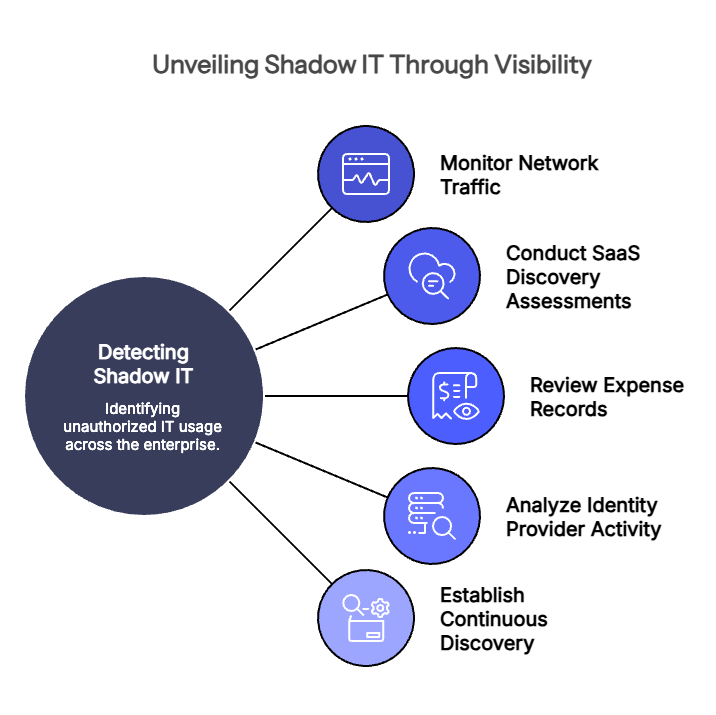
1. Monitor Network Traffic
Security teams should continuously analyze outbound network activity to identify unauthorized applications and cloud services. Unexpected SaaS usage patterns often reveal shadow IT before major incidents occur.
2. Conduct SaaS Discovery Assessments
Modern CASB (Cloud Access Security Broker) platforms can identify applications being accessed across the enterprise. This provides a baseline inventory of sanctioned and unsanctioned services.
3. Review Expense Records
Corporate credit card and procurement reviews often uncover software subscriptions that bypassed IT approval processes.
4. Analyze Identity Provider Activity
Monitoring authentication logs from systems such as Okta and Microsoft Entra can reveal connections to unauthorized services.
5. Establish Continuous Discovery
Shadow IT is not a one-time problem. So ensure that detection is done regularly.
How to Detect Shadow AI Before it Becomes a Compliance Problem?
Many security leaders now ask how to detect shadow AI when employees can access AI tools from any browser. Businesses must know that detection requires a more specialized approach.
1. Monitor AI Traffic Patterns
Organizations should identify connections to public AI services such as ChatGPT, Claude, Gemini, and other generative AI platforms. Visibility into AI usage helps security teams understand where business data may be flowing.
2. Analyze Prompt Activity
Prompt monitoring helps identify:
- Sensitive data submissions
- Customer information exposure
- Intellectual property sharing
- Regulated data transfers
Unlike traditional application monitoring, AI governance requires visibility into what users submit to models.
3. Deploy Enterprise AI Platforms
Employees often use public AI tools because approved alternatives do not exist. Providing secure enterprise AI environments reduces the incentive to use unauthorized solutions.
Protecto extends this protection through GPTGuard MCP, its enterprise AI chat platform, which automatically masks sensitive data before prompts are sent to leading LLMs. This allows employees to use AI confidently while helping organizations minimize shadow AI risks and prevent unintended data exposure.
4. Identify AI-Enabled Applications
Many business applications now include embedded AI functionality. Security teams should assess whether AI features are processing sensitive organizational data.
A Governance Framework for Both Shadow AI and Shadow IT
Rather than managing these risks separately, organizations should build a unified governance framework. Here are the layers:
Layer 1: Visibility
You cannot govern what you cannot see. Organizations need continuous monitoring of:
- SaaS applications
- AI tools
- Data flows
- User activity
Layer 2: Data Protection
The most effective control is to protect data before it leaves the enterprise boundaries. This approach reduces the impact of both shadow IT and shadow AI exposures.
Protecto’s Privacy Vault helps organizations discover, tokenize, and protect sensitive information across AI workflows through consistent tokenization and controlled de-tokenization. It can detect more than 200 PII, PHI, and PCI entity types across 50+ languages.
Layer 3: Access Governance
Traditional role-based access controls were designed for human users. AI agents require more dynamic controls.
Protecto’s Context-Based Access Control (CBAC) evaluates access requests in real time based on identity, purpose, and operational context. This enables secure governance for modern AI ecosystems.
Layer 4: Continuous Sensitive Data Discovery
Organizations need to continuously identify sensitive information across AI environments.
Protecto’s DeepSight provides AI-native sensitive data detection designed for unstructured and multilingual enterprise data. It can identify context-dependent sensitive information that traditional pattern-matching tools frequently miss.
Conclusion
The debate around shadow AI vs shadow IT is not about determining which threat is larger. It is about recognizing that enterprises now operate in an environment where unauthorized technology adoption can occur faster than ever.
While shadow IT security challenges remain significant, shadow AI introduces new dimensions involving data leakage, AI governance, intellectual property protection, and regulatory compliance.
Organizations need to understand the differences between shadow AI and shadow IT, invest in visibility, and learn to detect both to be better positioned to embrace AI innovation without sacrificing security.
FAQs on Shadow AI vs Shadow IT
How can organizations detect shadow AI?
Organizations can detect shadow AI by monitoring AI application usage, analyzing network traffic, tracking prompt submissions, and deploying AI governance platforms that identify unauthorized AI interactions.
What are the biggest shadow IT security challenges?
The primary shadow IT security challenges include poor visibility, unauthorized data sharing, compliance violations, unmanaged applications, increased exposure to cyberattacks, and inconsistent enforcement of security policies.
Which industries are most vulnerable to shadow AI?
Healthcare, financial services, government, insurance, legal, and SaaS organizations face the highest shadow AI risks because they routinely process regulated and highly sensitive business information.
What types of data are most vulnerable to shadow AI?
Personally identifiable information, protected health information, payment card data, financial records, proprietary source code, contracts, customer information, and confidential business documents are particularly vulnerable.
Should organizations block public AI tools completely?
No. Completely blocking AI tools often encourages employees to use unauthorized alternatives. Secure, governed AI platforms offer a more effective balance between productivity and enterprise security.
