

Every AI application relies on data. From customer conversations and healthcare records to financial transactions, organizations process enormous volumes of sensitive information every day. As AI adoption grows, so does the need to protect that data from misuse, exposure, and compliance risks.
This is why understanding what privacy by design entails has become a business necessity rather than just a compliance requirement. Instead of adding privacy controls after a system is built, privacy by design embeds privacy safeguards into products, applications, and AI workflows from the start.
The stakes are unbelievably high for this aspect. According to the 2024 Verizon Data Breach Investigations Report, 68% of data breaches are known to involve a human element such as errors, misuse, or even social engineering.
In this guide, we’ll explore what privacy by design is, why it matters for modern organizations, and how to implement it effectively in AI-driven environments.
What Is Privacy by Design?
The simplest answer to privacy by design is that privacy protections are built into a system from the start rather than added later.
Dr. Ann Cavoukian, former Information and Privacy Commissioner of Ontario, Canada, developed the concept. It promotes a proactive approach where privacy becomes a fundamental part of product development, business processes, and technology architecture.
In practical terms, privacy by design means:
- Collecting only the data that is very important
- Limiting access to highly sensitive information
- Encrypting and protecting data throughout its lifecycle
- Giving users control over their personal information
- Continuously monitoring privacy risks
When organizations use this approach, privacy becomes a business requirement instead of a simple compliance checkbox.
While privacy principles offer the foundation, organizations also need technical control to enforce them consistently across different AI systems and data pipelines.
Protecto Vault– Data Privacy Vault for AI helps organizations operationalize Privacy-by-Design by automatically discovering, masking, tokenizing, and securing sensitive information before it enters AI models, analytics systems, or enterprise workflows.
This allows organizations to reduce privacy risks without sacrificing AI performance or business productivity.
What Privacy by Design Means for AI Applications?
Many organizations understand privacy in traditional software. However, AI introduces unique challenges. When discussing privacy by design, AI systems require special consideration because they process massive volumes of sensitive information.
Examples include:
- Customer support chats
- Medical records
- Employee data
- Financial documents
- Proprietary business information
- Minimization of data
- Discovery of sensitive data
- Access governance
- Tokenization
- Data masking
- Continuous monitoring
- Audit trails
Organizations have to make sure that sensitive information remains protected before, during, and after AI processing.
Why Privacy-by-Design Matters More Than Ever
The importance of privacy by design has now increased significantly because organizations are handling more sensitive data than ever before. In fact, according to Cisco’s Consumer Privacy Survey, 94% of organizations say customers would not buy from them if data protections were inadequate.
Privacy is not only a legal requirement anymore. In fact, it has become a competitive advantage over others.
Rising Data Breach Risks
Cybercriminals increasingly target customer records, financial records, healthcare data, AI training datasets, and enterprise knowledge repositories. Embedding privacy controls during development reduces the likelihood of exposing sensitive information.
Growing AI Adoption
AI applications are known to process the following:
- Personally identifiable information (PII)
- Protected health information (PHI)
- Financial records
- Customer conversations
Without privacy safeguards, AI systems can even risk exposing sensitive data through prompts, training datasets, or generated outputs.
Protecto’s Secure AI Data Pipelines and Secure RAG solutions help organizations embed privacy protections throughout these workflows. It essentially masks sensitive information before vector database storage and before LLM prompt construction. It can help in reducing the risk of unintended data exposure.
Expanding Regulatory Requirements
Modern privacy regulations now require a privacy by design approach. Some examples include GDPR, HIPAA, CCPA/CPRA, India’s DPDP Act, and Saudi Arabia’s PDPL.
Organizations that adopt privacy by design often find compliance easier because privacy controls are already embedded into their systems.
What Are the Benefits of Privacy By Design?
Privacy-by-Design offers more than regulatory compliance. By embedding privacy safeguards from the start, organizations can thereby reduce risk, strengthen security, improve customer trust, and build AI systems that become responsible and scalable
Here are the key benefits:
-
Improved Customer Trust
Consumers care about how their data is handled. When organizations demonstrate strong privacy practices, they tend to strengthen customer relationships as well as brand reputation.
-
Reduced Compliance Risk
Privacy by design helps organizations align with regulatory requirements before audits occur. It can help reduce legal exposure, regulatory penalties, compliance costs, and remediation expenses.
-
Lower Security Costs
Fixing privacy issues during development is significantly cheaper than correcting them after deployment.
-
Better Data Governance
Privacy by design is important as it improves data classification, access management, retention policies, and data minimization. These practices highly support stronger governance across AI and traditional systems.
-
Stronger AI Security
Privacy by design plays a critical role in secure RAG architecture, AI model governance, data tokenization, sensitive data detection, and access control. These capabilities are essential as enterprises deploy agentic AI and large language model applications.
How to Implement Privacy by Design?
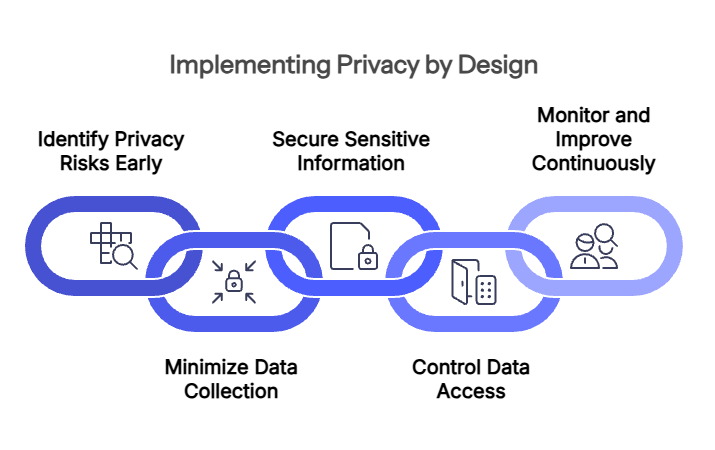
When organizations implement privacy by design, they need to make privacy a core part of every stage of development and not just add controls later. A structured approach helps reduce risks while supporting compliance and innovation.
1. Identify Privacy Risks Early
It is necessary to conduct privacy assessments during the planning phase to understand what data is being collected, how it is going to be used, and the potential risks involved.
2. Minimize Data Collection
It is necessary to collect only the necessary information. Limiting unnecessary data can help to reduce exposure as well as simplify compliance efforts.
3. Secure Sensitive Information
It is necessary to protect personal and sensitive data with the help of encryption, tokenization, masking, and secure storage practices throughout the entire lifecycle.
4. Control Data Access
Implement role-based or context-aware access controls to ensure only authorized users can view or modify highly sensitive information.
5. Monitor and Improve Continuously
It is also important to review privacy policies, conduct audits, and update controls on a regular basis as regulations and technologies evolve.
By following all these important steps, organizations can implement privacy by design while building secure, trustworthy, and compliant digital products.
How Protecto Helps Organizations Operationalize Privacy by Design?
Protecto helps organizations turn privacy by design into a practical reality by embedding privacy controls directly into AI workflows. Solutions like Privacy Vault enable sensitive data discovery, tokenization, and masking, while GPTGuard prevents sensitive information from reaching public LLMs.
For agentic AI environments, CBAC offers real-time, context-aware access control. Combined with capabilities such as Secure RAG, data leak prevention, as well as AI compliance support,
Protecto helps organizations protect sensitive data, meet regulatory requirements, and deploy AI applications with confidence.
Conclusion
In a world where data is supposed to power every AI-driven decision today, privacy cannot be an afterthought. Therefore, when an organization understands what privacy by design is, it helps them build trust, reduce compliance risks, and also protect sensitive information from the start.
By embedding privacy into systems, processes, and AI applications, businesses can effectively innovate with confidence while also meeting regulatory expectations. So, privacy by design is not just a best practice anymore. It is an important framework for businesses.
Frequently Asked Questions
Why is Privacy-by-Design considered a proactive approach to data protection?
Privacy-by-Design focuses on preventing privacy risks before they occur by embedding privacy safeguards into systems during development. This proactive approach reduces compliance gaps, minimizes security vulnerabilities, and lowers the likelihood of costly data breaches.
What role does tokenization play in Privacy-by-Design?
Tokenization replaces sensitive data with non-sensitive tokens while preserving its usability. This allows organizations to process information securely without exposing the original data during AI processing or analytics.
How does data minimization strengthen Privacy-by-Design?
Collecting only the information necessary for a specific purpose reduces an organization’s attack surface, simplifies compliance, and lowers the risk of unauthorized data exposure.
Why is access control important in a Privacy-by-Design strategy?
Restricting access based on user roles, context, and business purpose prevents unauthorized exposure of sensitive information while ensuring employees and AI systems access only the data they genuinely need.
Why is Privacy-by-Design becoming a competitive advantage for modern enterprises?
Organizations that prioritize privacy from the outset are better positioned to earn customer trust, simplify regulatory compliance, reduce operational risk, and accelerate secure AI adoption, making Privacy-by-Design a key business differentiator rather than just a compliance requirement.

