
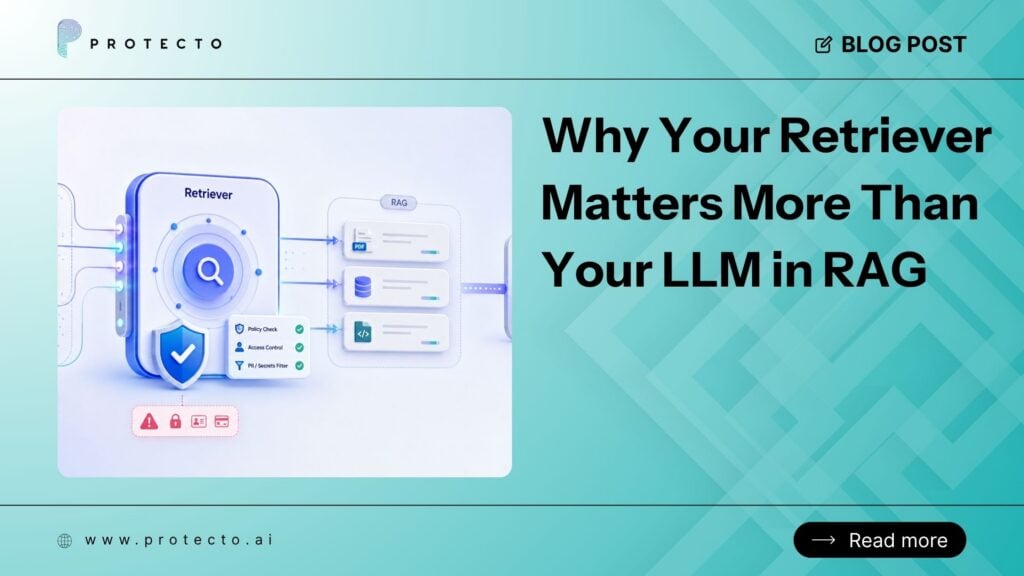
Most enterprise RAG security discussions focus on the wrong component. Teams spend weeks red-teaming the LLM, tuning system prompts, and filtering outputs. The component that actually decides what sensitive data the LLM sees receives almost no scrutiny: the retriever. The LLM is not where RAG data exposure begins. It begins the moment the retriever pulls a document into the context window.
What the Retriever Actually Does in a RAG Pipeline
In a retrieval-augmented generation pipeline, the LLM receives exactly what the retriever provides. Nothing more, nothing less. If a retrieved chunk contains a patient’s diagnosis, a customer’s tax identifier, or a confidential legal memo, the LLM sees that information and, in most cases, reflects it in its output. The LLM has no visibility into whether a particular piece of retrieved content was appropriate to surface for a particular user. It does not know that a support agent should not see contract terms retrieved alongside a billing question, or that a regional employee should not access records from another jurisdiction. The model processes context. It does not enforce policy. That enforcement gap sits entirely in the retriever. Most RAG architectures do not close it.
Three Ways Retriever Failures Create Data Exposure
1. Access control is lost at ingestion time
When organizations build a RAG corpus, they typically ingest documents without preserving the access controls that governed them in source systems. A document that required VP-level clearance in SharePoint becomes retrievable by anyone with access to the vector store. The embedding does not remember who was allowed to see the original file. OWASP LLM08:2025 identifies this directly: sensitive data from restricted sources can surface in responses to users who would never have been authorized to access the original documents. The risk is not hypothetical. It is structural.
2. Sensitive data enters the vector database unmasked
The content that gets chunked and embedded is often raw enterprise data: HR records, customer files, healthcare documents, financial reports. Every chunk containing PII, PHI, or confidential business identifiers becomes a retrievable unit. Dense retrieval systems surface the most semantically relevant chunks regardless of whether those chunks contain regulated data.
A question about a patient’s appointment history may retrieve chunks containing diagnoses, medications, and procedure codes alongside the scheduling information. The system retrieved what was relevant. It had no mechanism to separate retrievable context from protected context.
3. Over-retrieval amplifies exposure
Retrieval systems are tuned for recall, not privacy. Wider retrieval windows, re-ranking for relevance, and hybrid search approaches all increase the probability that sensitive fields appear in the context window. A RAG system optimized for accuracy will, by design, surface more context. More context means a larger surface area for sensitive data exposure on every query.
The Retriever Security Gap:
| Risk | Where It Occurs | Why Traditional Controls Miss It |
| Access control loss | At ingestion permissions stripped from source docs | Most vector DBs lack per-user retrieval policy. |
| Unmasked PII in embeddings | At chunking raw sensitive data embedded | No masking step before embedding |
| Over-retrieval | At query time relevance maximized, not privacy | Retrieval tuning optimizes recall, not exposure surface |
| Indirect prompt injection | In retrieved docs malicious instructions embedded | Retriever passes content without instruction validation |
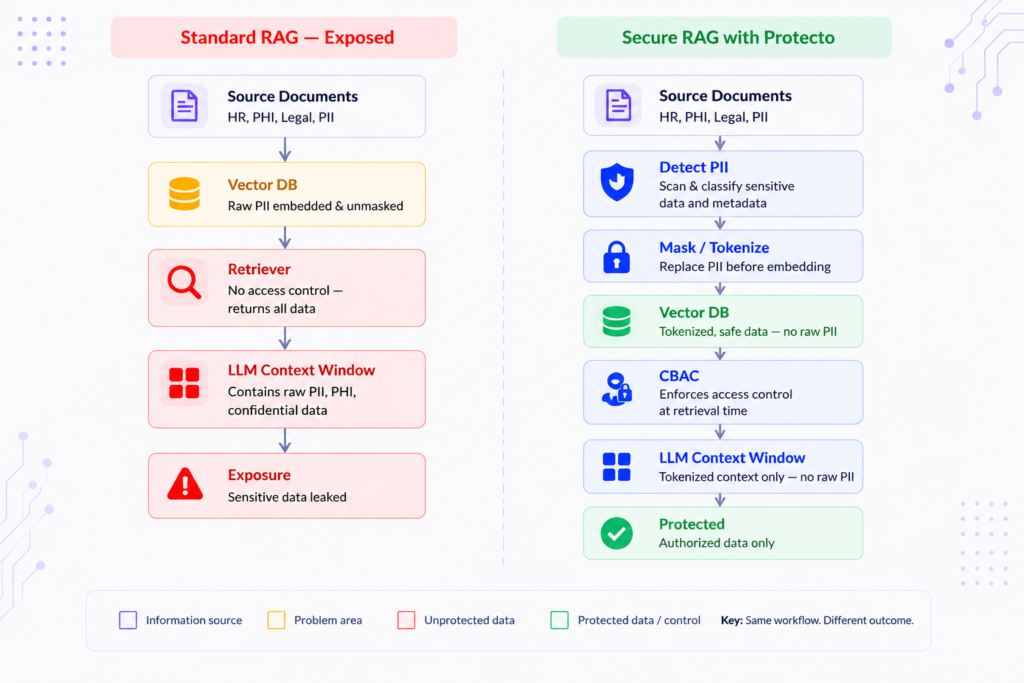
How Protecto Secure RAG Closes Each Gap
Securing a RAG pipeline means intervening at the data ingestion layer not the output layer. By the time an LLM generates a response, the exposure has already occurred inside the context window.
Protecto Secure RAG addresses this across the full pipeline, combining sensitive data detection, tokenization, access control, and audit logging into a single workflow designed specifically for RAG architectures. Here is how each layer works.
Detect what is in your corpus before ingestion
Every document entering a RAG corpus should be scanned for PII, PHI, PCI, and context-sensitive business data before it is chunked and embedded. DeepSight provides AI-native, context-aware detection across unstructured content, identifying sensitive entities that pattern-matching approaches miss.
Mask before embedding
Sensitive values should be replaced with context-preserving tokens before chunks are added to the vector database. Privacy Vault masks 200+ entity types across 50+ languages before embedding, so the vector store never holds raw PII, the LLM works with protected tokens, and authorized users detokenize on output only when identity and purpose have been verified. Once tokenized, the masked text is chunked and embedded into the vector store, so every embedding represents protected content, not raw PII. CBAC then enforces who can retrieve those chunks at query time.
Enforce access at retrieval time, not at ingestion
Static document-level permissions are not sufficient for AI workflows where agents and users operate with different access contexts across interactions. CBAC enforces access decisions at inference time evaluating identity, purpose, and context per request, so retrieved content is governed by who is asking and why, not just by what the document’s original folder permissions were.
Audit the context window, not just the outputs
This is where Secure RAG closes the gap that most logging approaches leave open. Most RAG systems log inputs and final outputs. What goes unrecorded is the retrieval event itself: what was retrieved, what appeared in the context window, and which sensitive entities were present in retrieved chunks. Without this, organizations cannot demonstrate to regulators what their AI systems accessed on behalf of users during any given interaction.
Protecto Secure RAG captures every retrieval event alongside masking and unmasking decisions, giving security and compliance teams complete visibility across the pipeline, not just at the endpoints. This supports audit requirements under GDPR, HIPAA, DPDP, and PCI DSS without requiring custom logging infrastructure.
The Practical Implication for AI Teams
Upgrading the LLM does not fix retriever security failures. Switching from one frontier model to another does not change what the retriever surfaces or who it surfaces it to. The LLM processes what the retriever provides. The teams building production RAG securely are treating retriever security as a distinct engineering problem from model selection. They ask three questions before deployment: What does the retriever surface? To whom? Under what conditions? Those are access control and data governance questions. They belong in the retrieval architecture, not the model.
FAQs
What is the difference between retriever security and LLM security in RAG?
LLM security focuses on what the model generates and how it responds to instructions. Retriever security controls what data enters the context window including what gets pulled into the prompt, before the LLM processes anything
How does access control work in a vector database?
Most vector databases do not natively enforce per-user or per-role access policies at query time. Access control in secure RAG architectures is applied at the retrieval layer through systems like Protecto CBAC, which evaluates identity, purpose, and context at inference time before determining what a user or agent can receive.
What is over-retrieval in RAG and why does it matter for security?
Over-retrieval occurs when a retrieval system surfaces more context than necessary to answer a query, which happens because retrieval tuning optimizes for relevance and recall rather than data minimization. In practice, it means sensitive fields appear in context windows even when the query did not require them, increasing the exposure surface on every interaction.
Does masking data before embedding affect RAG retrieval?
Context-preserving masking is designed to maintain the semantic structure of text so retrieval relevance is minimally affected. The same masked value maps consistently across the corpus, preserving data relationships. However, accuracy impact depends on the specific data and use case, Protecto recommends testing against your own corpus before production deployment.
