
Presidio is free to start. Then your team builds the token store, access rules and audit trail. Protecto ships them, so your engineers can stay on your product.
SOC 2 Type II · ISO 27001 · HIPAA, BAA available
Text sent to the model
Alice approved Bob’s refund, then Alice emailed Bob.





Presidio (formerly Microsoft Presidio) is a free, open-source library that finds and masks PII. Protecto is the alternative when AI with real data goes to production. It adds consistent, reversible tokens, unmasking by user, agent and task, audit logs, and controls for RAG, tool calls and MCP. With Presidio, your team builds those parts around it.
A SaaS company processing 13M+ long texts a day cut cost by 90% against its in-house estimate.
Lower cost than the in-house estimate, at a SaaS company
Months faster to market than the in-house estimate, at a security company
Live enterprise tenants at Automation Anywhere
Presidio is often the right place to start. It was built to find and mask PII, and AI with real data in production asks for more.
Presidio finds and masks PII in the data you hand it. An AI app moves data through prompts, retrieval, agents and tools, and each step needs its own decision.
Sample request: a support agent is asked to refund Maya Shah’s last order. Pick a step.
Presidio gives you strong parts, and your team builds the system around them. Pick a layer to see who owns it and where that comes from.
An analyst asks AI to summarize a supplier contract. The summary reveals a price cut and legal’s view of an exit clause. There is no name or ID in either sentence.
Presidio can add patterns, but a pattern can’t decide which passage this reader may see. Protecto applies policy to business-confidential information beyond PII, by user, agent and task.
“Summarize this supplier contract.”
An independent benchmark by DataXpert and UT Dallas, published by Protecto, with Presidio on default settings.
Phone false positives
11 Protecto, 502 Presidio
Credit card false positives
0 Protecto, 232 Presidio
SSN false positives
0 Protecto, 55 Presidio
How to read this. 3,000 synthetic samples scored at the entity level, March 2025. Presidio was analyzer 2.2.351 with the default en_core_web_sm model, in a setup that returned no organizations. Presidio’s own evaluation docs say default results aren’t very accurate and that a custom setup can raise F score by about 30%. So test both on your own data. Presidio has released new versions since this study.
Where they match, where Presidio is strong and where Protecto goes further.
| Capability | Protecto | Presidio |
|---|---|---|
| AI and agents | ||
| Built for AI | Yes | No. A general PII de-identification SDK |
| LLM prompts and responses | Masks prompts, restores real values by policy, any LLM | Through LiteLLM or AISIX, which you run |
| RAG and retrieval | Masks before indexing, applies policy at retrieval | No |
| Agents | Policy by user, agent and task | No |
| Tool calls | A tool gets a real value only when policy allows it | No |
| MCP servers | Controls which MCP servers get which real data | No |
| Detection | ||
| Method | Agentic detection and classification engine | Regex, checksums, context words and spaCy models. GLiNER, Transformers and LLM recognizers optional |
| Independent benchmark | Higher F1 (DataXpert, UT Dallas) | Lower F1 on default settings |
| Languages | Seven tested, others on request and tested on your data | English by default. Others you configure |
| Custom entities | Yes, added in days | Yes, you write recognizers |
| Tokens and access | ||
| Consistent, reversible tokens | Yes, in any session at any time | Not built in. Hash and sample options to adapt |
| Restoring real values | By policy, through Protecto Vault | Built-in AES decrypt. A mapping store is yours to build |
| Unmasking by user, agent and task | Yes, your application passes who is asking and for what task | No. You build it |
| Policy per tenant | Yes. Automation Anywhere runs 5,000+ live enterprise tenants on Protecto | No. You build it |
| Business-confidential information beyond PII | Context-Based Access Control | No |
| Audit logs | Logs each request and reveal, stored locally when self-hosted | No. You build it |
| Running it | ||
| Tables and pipelines | API, Snowflake UDF, Databricks, Kafka, Spark | presidio-structured, PySpark, Databricks, Fabric |
| Where it runs | SaaS, private cloud, on-premises, air-gapped | Anywhere you host it: Python package, Docker, Kubernetes |
| API authentication | Auth key | No. You add it at another layer |
| License | Commercial. Privacy Gateway is open source | Open source, MIT, free |
| Accountability | ||
| Support | Commercial support | Community. No SLA or official support |
| Certifications | SOC 2 Type II, ISO 27001. Signs a BAA when it hosts, manages or can access your instance | Not available. Community project |
Last checked November 9, 2026, against Presidio 2.2.366 (released October 27, 2026), its repo and docs.
Add these up before you compare Presidio’s price with a quote.
Hosting the analyzer, plus GPUs or LLM calls if you add GLiNER, Transformers or LLM recognizers.
A store for mappings, with backup and key management, if real values ever need to come back.
Authentication on the API, unmasking rules and logs your auditors will accept.
Thresholds and recognizers for each entity, and tests each time data or models change.
Upgrades, dependency fixes and someone to call when detection degrades, with no SLA behind the project.
Keep the move small until the results on your own data are clear.
Pick the prompt, RAG or tool call flow where Presidio’s limits show most, and test there first.
List what your recognizers catch today. Protecto can add custom entities in days.
Tokens aren’t portable between tools, so anything masked already needs processing again if you want the same token everywhere.
“Protecto enabled us to deliver data security, privacy, and compliance for our AI features at scale across 5,000+ enterprise clients, strengthening customer trust in our AI automation solutions.”
It depends on the job. For a free detector you host, teams look at GLiNER, OpenAI Privacy Filter or Philter. For a managed API in one cloud, AWS Comprehend, Google Cloud Sensitive Data Protection or Azure AI Language. When an LLM app, RAG pipeline or agent handles real data in production, Protecto adds consistent tokens, unmasking by policy and audit logs that Presidio leaves to your team.
Presidio is an open-source library that detects and masks PII in the text you hand it. Protecto is a commercial data security layer for AI. It detects sensitive data, replaces it with consistent tokens such as <PERSON>agjwd</PERSON>, and returns real values only to the users, agents and tools your policy allows, with an audit log of each reveal.
Yes, when AI with real data is going to production and your team doesn’t want to build the token store, unmasking rules and audit trail. For a prototype or a self-hosted library, Presidio is a good choice.
Not on its own. Presidio masks the data you hand it, and has no retrieval controls, agent policy, tool call support or MCP support. Teams connect it through frameworks such as LangChain, LlamaIndex or LiteLLM, then build the rest. Protecto covers all four by policy.
No. Presidio was created at Microsoft and is now an independent, community-governed project under the Data Privacy Stack organization, still under the MIT license. It is actively maintained, and older Microsoft links redirect to the new home.
The license is free. Teams still pay for compute, model hosting, a token store, access control, audit logging and the engineers who keep them working.
In a limited way. Its built-in reversal is AES encrypt and decrypt, and a salted hash stays consistent but doesn’t reverse. Consistent reversible tokens need a mapping store your team builds, and Presidio’s samples show one way to start.
It depends on your setup. Presidio’s maintainers describe it as a framework, not a solution, and its docs say custom setups score much higher than defaults. In the DataXpert and UT Dallas benchmark, default Presidio had lower F1 than Protecto. Test both on your own data.
Yes. LiteLLM can use Presidio as a guardrail and can restore values from replace operations in responses. See how Protecto works in LiteLLM.
Yes. Protecto runs as SaaS, in a private cloud, on-premises or air-gapped.
We can help you run a POC in under a week. Bring a prompt, document or tool call, and we’ll show you what each user, agent and model receives.
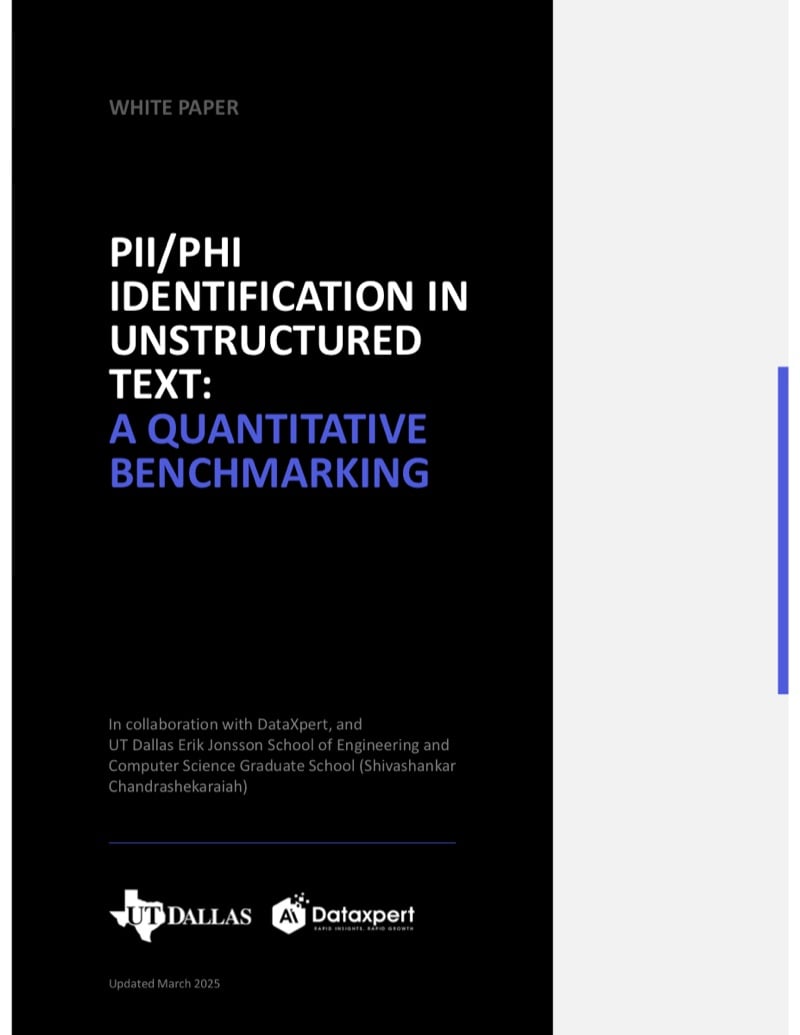
A third-party study compares how accurately Protecto, Microsoft Presidio, and AWS Comprehend find personal and health data in unstructured text.
By submitting you agree to Protecto’s privacy policy.