Data leaks and compliance risks are two major concerns for any team that sends customer data to an AI system.
The model rarely needs the real values. A support agent needs a customer’s name to open a ticket, and a claims analyst needs a claim number to look up a status. The AI assistant only needs to know which customer and which claim the question is about. But when teams cannot control which values reach the model, they often restrict the assistant’s access to enterprise data, and the project loses most of its value.
Data tokenization gives teams a way out. Protecto’s data tokenization replaces sensitive values with tokens before the text reaches the model, and answers a simple question: who sees which value, and at which step?
This post explains what data tokenization is, how it works, how it differs from masking and encryption, and what changes when the data goes to AI.
What happens to a customer’s name when a support ticket goes to an AI assistant?
A support team connects an AI assistant to its ticket system. A ticket reads: “Priya Shah says her claim 88-4021 was denied twice. Call her on 415-555-0142.”
The team does not want the model to see that name, claim number or phone number. So something has to change them before the text leaves the building. If it deletes them, the assistant can no longer tell which customer or claim the ticket is about, and the claims system finds nothing when the assistant looks it up. If it replaces them with the same token every time, the assistant keeps the thread and the real values stay in your environment.
That second approach is data tokenization.
What is data tokenization?
Data tokenization replaces a sensitive value, such as a name, card number or health record ID, with a token. The token is a stand-in with no meaning on its own. The real value sits in a secured token vault, and only people or systems with the right permission can turn a token back into the original.
Tokenization usually counts as pseudonymization, not anonymization. Because the original can be recovered, tokenized data is still personal data under laws like GDPR. It lowers risk. It does not remove the data from scope. Our post on pseudonymization vs anonymization covers the difference in detail. For a short definition, see the tokenization glossary entry.
How data tokenization works
- Find the sensitive values. A detection step scans the data, in tables and in free text, and flags names, IDs, card numbers, health details and other sensitive entities.
- Replace each value with a token. The sensitive value is swapped for a token. The token can keep the shape of the original, for example the same length and character types, so systems that expect that shape keep working.
- Store the mapping in a vault. The link between token and original lives in a secured vault, apart from the tokenized data.
- Reverse by policy. When an authorized user or system needs the real value, the token is resolved back to it. Everyone else sees only the token.
Two properties decide how useful the result is:
- Consistency. If the same value always gets the same token, joins, counts and references still work across tables, documents and sessions. If tokens are random each time, they do not.
- Format preservation. Tokens that look like the original (a 10-digit phone number stays 10 digits) pass the validation checks in downstream systems.
Types of tokenization
| Type | What it means | Trade-off |
|---|---|---|
| Vaulted | A lookup table maps each token to its value | Simple to reason about; the vault must be protected and scaled |
| Vaultless | Tokens come from a cryptographic method with a key, no lookup table | No table to scale; security depends on key handling |
| Consistent (deterministic) | Same value, same token | Keeps joins and references; repeated tokens reveal frequency |
| Random per use | Same value, new token each time | Hides frequency; breaks joins and references |
| Format-preserving | Token keeps length and character pattern | Works with strict validators; needs care to avoid collisions |
For a longer walk through methods, see types of data tokenization methods.
Tokenization vs masking, encryption, hashing and redaction
| Tokenization | Masking | Encryption | Hashing | Redaction | |
|---|---|---|---|---|---|
| Reversible | Yes, by policy | Often no | Yes, with the key | No | No |
| Keeps format | Can | Can | No, unless format-preserving encryption | No | No |
| Keeps joins and references | Yes, if consistent | Sometimes | No, until decrypted | Yes, same input gives same hash | No |
| Original value stored | In the vault | Usually discarded | In the ciphertext | Not stored | Discarded |
| Typical use | Payments, PII in analytics and AI | Test data, screen display | Data at rest and in transit | Passwords, integrity checks | Documents, logs |
Masking, encryption and tokenization overlap, and real systems use more than one. For the hashing comparison, read tokenization vs hashing.
Why AI changes the tokenization problem
Classic tokenization was built for card numbers in structured fields. AI systems send names, IDs and details inside free text, then pass those values on to tools and retrieval systems. That breaks simple approaches in three places:
- Tool calls. A placeholder reaches a tool that needs the real value, and the lookup returns nothing.
- Retrieval. If the same person gets a different placeholder in the question and in the documents, search cannot match them.
- Answer quality. The model loses track of who is who, so answers get vaguer or wrong, and it may hallucinate a link between two people.
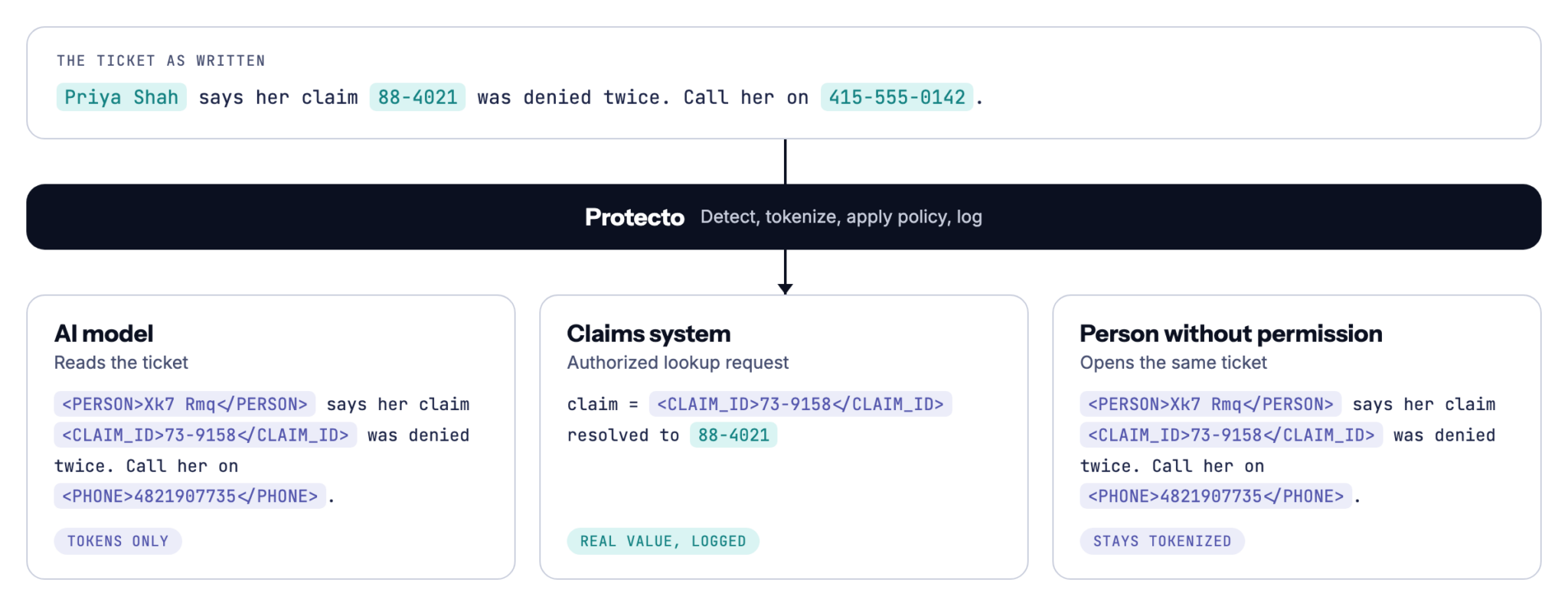
Here is the support ticket from the start, tokenized the way Protecto does it. The values are illustrative:
Before:  Priya Shah says her claim 88-4021 was denied twice. Call her on 415-555-0142.

After:   <PERSON>Xk7 Rmq</PERSON> says her claim <CLAIM_ID>73-9158</CLAIM_ID> was denied twice.
         Call her on <PHONE>4821907735</PHONE>.
The model sees tokens, not people. The same person gets the same token in every ticket and document, so the assistant can still follow the thread. When the assistant calls the claims system, an authorized request resolves the token to the real claim. A user without permission sees the token.
How Protecto approaches data tokenization
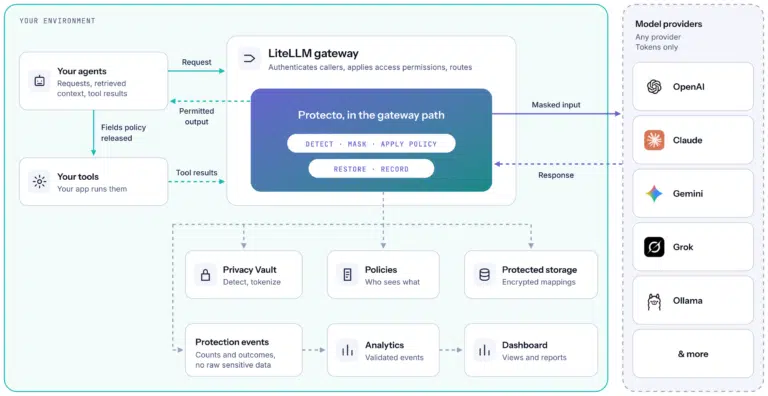
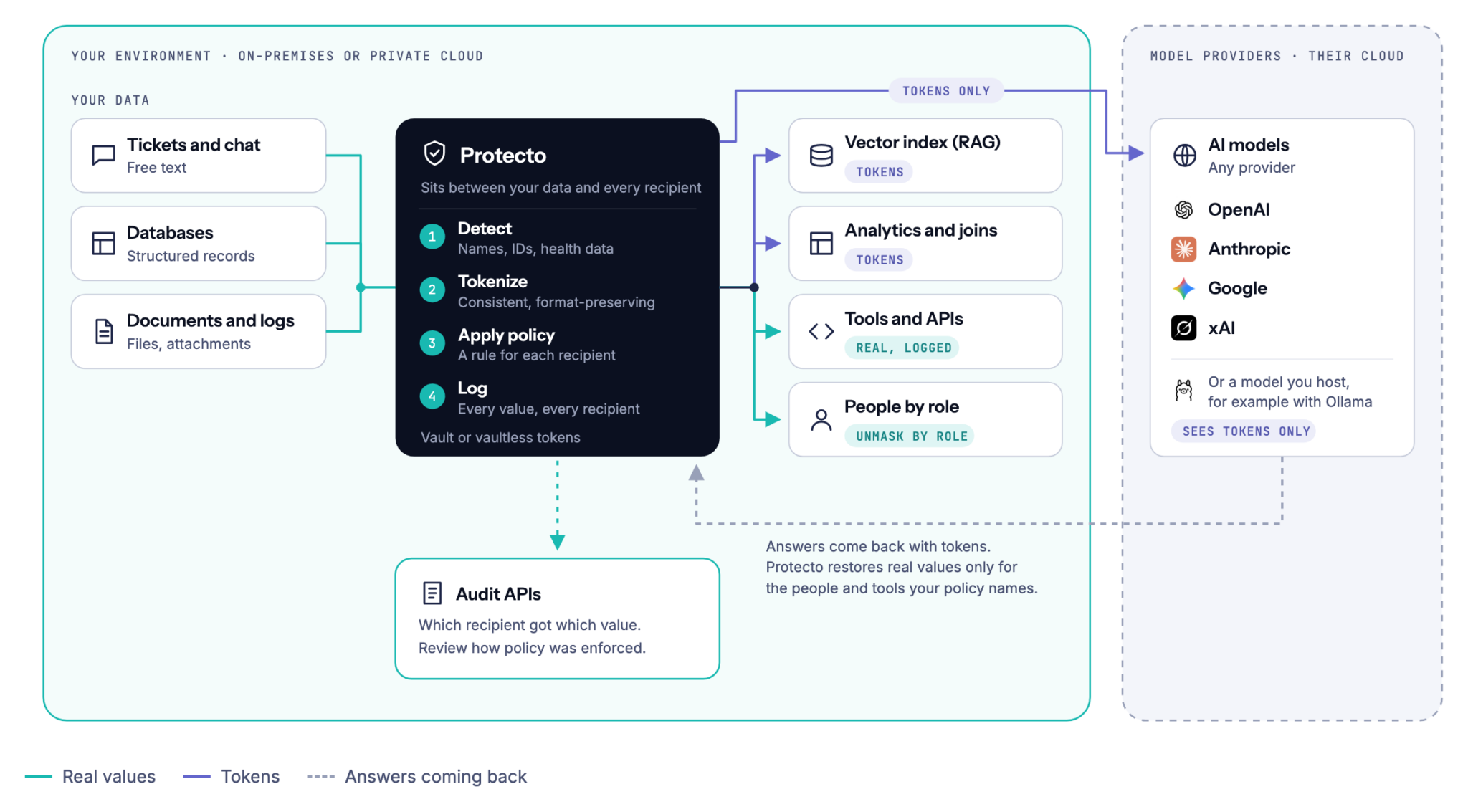
Protecto is the data security layer for the agentic AI era. Tokenization is one capability next to detection, policy, controlled unmasking by role, context-based access control (CBAC) and audit logs. In practice:
- Detection first. Protecto Vault uses an agentic detection and classification engine to find sensitive data in structured data and free text, across 200+ entity types plus custom entities you define.
- Vault or vaultless. Protecto Vault stores the mapping, which is the best fit when you reuse the data, for example for AI workflows that resolve tokens later. When sharing the data is the main goal, vaultless tokenization is also available, and the tokens are not stored.
- Same value, same token. The same value always gets the same token, in any session at any time. Tokens carry an entity tag, such as
<EMAIL>or<PERSON>, so you can tell what a token stands for. - Format-preserving tokens. Tokens keep the shape of the original value, so downstream systems keep working.
- Reversible by role. Authorized users and tools can resolve tokens to real values. Everyone else sees the token.
- Audit APIs. Protecto Vault offers audit APIs to review how policies were enforced. You decide how long to keep records.
- Runs where your data runs. SaaS, on-premise, private cloud or air-gapped. Pipelines connect through the API, a Snowflake UDF, Databricks, Kafka or Spark. Developers can start with the API docs.
Teams run Protecto at volume. A SaaS company processes more than 13 million long texts a day, and Automation Anywhere runs it across 5,000+ live enterprise tenants (see the Automation Anywhere case study). See the Protecto Vault page for the product, or tokenization for data lakes if your data sits in a warehouse or lake.
Tokenization supports GDPR, HIPAA and CCPA programs. It does not replace legal review of how your organization uses the data.
Choose a tokenization approach: six questions
- Do downstream systems need the real value at any point? If yes, you need reversible tokens and a clear policy for who can resolve them.
- Do you need joins, counts or references to keep working? If yes, you need consistent tokens.
- Does any system validate the format of the value? If yes, you need format-preserving tokens.
- Does the data live in tables, free text, or both? Free text needs detection before replacement.
- Will you reuse the data or share it? Reuse favors a vault. Sharing favors vaultless tokens that are not stored.
- Where must it run? Cloud, on-premise or air-gapped decides the deployment.
For a list of tools to compare against these questions, see our data tokenization tools guide.
Frequently asked questions
What is data tokenization?
Data tokenization replaces a sensitive value, such as a name or card number, with a token that has no meaning on its own. The original value is kept in a secured vault. Only authorized users and systems can turn a token back into the real value.
Is data tokenization the same as encryption?
No. Encryption turns data into ciphertext that anyone with the key can decrypt, and the ciphertext usually breaks the format. Tokenization swaps the value for a stand-in and keeps the real value in a separate vault. Tokens can keep the original format, so systems that check format keep working.
Is tokenization reversible?
With a vault, yes, by policy. A token can be resolved to the original value by an authorized user or system. Someone without permission sees only the token. With vaultless tokenization, the tokens are not stored.
Is tokenized data still personal data?
Usually yes. Tokenization is a form of pseudonymization, because the original can be recovered. GDPR still treats pseudonymized data as personal data, and its obligations still apply.
What is the difference between tokenization and masking?
Masking hides or changes a value, often with no way back. Tokenization replaces the value with a token and keeps a controlled way to reverse it. Tokenization is the better fit when some users or tools still need the real value.
Can I tokenize data before sending it to an LLM?
Yes. Tokenize names, IDs and other sensitive values before the text reaches the model. Consistent tokens let the model keep track of who is who, and an authorized request can resolve tokens when a tool needs the real value.
How is tokenization used for AI and RAG?
Tokenize documents before they go into a retrieval index, and tokenize questions the same way. Because the same value gets the same token, the question still matches the right passages. See Protecto Secure RAG.